Department of Clinical Sciences, Danderyd Hospital, Karolinska Institutet, Stockholm, Sweden.
PLoS One. 2021 Apr 1;16(4):e0248809. doi: 10.1371/journal.pone.0248809. eCollection 2021.
Fractures around the knee joint are inherently complex in terms of treatment; complication rates are high, and they are difficult to diagnose on a plain radiograph. An automated way of classifying radiographic images could improve diagnostic accuracy and would enable production of uniformly classified records of fractures to be used in researching treatment strategies for different fracture types. Recently deep learning, a form of artificial intelligence (AI), has shown promising results for interpreting radiographs. In this study, we aim to evaluate how well an AI can classify knee fractures according to the detailed 2018 AO-OTA fracture classification system.
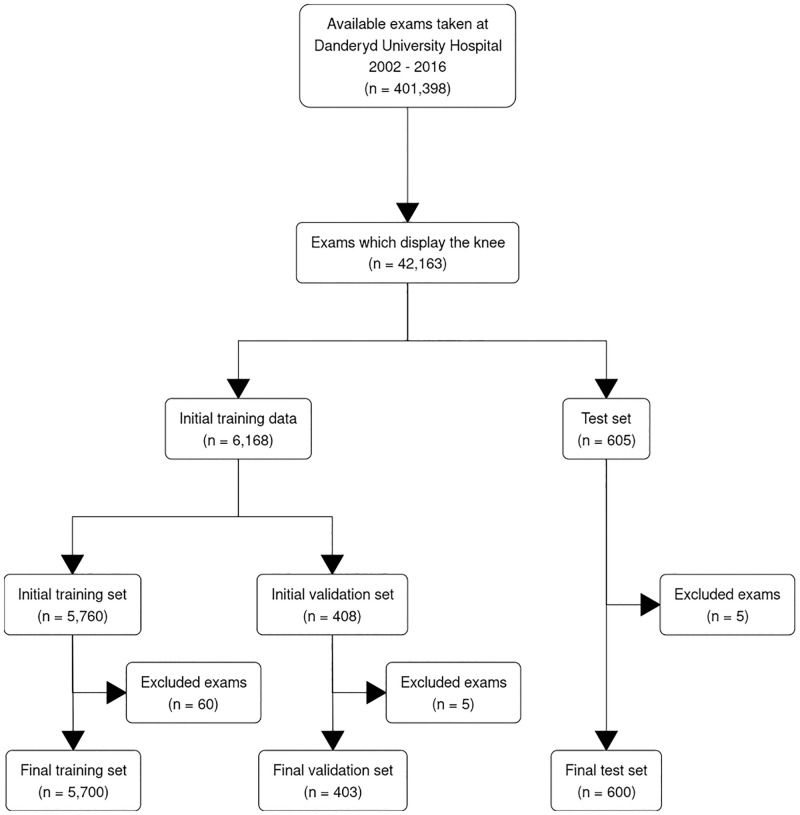
We selected 6003 radiograph exams taken at Danderyd University Hospital between the years 2002-2016, and manually categorized them according to the AO/OTA classification system and by custom classifiers. We then trained a ResNet-based neural network on this data. We evaluated the performance against a test set of 600 exams. Two senior orthopedic surgeons had reviewed these exams independently where we settled exams with disagreement through a consensus session.
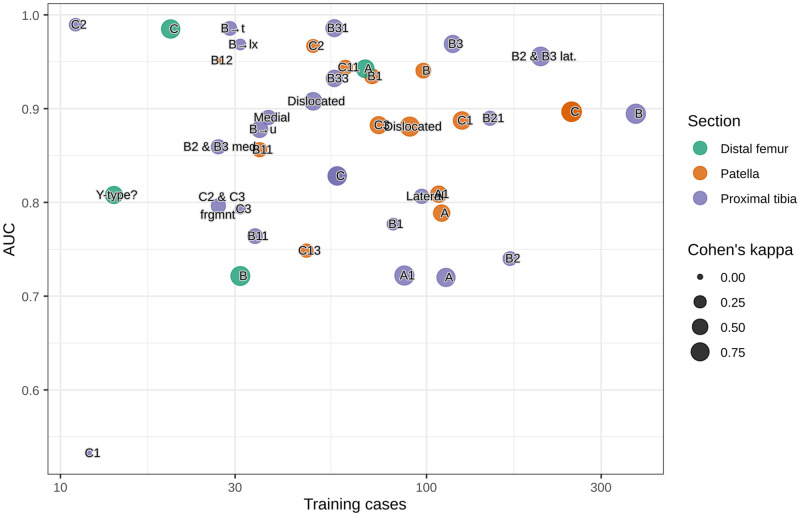
We captured a total of 49 nested fracture classes. Weighted mean AUC was 0.87 for proximal tibia fractures, 0.89 for patella fractures and 0.89 for distal femur fractures. Almost ¾ of AUC estimates were above 0.8, out of which more than half reached an AUC of 0.9 or above indicating excellent performance.
Our study shows that neural networks can be used not only for fracture identification but also for more detailed classification of fractures around the knee joint.
膝关节周围骨折在治疗上具有固有复杂性;并发症发生率高,且在普通放射照片上难以诊断。对放射照片进行自动分类的方法可以提高诊断准确性,并能够生成统一分类的骨折记录,用于研究不同类型骨折的治疗策略。最近,深度学习(一种人工智能形式)在解释放射照片方面显示出了有前景的结果。在这项研究中,我们旨在评估人工智能根据详细的 2018AO-OTA 骨折分类系统对膝关节骨折进行分类的能力。
我们从 2002 年至 2016 年期间在 Danderyd 大学医院采集了 6003 份放射照片,并根据 AO/OTA 分类系统和自定义分类器对其进行了手动分类。然后,我们在该数据上训练了一个基于 ResNet 的神经网络。我们使用 600 份测试集评估了性能。两位资深骨科医生对这些检查进行了独立审查,我们通过共识会议解决了存在分歧的检查。
我们总共捕获了 49 个嵌套骨折类别。胫骨近端骨折的加权平均 AUC 为 0.87,髌骨骨折为 0.89,股骨远端骨折为 0.89。超过 3/4 的 AUC 估计值高于 0.8,其中一半以上达到了 0.9 或更高,表明性能优异。
我们的研究表明,神经网络不仅可用于骨折识别,还可用于更详细地分类膝关节周围的骨折。