State Key Laboratory of Remote Sensing Science, Aerospace Information Research Institute, Chinese Academy of Sciences, Beijing 100101, China.
School of Geography, Geomatics and Planning, Jiangsu Normal University, Xuzhou 221116, China.
Int J Environ Res Public Health. 2021 Mar 30;18(7):3583. doi: 10.3390/ijerph18073583.
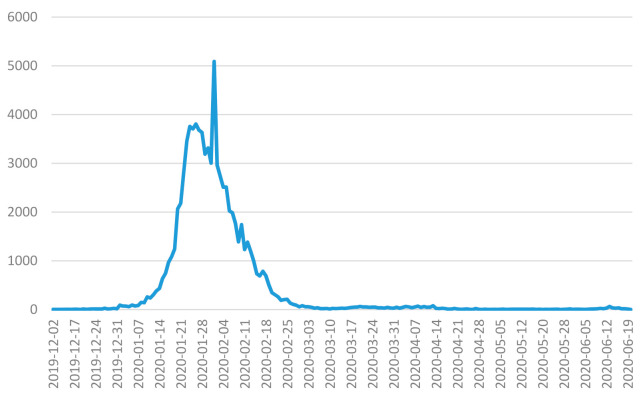
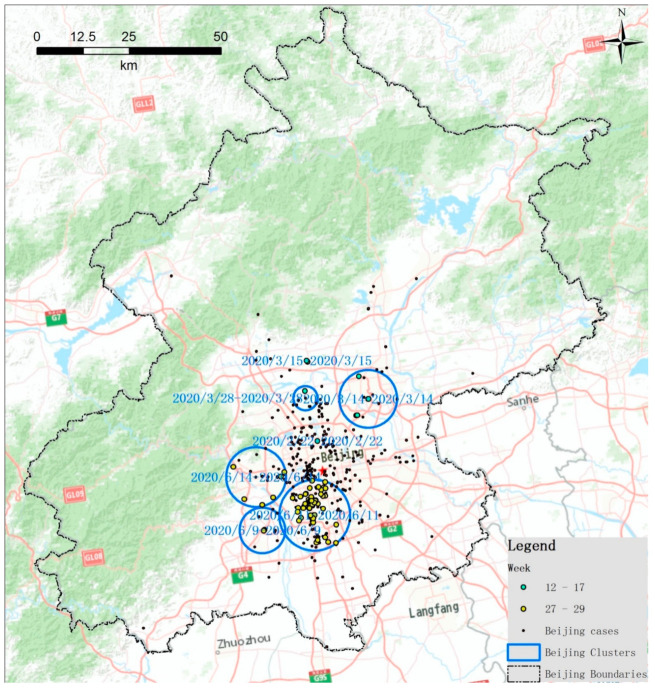
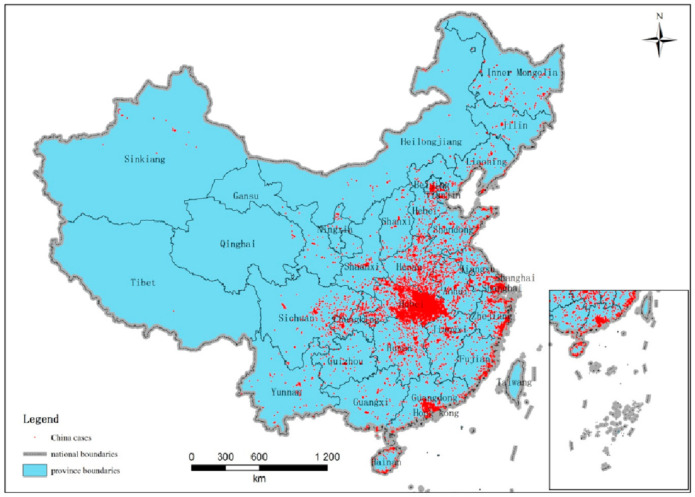
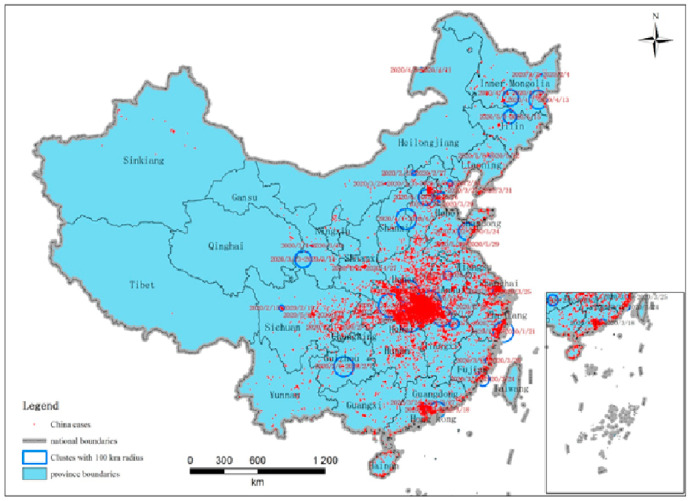
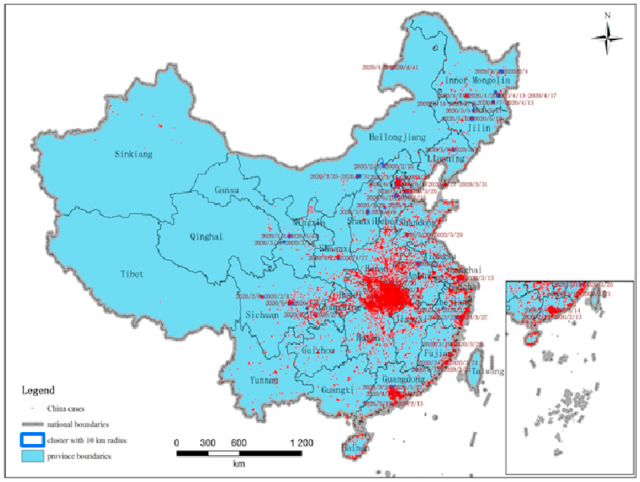
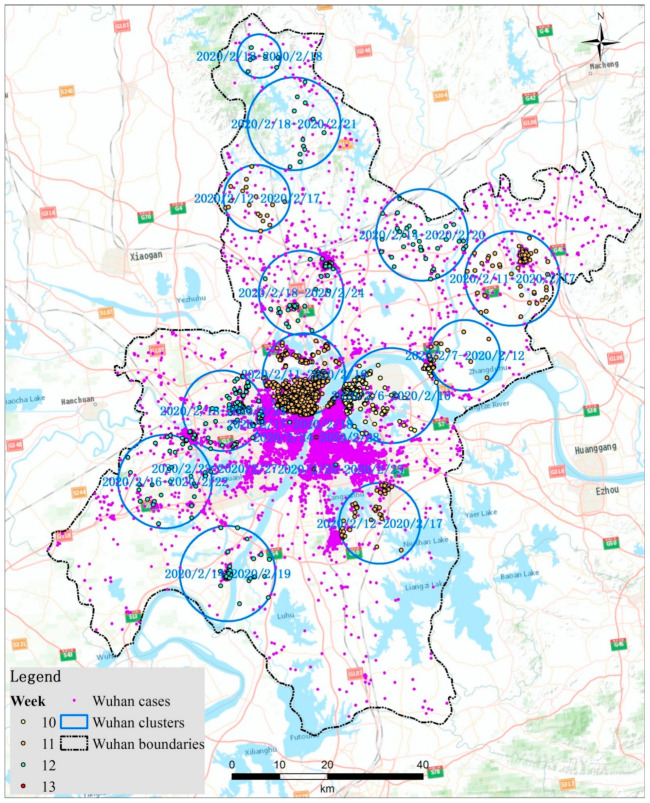
Exploring spatio-temporal patterns of disease incidence can help to identify areas of significantly elevated or decreased risk, providing potential etiologic clues. The study uses the retrospective analysis of space-time scan statistic to detect the clusters of COVID-19 in mainland China with a different maximum clustering radius at the family-level based on case dates of onset. The results show that the detected clusters vary with the clustering radius. Forty-three space-time clusters were detected with a maximum clustering radius of 100 km and 88 clusters with a maximum clustering radius of 10 km from 2 December 2019 to 20 June 2020. Using a smaller clustering radius may identify finer clusters. Hubei has the most clusters regardless of scale. In addition, most of the clusters were generated in February. That indicates China's COVID-19 epidemic prevention and control strategy is effective, and they have successfully prevented the virus from spreading from Hubei to other provinces over time. Well-developed provinces or cities, which have larger populations and developed transportation networks, are more likely to generate space-time clusters. The analysis based on the data of cases from onset may detect the start times of clusters seven days earlier than similar research based on diagnosis dates. Our analysis of space-time clustering based on the data of cases on the family-level can be reproduced in other countries that are still seriously affected by the epidemic such as the USA, India, and Brazil, thus providing them with more precise signals of clustering.
探索疾病发病率的时空模式有助于识别风险显著升高或降低的区域,提供潜在的病因线索。本研究使用时空扫描统计的回顾性分析,基于发病日期,以家庭为单位,在中国大陆检测不同最大聚类半径的 COVID-19 聚类。结果表明,检测到的聚类随聚类半径而变化。从 2019 年 12 月 2 日至 2020 年 6 月 20 日,最大聚类半径为 100km 时检测到 43 个时空聚类,最大聚类半径为 10km 时检测到 88 个聚类。使用较小的聚类半径可能会识别出更精细的聚类。无论规模大小,湖北的聚类数量最多。此外,大多数聚类发生在 2 月。这表明中国的 COVID-19 疫情防控策略是有效的,随着时间的推移,他们成功地阻止了病毒从湖北传播到其他省份。人口较多、交通网络发达的发达省份或城市更容易产生时空聚类。基于发病日期的病例数据进行的分析比基于诊断日期的类似研究更早地检测到聚类的开始时间,可提前七天。我们基于家庭级病例数据的时空聚类分析可以在其他仍受疫情严重影响的国家(如美国、印度和巴西)重现,从而为它们提供更精确的聚类信号。