Department of Educational and Developmental Psychology, Faculty of Psychology, Campus Universitario de Cartuja, University of Granada, 18071 Granada, Spain.
Department of Developmental and Educational Psychology, Campus of Espinardo, University of Murcia, 30100 Murcia, Spain.
Int J Environ Res Public Health. 2021 Mar 22;18(6):3280. doi: 10.3390/ijerph18063280.
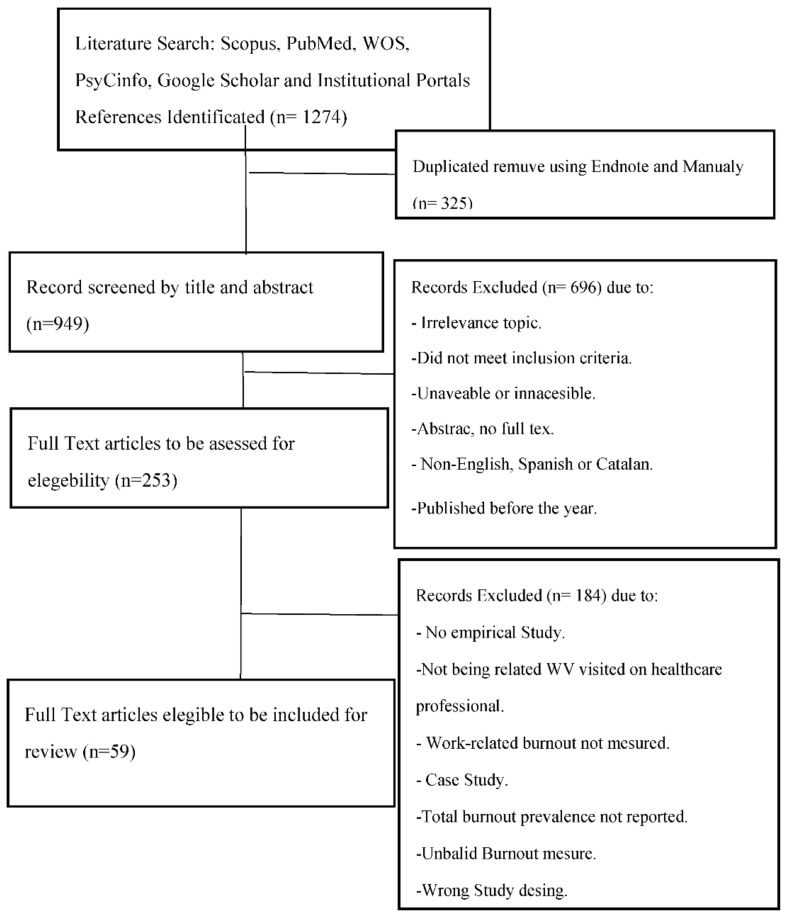
The present study aims analyze the risk factors that lead to high levels of burnout among nurses and physicians and the protective factors that prevent them. Thus, it is also intended to explore the possible correlation between physical and verbal violence produced at work and the symptoms derived from burnout. Methods: The search was carried out on the Scopus, PubMed and Web of Science databases between 2000 and 2019 (on which date the bibliographic search ends). Descriptive studies estimating the prevalence of workplace violence and risk and protective factors and burnout were included. An adapted version of the Downs and Black quality checklist was used for article selection. 89.6 percent of the studies analysed were in the health sector. There is a significant correlation between burnout symptoms and physical violence at work. On the one hand, the risk factors that moderate this correlation were of structural/organisational type (social support, quality of the working environment, authoritarian leadership, little autonomy or long working days, etc.) and personal type (age, gender, nationality or academic degree, etc.). On the other hand, protective factors were the quality of the working environment, mutual support networks or coping strategies. The results were analysed in-depth and intervention strategies were proposed.
本研究旨在分析导致护士和医生 burnout 水平高的风险因素以及预防 burnout 的保护因素。因此,还旨在探讨工作中产生的身体和言语暴力与 burnout 症状之间的可能相关性。方法:在 Scopus、PubMed 和 Web of Science 数据库中进行了 2000 年至 2019 年的检索(文献检索截止日期为该日期)。纳入了估计工作场所暴力以及风险和保护因素与 burnout 患病率的描述性研究。使用 Downs 和 Black 质量检查表的改编版进行文章选择。分析的研究中有 89.6%来自卫生部门。burnout 症状与工作中的身体暴力之间存在显著相关性。一方面,调节这种相关性的风险因素具有结构/组织类型(社会支持、工作环境质量、威权领导、自主性低或工作时间长等)和个人类型(年龄、性别、国籍或学历等)。另一方面,保护因素是工作环境质量、相互支持网络或应对策略。对结果进行了深入分析并提出了干预策略。