Ohno Yoshiharu, Seo Joon Beom, Parraga Grace, Lee Kyung Soo, Gefter Warren B, Fain Sean B, Schiebler Mark L, Hatabu Hiroto
From the Department of Radiology, Fujita Health University School of Medicine, Toyoake, Aichi, Japan (Y.O.); Joint Research Laboratory of Advanced Medical Imaging, Fujita Health University School of Medicine, Toyoake, Aichi, Japan (Y.O.); Division of Functional and Diagnostic Imaging Research, Department of Radiology, Kobe University Graduate School of Medicine, Kobe, Hyogo, Japan (Y.O.); Department of Radiology, Research Institute of Radiology, Asan Medical Center, University of Ulsan College of Medicine, Seoul, South Korea (J.B.S.); Department of Medicine, Robarts Research Institute, and Department of Medical Biophysics, Western University, London, Canada (G.P.); Department of Radiology, Samsung Medical Center, Sungkyunkwan University School of Medicine (SKKU-SOM), Seoul, Korea (K.S.L.); Department of Radiology, Penn Medicine, University of Pennsylvania, Philadelphia, Pa (W.B.G.); Departments of Medical Physics and Radiology (S.B.F., M.L.S.), UW-Madison School of Medicine and Public Health, Madison, Wis; and Center for Pulmonary Functional Imaging, Brigham and Women's Hospital and Harvard Medical School, 75 Francis St, Boston, MA 02215 (H.H.).
Radiology. 2021 Jun;299(3):508-523. doi: 10.1148/radiol.2021203711. Epub 2021 Apr 6.
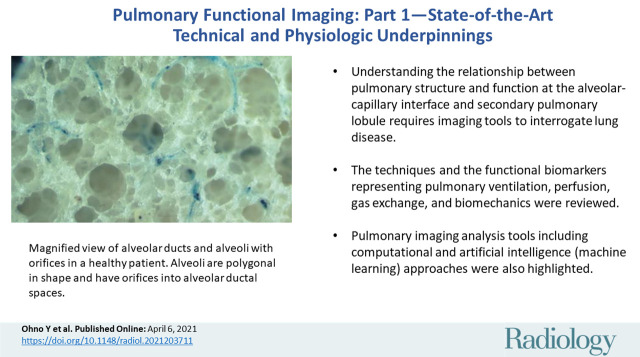
Over the past few decades, pulmonary imaging technologies have advanced from chest radiography and nuclear medicine methods to high-spatial-resolution or low-dose chest CT and MRI. It is currently possible to identify and measure pulmonary pathologic changes before these are obvious even to patients or depicted on conventional morphologic images. Here, key technological advances are described, including multiparametric CT image processing methods, inhaled hyperpolarized and fluorinated gas MRI, and four-dimensional free-breathing CT and MRI methods to measure regional ventilation, perfusion, gas exchange, and biomechanics. The basic anatomic and physiologic underpinnings of these pulmonary functional imaging techniques are explained. In addition, advances in image analysis and computational and artificial intelligence (machine learning) methods pertinent to functional lung imaging are discussed. The clinical applications of pulmonary functional imaging, including both the opportunities and challenges for clinical translation and deployment, will be discussed in part 2 of this review. Given the technical advances in these sophisticated imaging methods and the wealth of information they can provide, it is anticipated that pulmonary functional imaging will be increasingly used in the care of patients with lung disease. © RSNA, 2021
在过去几十年中,肺部成像技术已从胸部X线摄影和核医学方法发展到高空间分辨率或低剂量胸部CT及MRI。目前,甚至在肺部病理变化对患者而言尚不明显或尚未在传统形态学图像上显示出来之前,就有可能识别和测量这些变化。在此,将介绍关键的技术进展,包括多参数CT图像处理方法、吸入式超极化和氟化气体MRI,以及用于测量区域通气、灌注、气体交换和生物力学的四维自由呼吸CT和MRI方法。还将解释这些肺功能成像技术的基本解剖学和生理学基础。此外,还将讨论与功能性肺部成像相关的图像分析以及计算和人工智能(机器学习)方法的进展。肺功能成像的临床应用,包括临床转化和应用的机遇与挑战,将在本综述的第2部分进行讨论。鉴于这些先进成像方法的技术进步以及它们所能提供的丰富信息,预计肺功能成像将越来越多地用于肺部疾病患者的护理。© RSNA,2021