• 文献检索
  • 文档翻译
  • 深度研究
  • 学术资讯
  • Suppr Zotero 插件Zotero 插件
  • 邀请有礼
  • 套餐&价格
  • 历史记录
应用&插件
Suppr Zotero 插件Zotero 插件浏览器插件Mac 客户端Windows 客户端微信小程序
定价
高级版会员购买积分包购买API积分包
服务
文献检索文档翻译深度研究API 文档MCP 服务
关于我们
关于 Suppr公司介绍联系我们用户协议隐私条款
关注我们

Suppr 超能文献

核心技术专利:CN118964589B侵权必究
粤ICP备2023148730 号-1Suppr @ 2026

文献检索

告别复杂PubMed语法,用中文像聊天一样搜索,搜遍4000万医学文献。AI智能推荐,让科研检索更轻松。

立即免费搜索

文件翻译

保留排版,准确专业,支持PDF/Word/PPT等文件格式,支持 12+语言互译。

免费翻译文档

深度研究

AI帮你快速写综述,25分钟生成高质量综述,智能提取关键信息,辅助科研写作。

立即免费体验

利用深度学习预测皮肤损伤的临床管理。

Predicting the clinical management of skin lesions using deep learning.

机构信息

School of Computing Science, Simon Fraser University, Burnaby, BC V5A 1S6, Canada.

出版信息

Sci Rep. 2021 Apr 8;11(1):7769. doi: 10.1038/s41598-021-87064-7.

DOI:10.1038/s41598-021-87064-7
PMID:33833293
原文链接:https://pmc.ncbi.nlm.nih.gov/articles/PMC8032721/
Abstract

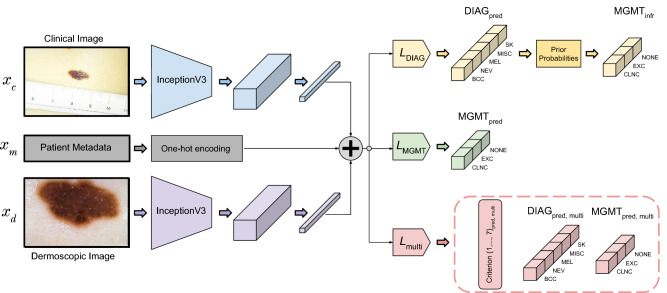
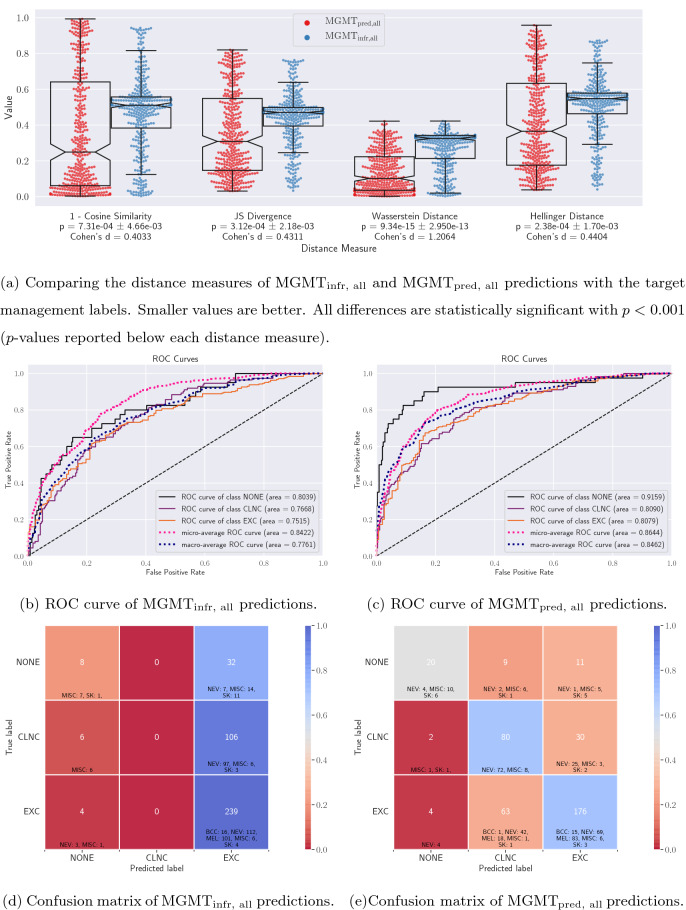
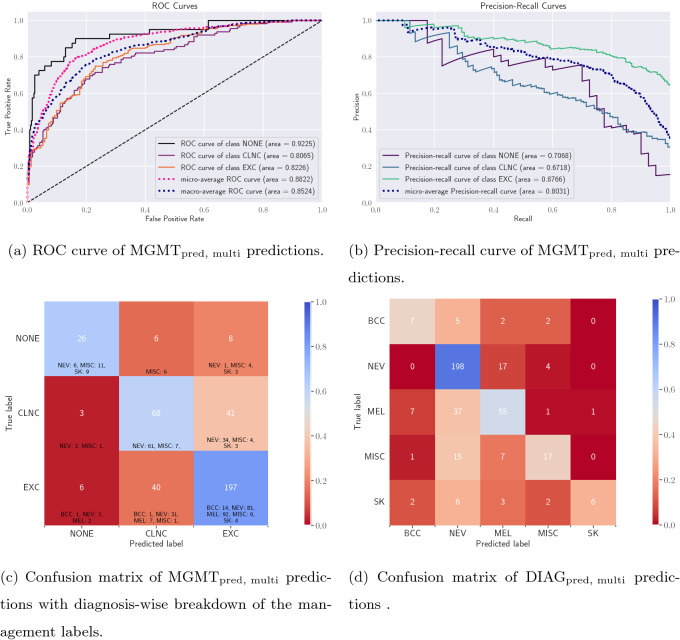
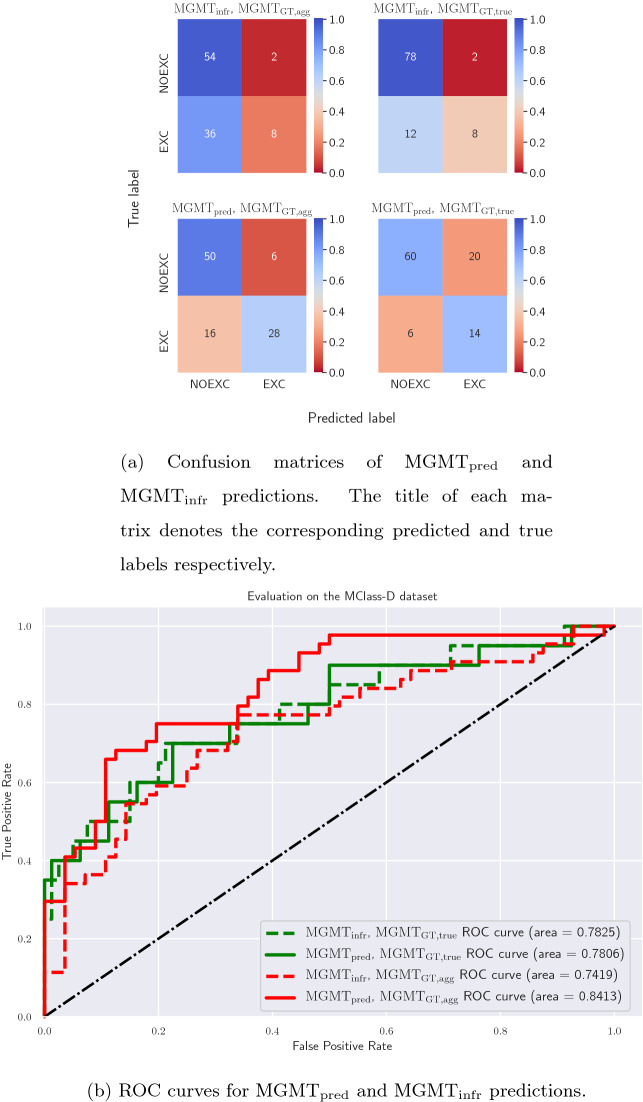
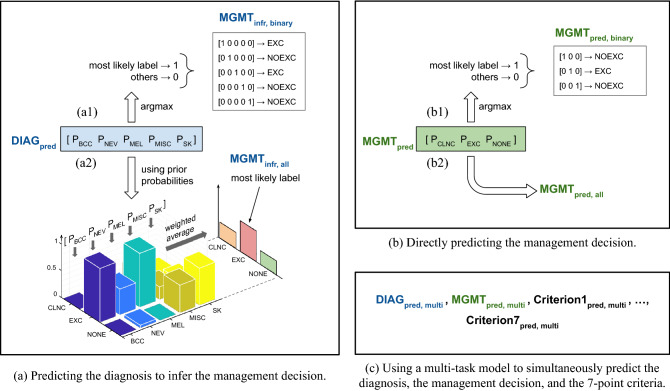
Automated machine learning approaches to skin lesion diagnosis from images are approaching dermatologist-level performance. However, current machine learning approaches that suggest management decisions rely on predicting the underlying skin condition to infer a management decision without considering the variability of management decisions that may exist within a single condition. We present the first work to explore image-based prediction of clinical management decisions directly without explicitly predicting the diagnosis. In particular, we use clinical and dermoscopic images of skin lesions along with patient metadata from the Interactive Atlas of Dermoscopy dataset (1011 cases; 20 disease labels; 3 management decisions) and demonstrate that predicting management labels directly is more accurate than predicting the diagnosis and then inferring the management decision ([Formula: see text] and [Formula: see text] improvement in overall accuracy and AUROC respectively), statistically significant at [Formula: see text]. Directly predicting management decisions also considerably reduces the over-excision rate as compared to management decisions inferred from diagnosis predictions (24.56% fewer cases wrongly predicted to be excised). Furthermore, we show that training a model to also simultaneously predict the seven-point criteria and the diagnosis of skin lesions yields an even higher accuracy (improvements of [Formula: see text] and [Formula: see text] in overall accuracy and AUROC respectively) of management predictions. Finally, we demonstrate our model's generalizability by evaluating on the publicly available MClass-D dataset and show that our model agrees with the clinical management recommendations of 157 dermatologists as much as they agree amongst each other.

摘要

基于图像的皮肤病变诊断自动化机器学习方法已接近皮肤科医生的水平。然而,目前的机器学习方法在建议管理决策时依赖于预测潜在的皮肤状况,从而推断出管理决策,而没有考虑到单一条件下可能存在的管理决策的可变性。我们首次探索了直接基于图像预测临床管理决策的方法,而无需明确预测诊断。具体来说,我们使用来自 Interactive Atlas of Dermoscopy 数据集的皮肤病变的临床和皮肤镜图像以及患者元数据(1011 例;20 种疾病标签;3 种管理决策),并证明直接预测管理标签比预测诊断然后推断管理决策更准确(整体准确性和 AUROC 分别提高了[Formula: see text]和[Formula: see text]),在[Formula: see text]上具有统计学意义。与从诊断预测推断的管理决策相比,直接预测管理决策还大大降低了过度切除率(错误预测需要切除的病例减少了 24.56%)。此外,我们还表明,训练一个模型同时预测七点标准和皮肤病变的诊断可以提高管理预测的准确性(整体准确性和 AUROC 分别提高了[Formula: see text]和[Formula: see text])。最后,我们通过评估公开可用的 MClass-D 数据集展示了我们模型的泛化能力,并表明我们的模型与 157 位皮肤科医生的临床管理建议的一致性与他们之间的一致性一样高。
https://cdn.ncbi.nlm.nih.gov/pmc/blobs/444a/8032721/fc15c9f67da1/41598_2021_87064_Fig6_HTML.jpg
https://cdn.ncbi.nlm.nih.gov/pmc/blobs/444a/8032721/d80a57a62ef8/41598_2021_87064_Fig1_HTML.jpg
https://cdn.ncbi.nlm.nih.gov/pmc/blobs/444a/8032721/c87c4b0fc961/41598_2021_87064_Fig2_HTML.jpg
https://cdn.ncbi.nlm.nih.gov/pmc/blobs/444a/8032721/b1a1f0cdf376/41598_2021_87064_Fig3_HTML.jpg
https://cdn.ncbi.nlm.nih.gov/pmc/blobs/444a/8032721/4fd5de6afd57/41598_2021_87064_Fig4_HTML.jpg
https://cdn.ncbi.nlm.nih.gov/pmc/blobs/444a/8032721/56e6acf0493f/41598_2021_87064_Fig5_HTML.jpg
https://cdn.ncbi.nlm.nih.gov/pmc/blobs/444a/8032721/fc15c9f67da1/41598_2021_87064_Fig6_HTML.jpg
https://cdn.ncbi.nlm.nih.gov/pmc/blobs/444a/8032721/d80a57a62ef8/41598_2021_87064_Fig1_HTML.jpg
https://cdn.ncbi.nlm.nih.gov/pmc/blobs/444a/8032721/c87c4b0fc961/41598_2021_87064_Fig2_HTML.jpg
https://cdn.ncbi.nlm.nih.gov/pmc/blobs/444a/8032721/b1a1f0cdf376/41598_2021_87064_Fig3_HTML.jpg
https://cdn.ncbi.nlm.nih.gov/pmc/blobs/444a/8032721/4fd5de6afd57/41598_2021_87064_Fig4_HTML.jpg
https://cdn.ncbi.nlm.nih.gov/pmc/blobs/444a/8032721/56e6acf0493f/41598_2021_87064_Fig5_HTML.jpg
https://cdn.ncbi.nlm.nih.gov/pmc/blobs/444a/8032721/fc15c9f67da1/41598_2021_87064_Fig6_HTML.jpg

相似文献

1
Predicting the clinical management of skin lesions using deep learning.利用深度学习预测皮肤损伤的临床管理。
Sci Rep. 2021 Apr 8;11(1):7769. doi: 10.1038/s41598-021-87064-7.
2
Radiomic and deep learning analysis of dermoscopic images for skin lesion pattern decoding.基于皮肤镜图像的放射组学和深度学习分析进行皮肤病变模式解码。
Sci Rep. 2024 Aug 26;14(1):19781. doi: 10.1038/s41598-024-70231-x.
3
Computer algorithms show potential for improving dermatologists' accuracy to diagnose cutaneous melanoma: Results of the International Skin Imaging Collaboration 2017.计算机算法显示出提高皮肤科医生诊断皮肤黑色素瘤准确性的潜力:国际皮肤成像协作 2017 年的研究结果。
J Am Acad Dermatol. 2020 Mar;82(3):622-627. doi: 10.1016/j.jaad.2019.07.016. Epub 2019 Jul 12.
4
A new deep learning approach integrated with clinical data for the dermoscopic differentiation of early melanomas from atypical nevi.一种新的深度学习方法与临床数据相结合,用于对早期黑色素瘤与非典型痣进行皮肤镜鉴别。
J Dermatol Sci. 2021 Feb;101(2):115-122. doi: 10.1016/j.jdermsci.2020.11.009. Epub 2020 Dec 2.
5
Learning from dermoscopic images in association with clinical metadata for skin lesion segmentation and classification.结合临床元数据从皮肤镜图像中学习以进行皮肤病变分割和分类。
Comput Biol Med. 2023 Jan;152:106321. doi: 10.1016/j.compbiomed.2022.106321. Epub 2022 Nov 17.
6
Deep Learning Approaches Towards Skin Lesion Segmentation and Classification from Dermoscopic Images - A Review.深度学习方法在皮肤镜图像的皮肤损伤分割和分类中的应用综述。
Curr Med Imaging. 2020;16(5):513-533. doi: 10.2174/1573405615666190129120449.
7
Diagnostic accuracy of content-based dermatoscopic image retrieval with deep classification features.基于深度学习分类特征的基于内容的皮肤镜图像检索的诊断准确性。
Br J Dermatol. 2019 Jul;181(1):155-165. doi: 10.1111/bjd.17189. Epub 2018 Oct 17.
8
A Computer-Aided Decision Support System for Detection and Localization of Cutaneous Vasculature in Dermoscopy Images Via Deep Feature Learning.基于深度特征学习的皮肤镜图像皮肤血管检测与定位的计算机辅助决策支持系统。
J Med Syst. 2018 Jan 9;42(2):33. doi: 10.1007/s10916-017-0885-2.
9
Attention Residual Learning for Skin Lesion Classification.注意:用于皮肤损伤分类的残差学习。
IEEE Trans Med Imaging. 2019 Sep;38(9):2092-2103. doi: 10.1109/TMI.2019.2893944. Epub 2019 Jan 21.
10
Efficient skin lesion segmentation using separable-Unet with stochastic weight averaging.使用可分离 U-Net 和随机权重平均化实现高效的皮肤病变分割。
Comput Methods Programs Biomed. 2019 Sep;178:289-301. doi: 10.1016/j.cmpb.2019.07.005. Epub 2019 Jul 8.

引用本文的文献

1
The Role of ChatGPT in Dermatology Diagnostics.ChatGPT在皮肤病诊断中的作用。
Diagnostics (Basel). 2025 Jun 16;15(12):1529. doi: 10.3390/diagnostics15121529.
2
Artificial intelligence-enabled precision medicine for inflammatory skin diseases.用于炎症性皮肤病的人工智能精准医学。
ArXiv. 2025 May 14:arXiv:2505.09527v1.
3
Skin Type Diversity in Skin Lesion Datasets: A Review.皮肤病变数据集中的皮肤类型多样性:综述

本文引用的文献

1
Effects of Label Noise on Deep Learning-Based Skin Cancer Classification.标签噪声对基于深度学习的皮肤癌分类的影响。
Front Med (Lausanne). 2020 May 6;7:177. doi: 10.3389/fmed.2020.00177. eCollection 2020.
2
Augmented Intelligence Dermatology: Deep Neural Networks Empower Medical Professionals in Diagnosing Skin Cancer and Predicting Treatment Options for 134 Skin Disorders.增强智能皮肤科:深度神经网络为医疗专业人员诊断皮肤癌和预测 134 种皮肤疾病的治疗方案提供支持。
J Invest Dermatol. 2020 Sep;140(9):1753-1761. doi: 10.1016/j.jid.2020.01.019. Epub 2020 Mar 31.
3
SciPy 1.0: fundamental algorithms for scientific computing in Python.
Curr Dermatol Rep. 2024;13(3):198-210. doi: 10.1007/s13671-024-00440-0. Epub 2024 Aug 14.
4
Artificial intelligence and skin cancer.人工智能与皮肤癌
Front Med (Lausanne). 2024 Mar 19;11:1331895. doi: 10.3389/fmed.2024.1331895. eCollection 2024.
5
Multi-sample -mixup: richer, more realistic synthetic samples from a -series interpolant.多样本混合:通过一系列插值生成更丰富、更逼真的合成样本。
J Big Data. 2024;11(1):43. doi: 10.1186/s40537-024-00898-6. Epub 2024 Mar 23.
6
The accuracy of artificial intelligence used for non-melanoma skin cancer diagnoses: a meta-analysis.人工智能用于非黑色素瘤皮肤癌诊断的准确性:一项荟萃分析。
BMC Med Inform Decis Mak. 2023 Jul 28;23(1):138. doi: 10.1186/s12911-023-02229-w.
7
Predicting Mohs surgery complexity by applying machine learning to patient demographics and tumor characteristics.应用机器学习对患者人口统计学和肿瘤特征进行分析,预测 Mohs 手术的复杂性。
Exp Dermatol. 2022 Jul;31(7):1029-1035. doi: 10.1111/exd.14550. Epub 2022 Mar 3.
SciPy 1.0:Python 中的科学计算基础算法。
Nat Methods. 2020 Mar;17(3):261-272. doi: 10.1038/s41592-019-0686-2. Epub 2020 Feb 3.
4
Machine Friendly Machine Learning: Interpretation of Computed Tomography Without Image Reconstruction.机器友好型机器学习:无需图像重建的计算机断层扫描解释。
Sci Rep. 2019 Oct 29;9(1):15540. doi: 10.1038/s41598-019-51779-5.
5
Direct Cup-to-Disc Ratio Estimation for Glaucoma Screening via Semi-Supervised Learning.通过半监督学习进行青光眼筛查的直接杯盘比估计
IEEE J Biomed Health Inform. 2020 Apr;24(4):1104-1113. doi: 10.1109/JBHI.2019.2934477. Epub 2019 Aug 12.
6
Pivotal trial of an autonomous AI-based diagnostic system for detection of diabetic retinopathy in primary care offices.在基层医疗诊所中用于检测糖尿病视网膜病变的基于人工智能的自主诊断系统的关键试验。
NPJ Digit Med. 2018 Aug 28;1:39. doi: 10.1038/s41746-018-0040-6. eCollection 2018.
7
Detection of Skin Cancer Using SVM, Random Forest and kNN Classifiers.利用支持向量机、随机森林和 kNN 分类器检测皮肤癌。
J Med Syst. 2019 Jul 4;43(8):269. doi: 10.1007/s10916-019-1400-8.
8
Deep Learning Based Skin Lesion Segmentation and Classification of Melanoma Using Support Vector Machine (SVM).基于深度学习的皮肤病变分割以及使用支持向量机(SVM)对黑色素瘤进行分类
Asian Pac J Cancer Prev. 2019 May 25;20(5):1555-1561. doi: 10.31557/APJCP.2019.20.5.1555.
9
Deep learning outperformed 136 of 157 dermatologists in a head-to-head dermoscopic melanoma image classification task.深度学习在一项针对皮肤镜黑色素瘤图像分类任务的一对一皮肤科医生比较中,击败了 157 名皮肤科医生中的 136 名。
Eur J Cancer. 2019 May;113:47-54. doi: 10.1016/j.ejca.2019.04.001. Epub 2019 Apr 10.
10
Comparing artificial intelligence algorithms to 157 German dermatologists: the melanoma classification benchmark.将人工智能算法与 157 名德国皮肤科医生进行比较:黑素瘤分类基准。
Eur J Cancer. 2019 Apr;111:30-37. doi: 10.1016/j.ejca.2018.12.016. Epub 2019 Feb 22.