Aravinthan Adithan, Hossain Mohammad Amjad, Kim Bumseok, Kang Chang-Won, Kim Nam Soo, Hwang Ki-Chul, Kim Jong-Hoon
College of Veterinary Medicine, Biosafety Research Institute, Chonbuk National University, Iksan-city, Jeollabuk-Do, Republic of Korea.
Department of Medicine, College of Medicine, Catholic Kwandong University, Gangneung, Republic of Korea.
J Ginseng Res. 2021 Mar;45(2):287-294. doi: 10.1016/j.jgr.2020.01.004. Epub 2020 Jan 21.
Ginsenoside Rb1 (G-Rb1), one of the major active compounds in , has already been shown to reduce inflammation in various diseases. Osteoarthritis (OA) has traditionally been considered a degenerative disease with degradation of joint articular cartilage. However, recent studies have shown the association of inflammation with OA. In the present study, we investigated whether Rb1 had an antiinflammatory effect on monoiodoacetate (MIA)-induced OA in ovariectomized rats as a model of postmenopausal arthritis.
G-Rb1 at a dosage of 3 and 10 μg/kg body weight was administered every 3 days intraarticularly for a period of 4 weeks to observe antiarthritic effects. Diclofenac (10 mg/kg) served as a positive control.
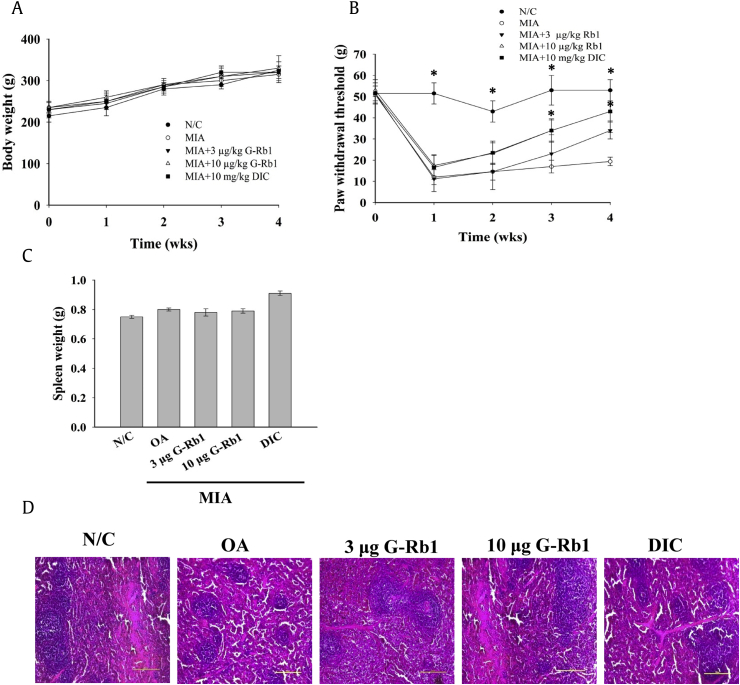
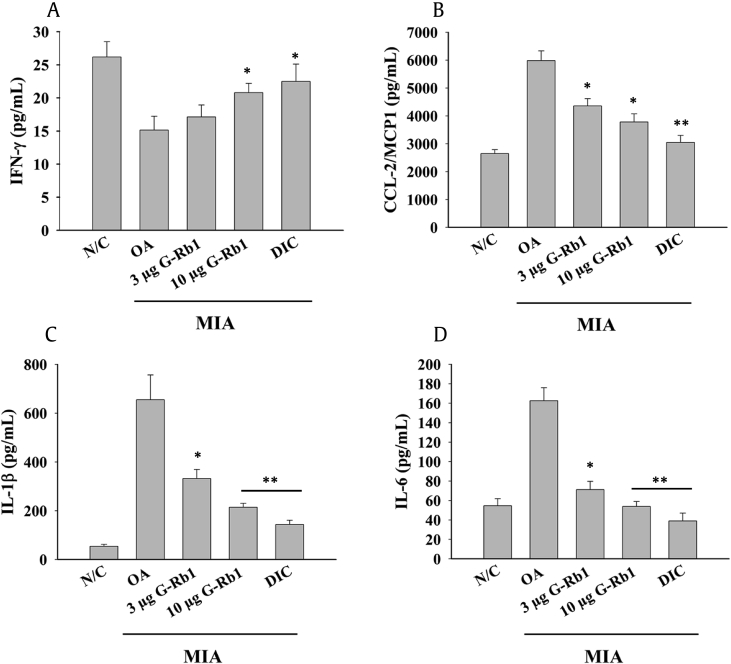
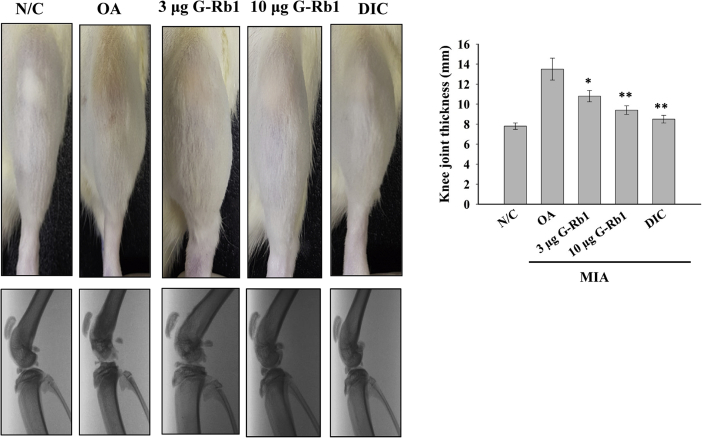
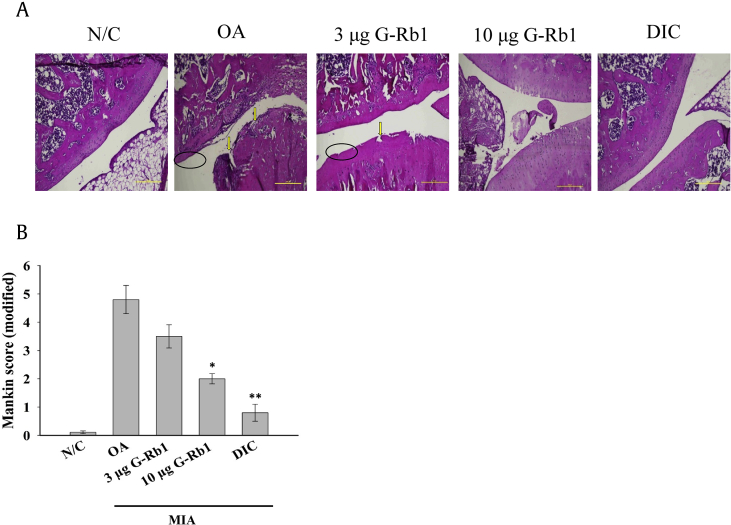
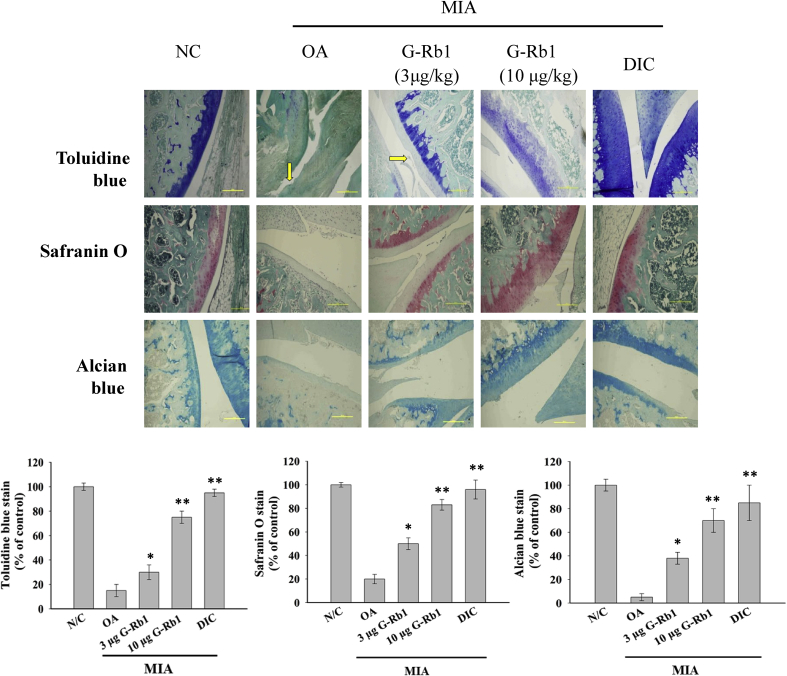
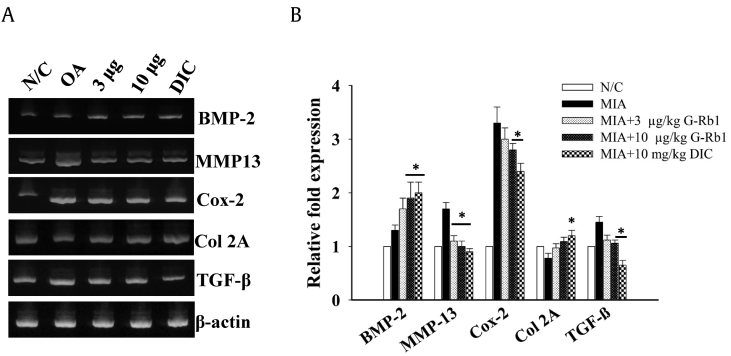
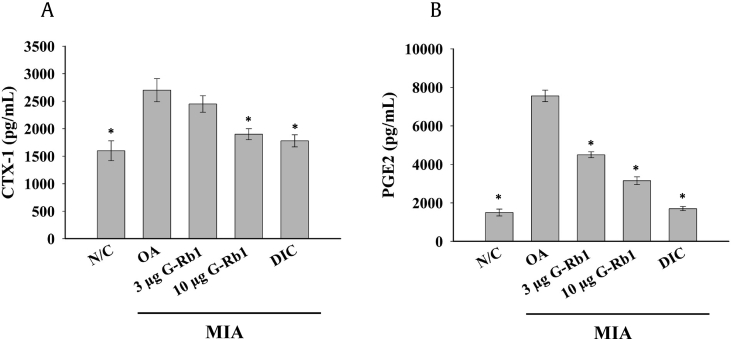
The administration of Rb1 significantly ameliorated OA inflammatory symptoms and reduced serum levels of inflammatory cytokines. Furthermore, G-Rb1 administration considerably enhanced the expression of bone morphogenetic protein-2 and collagen 2A and reduced the levels of matrix metalloproteinase-13 genes, indicating a chondroprotective effect of G-Rb1. G-Rb1 also significantly reduced the expression of several inflammatory cytokines/chemokines (interferon gamma (IFN-γ), monocyte chemoattractant protein-1 (MCP-1)/CCL-2, interleukin [IL]-1β, and IL-6). Histological analysis demonstrated that G-Rb1 significantly attenuated the pathological changes in MIA-induced OA in ovariectomized rats. Safranin O and toluidine blue staining further demonstrated that G-Rb1 effectively prevented the degradation of cartilage and glycosaminoglycans, respectively.
Overall, our results suggest that G-Rb1 exerts cartilage protective effect on MIA-induced ovariectomized OA rats, by inhibiting inflammatory mediators such as IL-6, IL-1β, MCP-1/CCL-2, cyclooxygenase-2 (COX-2), and prostaglandin E (PGE2). These results shed a light on possible therapeutic application of G-Rb1 in OA.
人参皂苷Rb1(G-Rb1)是人参中的主要活性成分之一,已被证明可减轻多种疾病中的炎症。骨关节炎(OA)传统上被认为是一种关节软骨退化的退行性疾病。然而,最近的研究表明炎症与OA有关。在本研究中,我们以去卵巢大鼠的单碘乙酸盐(MIA)诱导的OA作为绝经后关节炎模型,研究Rb1是否对其具有抗炎作用。
以3和10μg/kg体重的剂量,每3天关节内注射G-Rb1,持续4周,以观察其抗关节炎作用。双氯芬酸(10mg/kg)作为阳性对照。
Rb1的给药显著改善了OA炎症症状,并降低了炎症细胞因子的血清水平。此外,G-Rb1给药显著增强了骨形态发生蛋白-2和胶原蛋白2A的表达,并降低了基质金属蛋白酶-13基因的水平,表明G-Rb1具有软骨保护作用。G-Rb1还显著降低了几种炎症细胞因子/趋化因子(γ干扰素(IFN-γ)、单核细胞趋化蛋白-1(MCP-1)/CCL-2、白细胞介素[IL]-1β和IL-6)的表达。组织学分析表明,G-Rb1显著减轻了去卵巢大鼠MIA诱导的OA的病理变化。番红O和甲苯胺蓝染色进一步表明,G-Rb1分别有效防止了软骨和糖胺聚糖的降解。
总体而言,我们的结果表明,G-Rb1通过抑制IL-6、IL-1β、MCP-1/CCL-2、环氧化酶-2(COX-2)和前列腺素E(PGE2)等炎症介质,对MIA诱导的去卵巢OA大鼠发挥软骨保护作用。这些结果为G-Rb1在OA中的可能治疗应用提供了线索。