Tapio Kosti, Mostafa Amr, Kanehira Yuya, Suma Antonio, Dutta Anushree, Bald Ilko
Institute of Chemistry, University of Potsdam, Potsdam DE-14476, Germany.
Institute for Computational Molecular Science, Temple University, Philadelphia, Pennsylvania19122, United States.
ACS Nano. 2021 Apr 27;15(4):7065-7077. doi: 10.1021/acsnano.1c00188. Epub 2021 Apr 19.
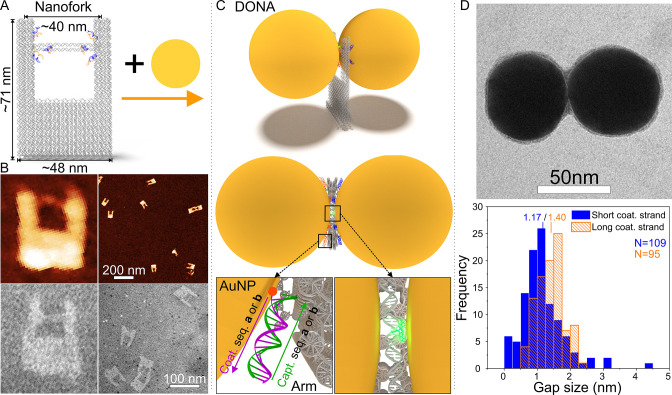
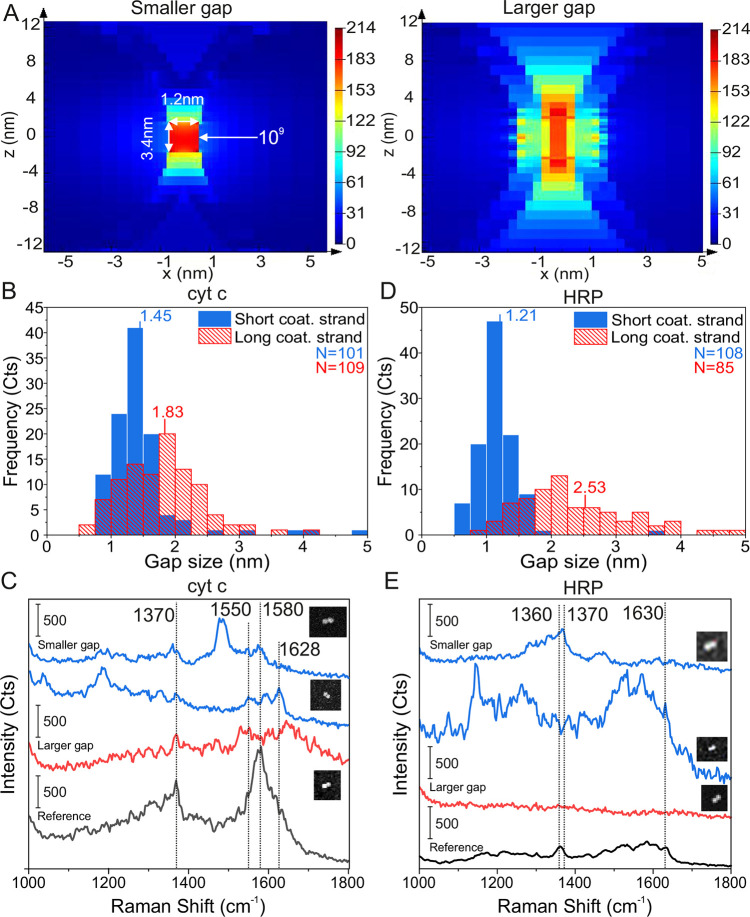
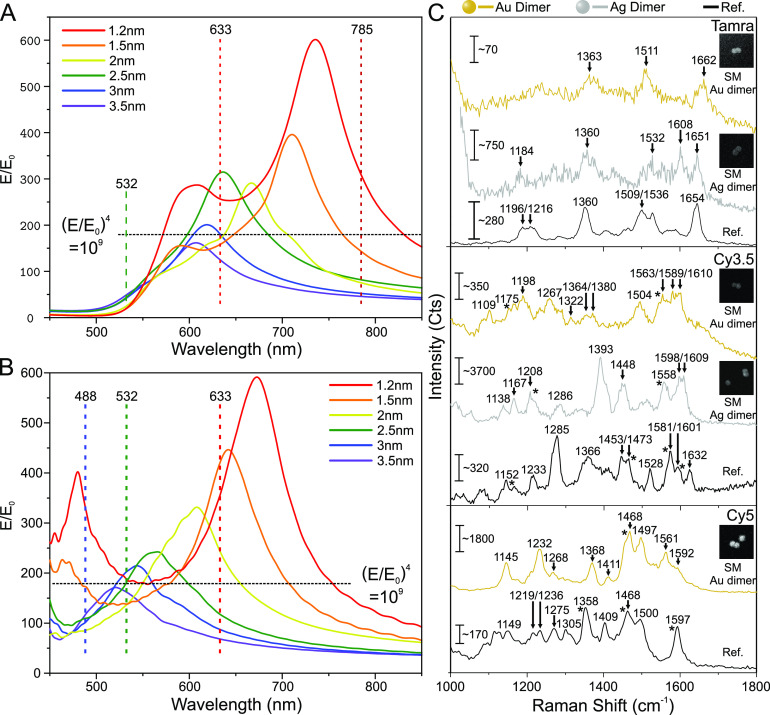
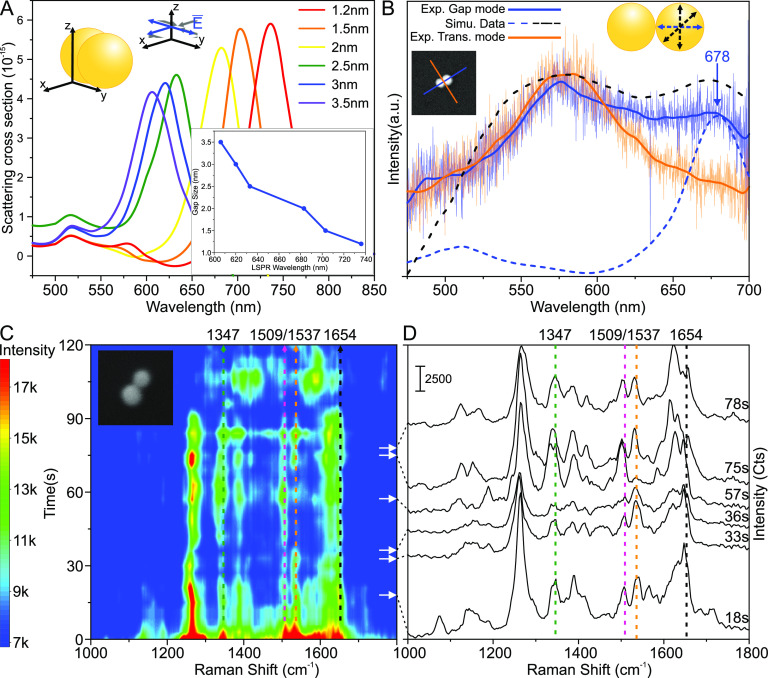
DNA origami technology allows for the precise nanoscale assembly of chemical entities that give rise to sophisticated functional materials. We have created a versatile DNA origami nanofork antenna (DONA) by assembling Au or Ag nanoparticle dimers with different gap sizes down to 1.17 nm, enabling signal enhancements in surface-enhanced Raman scattering (SERS) of up to 10. This allows for single-molecule SERS measurements, which can even be performed with larger gap sizes to accommodate differently sized molecules, at various excitation wavelengths. A general scheme is presented to place single analyte molecules into the SERS hot spots using the DNA origami structure exploiting covalent and noncovalent coupling schemes. By using Au and Ag dimers, single-molecule SERS measurements of three dyes and cytochrome and horseradish peroxidase proteins are demonstrated even under nonresonant excitation conditions, thus providing long photostability during time-series measurement and enabling optical monitoring of single molecules.
DNA折纸技术能够实现化学实体在纳米尺度上的精确组装,从而产生复杂的功能材料。我们通过组装间隙尺寸低至1.17纳米的金或银纳米颗粒二聚体,创建了一种多功能DNA折纸纳米叉天线(DONA),可使表面增强拉曼散射(SERS)中的信号增强高达10倍。这使得单分子SERS测量成为可能,甚至可以使用更大的间隙尺寸来容纳不同大小的分子,在各种激发波长下均可进行。本文提出了一种通用方案,利用DNA折纸结构,通过共价和非共价偶联方案将单个分析物分子置于SERS热点中。通过使用金和银二聚体,即使在非共振激发条件下,也能对三种染料以及细胞色素和辣根过氧化物酶蛋白进行单分子SERS测量,从而在时间序列测量期间提供长时间的光稳定性,并实现对单分子的光学监测。