The Clinical Hospital of Chengdu Brain Science Institute, MOE Key Lab for Neuroinformation, School of Life Science and Technology, University of Electronic Science and Technology of China, Chengdu, China.
Research Unit of NeuroInformation, Chinese Academy of Medical Sciences, Chengdu, 2019RU035, China.
Brain Topogr. 2021 Jul;34(4):403-414. doi: 10.1007/s10548-021-00844-2. Epub 2021 May 5.
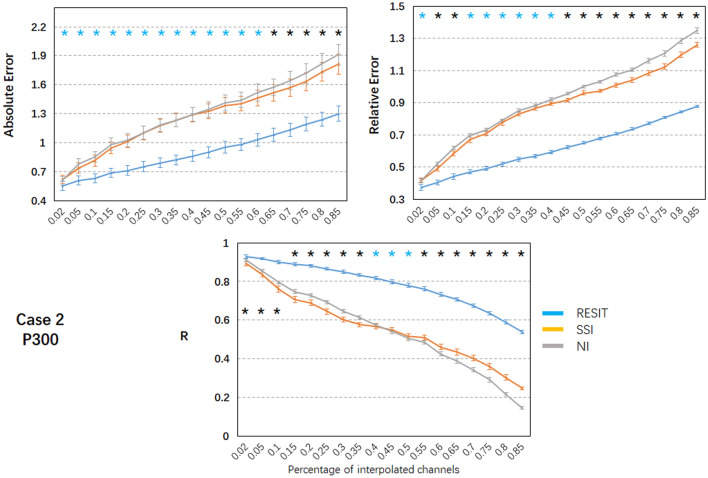
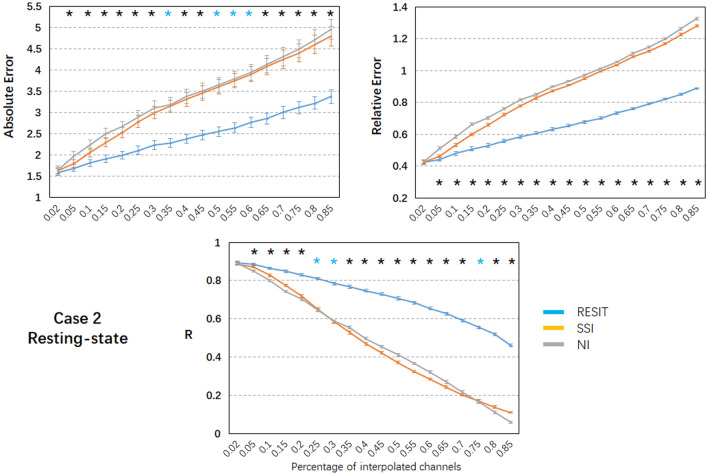
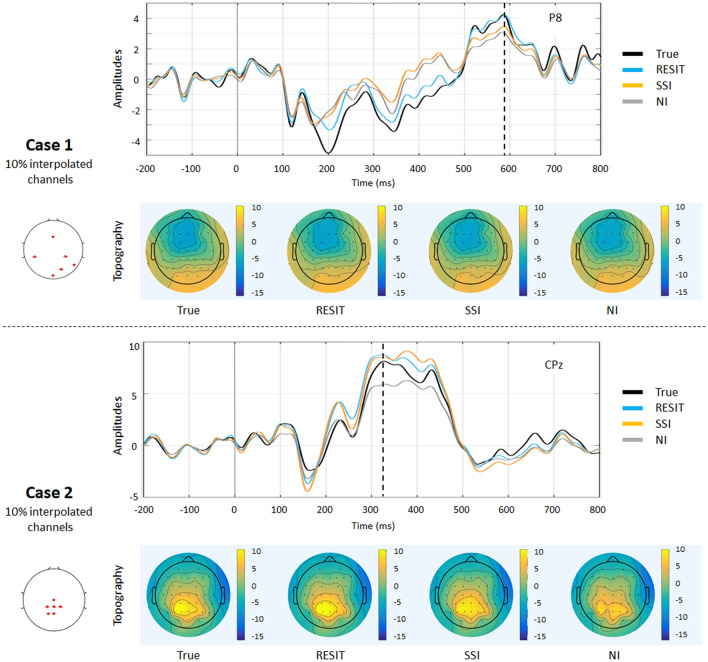
"Bad channels" are common phenomena during scalp electroencephalography (EEG) recording that arise due to various technique-related reasons, and reconstructing signals from bad channels is an inevitable choice in EEG processing. However, current interpolation methods are all based on purely mathematical interpolation theory, ignoring the neurophysiological basis of the EEG signals, and their performance needs to be further improved, especially when there are many scattered or adjacent bad channels. Therefore, a new interpolation method, named the reference electrode standardization interpolation technique (RESIT), was developed for interpolating scalp EEG channels. Resting-state and event-related EEG datasets were used to investigate the performance of the RESIT. The main results showed that (1) assuming 10% bad channels, RESIT can reconstruct the bad channels well; (2) as the percentage of bad channels increased (from 2% to 85%), the absolute and relative errors between the true and RESIT-reconstructed signals generally increased, and the correlations between the true and RESIT signals decreased; (3) for a range of bad channel percentages (2% ~ 85%), the RESIT had lower absolute error (approximately 2.39% ~ 33.5% reduction), lower relative errors (approximately 1.3% ~ 35.7% reduction) and higher correlations (approximately 2% ~ 690% increase) than traditional interpolation methods, including neighbor interpolation (NI) and spherical spline interpolation (SSI). In addition, the RESIT was integrated into the EEG preprocessing pipeline on the WeBrain cloud platform ( https://webrain.uestc.edu.cn/ ). These results suggest that the RESIT is a promising interpolation method for both separate and simultaneous EEG preprocessing that benefits further EEG analysis, including event-related potential (ERP) analysis, EEG network analysis, and strict group-level statistics.
“坏道”是头皮脑电图(EEG)记录中常见的现象,是由各种技术相关原因引起的,从坏道中重建信号是 EEG 处理中不可避免的选择。然而,目前的插值方法都是基于纯数学插值理论,忽略了 EEG 信号的神经生理学基础,其性能有待进一步提高,尤其是在存在大量分散或相邻坏道的情况下。因此,开发了一种新的插值方法,称为参考电极标准化插值技术(RESIT),用于插值头皮 EEG 通道。使用静息态和事件相关 EEG 数据集来研究 RESIT 的性能。主要结果表明:(1)假设 10%的坏道,RESIT 可以很好地重建坏道;(2)随着坏道百分比的增加(从 2%增加到 85%),真实信号和 RESIT 重建信号之间的绝对和相对误差通常会增加,真实信号和 RESIT 信号之间的相关性会降低;(3)对于一系列坏道百分比(2%85%),RESIT 的绝对误差较小(约减少 2.39%33.5%),相对误差较小(约减少 1.3%35.7%),相关性较高(约增加 2%690%),优于传统的插值方法,包括邻域插值(NI)和球样条插值(SSI)。此外,RESIT 已集成到 WeBrain 云平台(https://webrain.uestc.edu.cn/)的 EEG 预处理流水线中。这些结果表明,RESIT 是一种很有前途的 EEG 预处理方法,无论是单独还是同时处理 EEG,都有利于进一步的 EEG 分析,包括事件相关电位(ERP)分析、EEG 网络分析和严格的组水平统计。