Department of Prosthodontics, Yonsei University College of Dentistry, Seoul, 03722, Korea.
Int J Implant Dent. 2021 May 10;7(1):37. doi: 10.1186/s40729-021-00318-x.
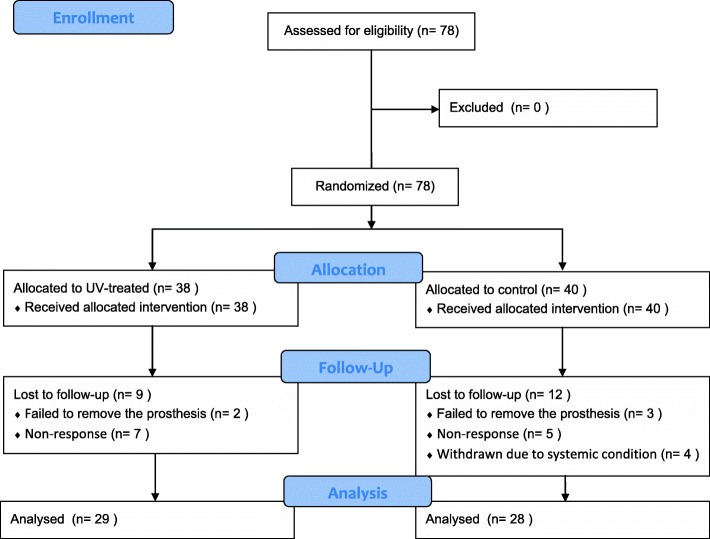
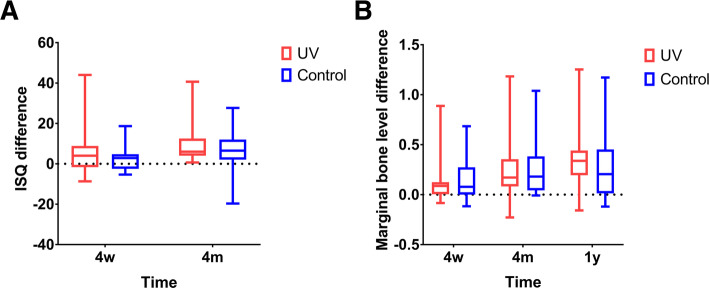
This study aimed to investigate the effects of ultraviolet (UV) photofunctionalization on the stability of implants during the early phase in the posterior region of the maxilla. The study was a randomized double-blinded clinical trial. Half of the participants received conventional commercial implants while the other half received UV-irradiated implants. The surgical sites were classified into three bone quality groups (II, III, IV) based on the grayscale value measured on cone-beam computed tomography. The values obtained from resonance frequency analysis were recorded immediately after implant placement and at 4 weeks and at 4 months postoperatively. The marginal bone level of the implants was evaluated using periapical radiographs at 4 weeks, 4 months, and 1 year postoperatively.
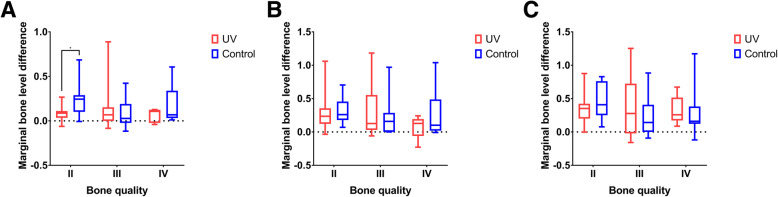
Fifty-seven implants placed in 34 participants were analyzed in this study. In group III, significant differences were observed in terms of the differences of resonance frequency analysis values at 4 weeks (p = 0.004) and 4 months (p = 0.017) postoperatively. In group II, the UV-treated group showed significantly lesser bone loss at 4 weeks post-operatively (p = 0.037).
Within the limitation of the present study, we concluded that UV surface treatment on implants may increase the initial stability in the region of the maxilla with poor bone quality.
本研究旨在探讨紫外线(UV)光功能化对在上颌后区植入物早期稳定性的影响。这是一项随机双盲临床试验。一半参与者接受常规商业植入物,另一半接受 UV 辐照植入物。根据锥形束计算机断层扫描测量的灰度值,将手术部位分为三组骨质量(II、III、IV)。在植入物放置后即刻、4 周和 4 个月记录共振频率分析获得的数值。在术后 4 周、4 个月和 1 年,使用根尖片评估植入物的边缘骨水平。
本研究分析了 34 名参与者的 57 个植入物。在第 III 组中,术后 4 周(p=0.004)和 4 个月(p=0.017)时,共振频率分析值的差异有统计学意义。在第 II 组中,术后 4 周时,UV 处理组的骨丢失明显较少(p=0.037)。
在本研究的限制范围内,我们得出结论,UV 表面处理可增加骨质量较差的上颌区域的初始稳定性。