Department of Diagnostic and Interventional Radiology, Quantitative Imaging Lab Bonn (QILaB), University Hospital Bonn (Universitätsklinikum Bonn), Venusberg-Campus 1, 53127, Bonn, Germany.
Image Analysis, German Center for Neurodegenerative Diseases (DZNE), Bonn, Germany.
Eur Radiol. 2021 Nov;31(11):8807-8815. doi: 10.1007/s00330-021-07858-1. Epub 2021 May 11.
To investigate the diagnostic performance of deep transfer learning (DTL) to detect liver cirrhosis from clinical MRI.
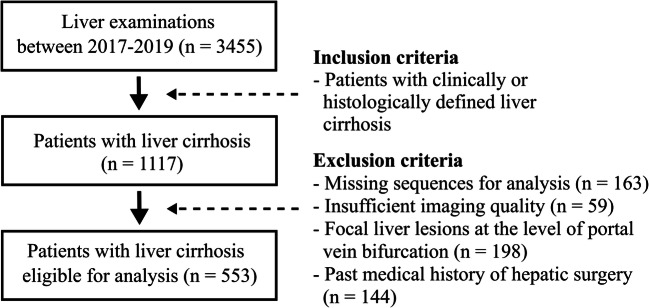
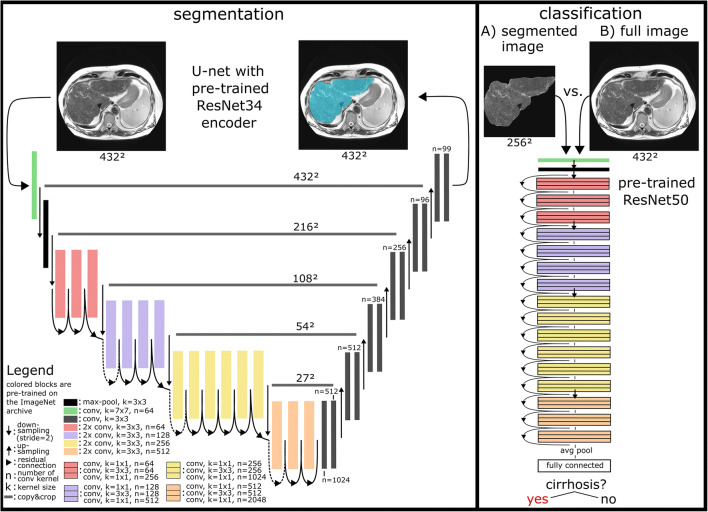
The dataset for this retrospective analysis consisted of 713 (343 female) patients who underwent liver MRI between 2017 and 2019. In total, 553 of these subjects had a confirmed diagnosis of liver cirrhosis, while the remainder had no history of liver disease. T2-weighted MRI slices at the level of the caudate lobe were manually exported for DTL analysis. Data were randomly split into training, validation, and test sets (70%/15%/15%). A ResNet50 convolutional neural network (CNN) pre-trained on the ImageNet archive was used for cirrhosis detection with and without upstream liver segmentation. Classification performance for detection of liver cirrhosis was compared to two radiologists with different levels of experience (4-year resident, board-certified radiologist). Segmentation was performed using a U-Net architecture built on a pre-trained ResNet34 encoder. Differences in classification accuracy were assessed by the χ-test.
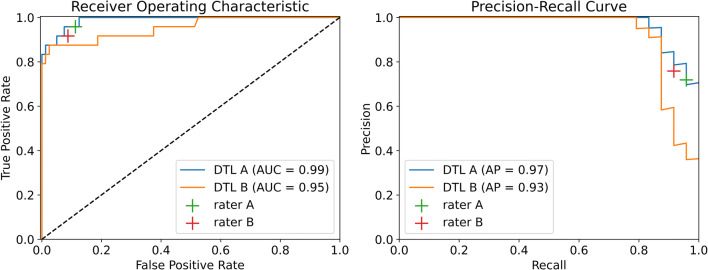
Dice coefficients for automatic segmentation were above 0.98 for both validation and test data. The classification accuracy of liver cirrhosis on validation (vACC) and test (tACC) data for the DTL pipeline with upstream liver segmentation (vACC = 0.99, tACC = 0.96) was significantly higher compared to the resident (vACC = 0.88, p < 0.01; tACC = 0.91, p = 0.01) and to the board-certified radiologist (vACC = 0.96, p < 0.01; tACC = 0.90, p < 0.01).
This proof-of-principle study demonstrates the potential of DTL for detecting cirrhosis based on standard T2-weighted MRI. The presented method for image-based diagnosis of liver cirrhosis demonstrated expert-level classification accuracy.
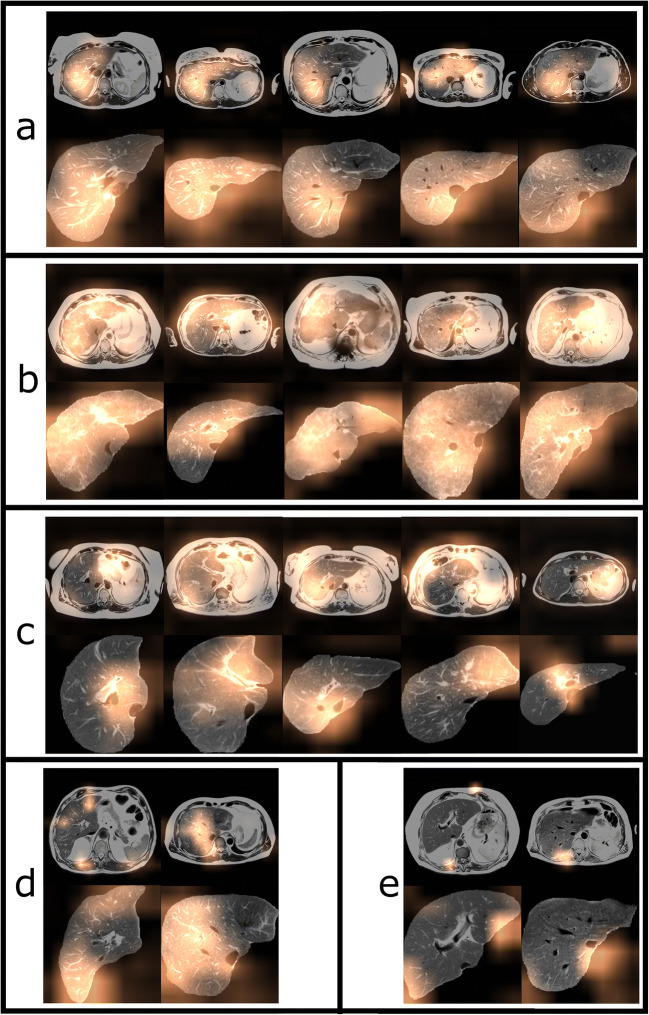
• A pipeline consisting of two convolutional neural networks (CNNs) pre-trained on an extensive natural image database (ImageNet archive) enables detection of liver cirrhosis on standard T2-weighted MRI. • High classification accuracy can be achieved even without altering the pre-trained parameters of the convolutional neural networks. • Other abdominal structures apart from the liver were relevant for detection when the network was trained on unsegmented images.
探究深度迁移学习(DTL)在从临床 MRI 检测肝硬化中的诊断性能。
本回顾性分析的数据集中包含 713 名(343 名女性)于 2017 年至 2019 年期间进行肝脏 MRI 检查的患者。其中,553 名患者被确诊为肝硬化,其余患者无肝脏疾病史。在尾状叶水平手动导出 T2 加权 MRI 切片进行 DTL 分析。数据随机分为训练集、验证集和测试集(70%/15%/15%)。使用在 ImageNet 存档上预先训练的 ResNet50 卷积神经网络(CNN)进行肝硬化检测,有无上游肝脏分割。将两名具有不同经验水平(4 年住院医师、董事会认证放射科医师)的放射科医生的分类性能与检测肝硬化的性能进行比较。分割使用基于预训练 ResNet34 编码器的 U-Net 架构进行。通过 χ 检验评估分类准确性的差异。
验证(vACC)和测试(tACC)数据中自动分割的 Dice 系数均高于 0.98。具有上游肝脏分割的 DTL 管道(vACC=0.99,tACC=0.96)的肝硬化分类准确性(vACC)在验证(vACC)和测试(tACC)数据中明显高于住院医师(vACC=0.88,p<0.01;tACC=0.91,p=0.01)和董事会认证放射科医师(vACC=0.96,p<0.01;tACC=0.90,p<0.01)。
本研究初步证明了基于标准 T2 加权 MRI 进行 DTL 检测肝硬化的潜力。所提出的基于图像的肝硬化诊断方法达到了专家级别的分类准确性。
• 由两个在大型自然图像数据库(ImageNet 存档)上预先训练的卷积神经网络(CNN)组成的管道可在标准 T2 加权 MRI 上检测肝硬化。• 即使不改变卷积神经网络的预训练参数,也能实现高分类准确性。• 当网络在未分割的图像上进行训练时,除了肝脏之外的其他腹部结构对于检测也很重要。