Saylors Karen, Wolking David J, Hagan Emily, Martinez Stephanie, Francisco Leilani, Euren Jason, Olson Sarah H, Miller Maureen, Fine Amanda E, Thanh Nga Nguyen Thi, Tran Minh Phuc, Kalengkongan Jusuf D, Kusumaningrum Tina, Latinne Alice, Pamungkas Joko, Safari Dodi, Saputro Suryo, Bamba Djeneba, Coulibaly Kalpy Julien, Dosso Mireille, Laudisoit Anne, N'guettia Jean Kouassi Manzan, Dutta Shusmita, Islam Ariful, Shano Shahanaj, Mwanzalila Mwokozi I, Trupin Ian P, Gbakima Aiah, Bangura James, Yondah Sylvester T, Karmacharya Dibesh, Shrestha Rima D, Kamta Marcelle Annie Matsida, Mouiche Mohamed Moctar Mouliom, Ndolo Hilarion Moukala, Niama Fabien Roch, Onikrotin Dionne, Daszak Peter, Johnson Christine K, Mazet Jonna A K
Labyrinth Global Health, St. Petersburg, FL, USA.
One Health Institute, University of California, Davis, One Shields Ave, Davis, CA, 95616, USA.
One Health Outlook. 2021 May 14;3(1):11. doi: 10.1186/s42522-021-00036-9.
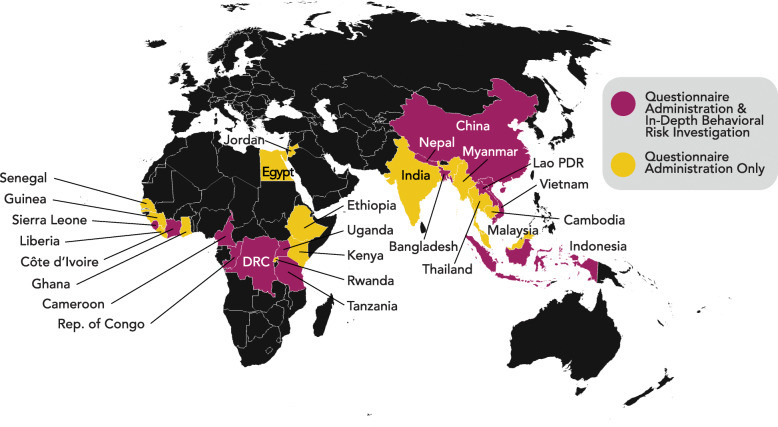
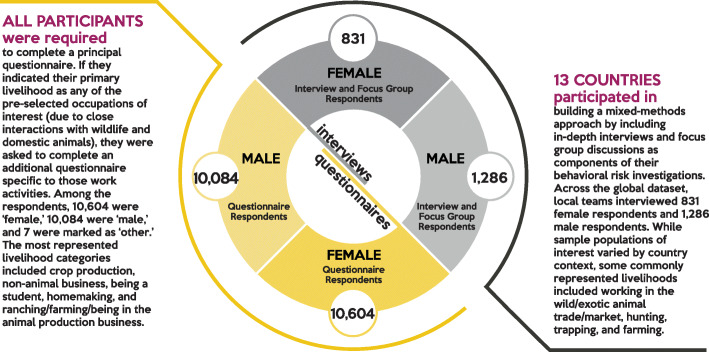
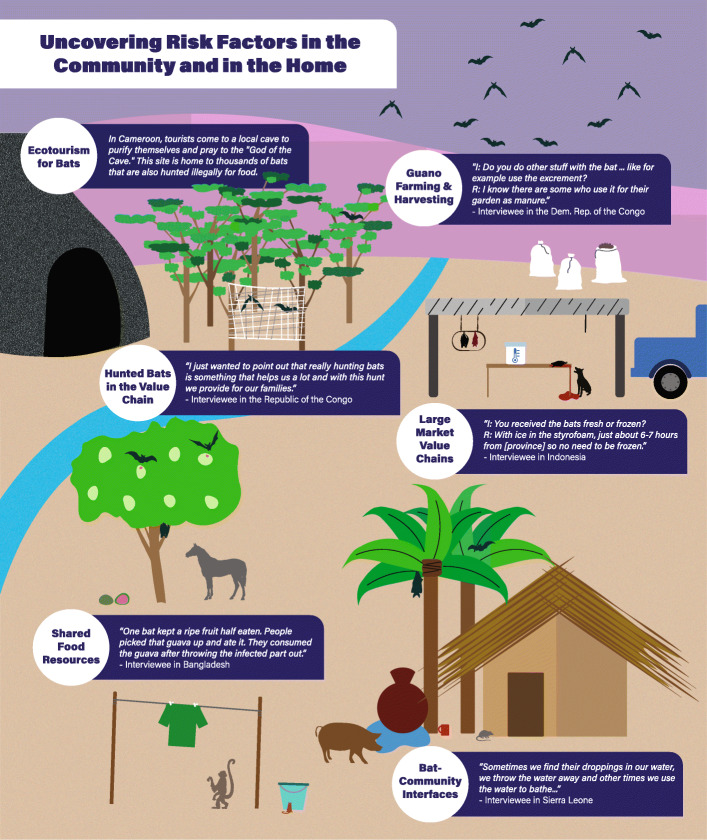
In an effort to strengthen global capacity to prevent, detect, and control infectious diseases in animals and people, the United States Agency for International Development's (USAID) Emerging Pandemic Threats (EPT) PREDICT project funded development of regional, national, and local One Health capacities for early disease detection, rapid response, disease control, and risk reduction. From the outset, the EPT approach was inclusive of social science research methods designed to understand the contexts and behaviors of communities living and working at human-animal-environment interfaces considered high-risk for virus emergence. Using qualitative and quantitative approaches, PREDICT behavioral research aimed to identify and assess a range of socio-cultural behaviors that could be influential in zoonotic disease emergence, amplification, and transmission. This broad approach to behavioral risk characterization enabled us to identify and characterize human activities that could be linked to the transmission dynamics of new and emerging viruses. This paper provides a discussion of implementation of a social science approach within a zoonotic surveillance framework. We conducted in-depth ethnographic interviews and focus groups to better understand the individual- and community-level knowledge, attitudes, and practices that potentially put participants at risk for zoonotic disease transmission from the animals they live and work with, across 6 interface domains. When we asked highly-exposed individuals (ie. bushmeat hunters, wildlife or guano farmers) about the risk they perceived in their occupational activities, most did not perceive it to be risky, whether because it was normalized by years (or generations) of doing such an activity, or due to lack of information about potential risks. Integrating the social sciences allows investigations of the specific human activities that are hypothesized to drive disease emergence, amplification, and transmission, in order to better substantiate behavioral disease drivers, along with the social dimensions of infection and transmission dynamics. Understanding these dynamics is critical to achieving health security--the protection from threats to health-- which requires investments in both collective and individual health security. Involving behavioral sciences into zoonotic disease surveillance allowed us to push toward fuller community integration and engagement and toward dialogue and implementation of recommendations for disease prevention and improved health security.
为加强全球预防、检测和控制动物及人类传染病的能力,美国国际开发署(USAID)的新兴大流行威胁(EPT)预测项目资助了区域、国家和地方层面的“同一健康”能力建设,以实现疾病早期检测、快速应对、疾病控制和风险降低。从一开始,EPT方法就纳入了社会科学研究方法,旨在了解生活和工作在被认为病毒出现高风险的人类-动物-环境界面的社区的背景和行为。通过定性和定量方法,预测行为研究旨在识别和评估一系列可能影响人畜共患病出现、扩增和传播的社会文化行为。这种广泛的行为风险特征描述方法使我们能够识别和描述可能与新出现病毒的传播动态相关的人类活动。本文讨论了在人畜共患病监测框架内实施社会科学方法的情况。我们进行了深入的人种志访谈和焦点小组讨论,以更好地了解个人和社区层面的知识、态度和做法,这些因素可能使参与者面临与其生活和工作的动物发生人畜共患病传播的风险,涉及6个界面领域。当我们询问高暴露个体(如丛林肉猎人、野生动物或鸟粪养殖户)他们在职业活动中所感知的风险时,大多数人并不认为有风险,这要么是因为多年(或几代人)从事此类活动已使其常态化,要么是由于缺乏关于潜在风险的信息。整合社会科学能够对被假设为人畜共患病出现、扩增和传播驱动因素的特定人类活动进行调查,以便更好地证实行为性疾病驱动因素以及感染和传播动态的社会层面。了解这些动态对于实现健康安全至关重要——即防范健康威胁——这需要对集体和个人健康安全进行投资。将行为科学纳入人畜共患病监测使我们能够推动更全面的社区融合与参与,并推动就疾病预防和改善健康安全的建议进行对话和实施。