U.S. Army Engineer Research and Development Center, Vicksburg, MS, USA.
U.S. Army Engineer Research and Development Center, Hanover, NH, USA.
Sci Rep. 2021 May 25;11(1):10875. doi: 10.1038/s41598-021-90227-1.
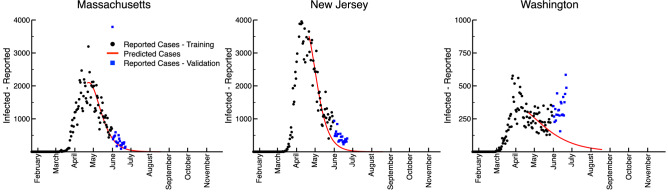
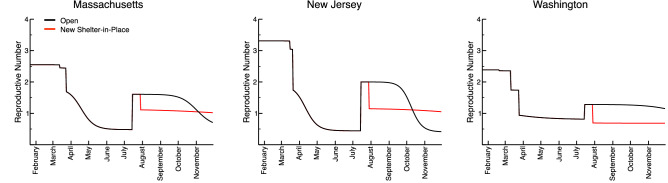
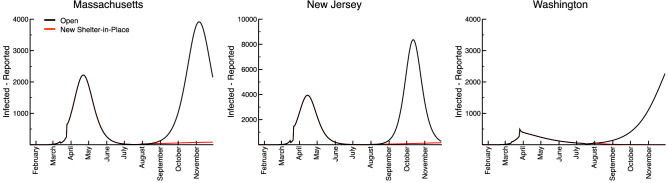
The SARS-CoV-2 virus is responsible for the novel coronavirus disease 2019 (COVID-19), which has spread to populations throughout the continental United States. Most state and local governments have adopted some level of "social distancing" policy, but infections have continued to spread despite these efforts. Absent a vaccine, authorities have few other tools by which to mitigate further spread of the virus. This begs the question of how effective social policy really is at reducing new infections that, left alone, could potentially overwhelm the existing hospitalization capacity of many states. We developed a mathematical model that captures correlations between some state-level "social distancing" policies and infection kinetics for all U.S. states, and use it to illustrate the link between social policy decisions, disease dynamics, and an effective reproduction number that changes over time, for case studies of Massachusetts, New Jersey, and Washington states. In general, our findings indicate that the potential for second waves of infection, which result after reopening states without an increase to immunity, can be mitigated by a return of social distancing policies as soon as possible after the waves are detected.
SARS-CoV-2 病毒引发了 2019 年新型冠状病毒病(COVID-19),该病毒已传播到美国大陆的各个地区。大多数州和地方政府都采取了一定程度的“社交距离”政策,但尽管采取了这些措施,感染仍在继续蔓延。在没有疫苗的情况下,当局几乎没有其他工具可以减轻病毒的进一步传播。这就引出了一个问题,即社会政策在减少新感染方面究竟有多有效,如果不加以控制,这些新感染可能会使许多州现有的住院能力不堪重负。我们开发了一个数学模型,该模型可以捕捉美国各州的一些“社交距离”政策与感染动力学之间的相关性,并使用它来说明社会政策决策、疾病动态和随时间变化的有效繁殖数之间的联系,以马萨诸塞州、新泽西州和华盛顿州为例进行案例研究。总的来说,我们的研究结果表明,在没有增加免疫力的情况下重新开放各州后,可能会出现第二波感染,通过在波出现后尽快恢复社交距离政策,就可以减轻这种可能性。