Department of Epidemiology and Biostatistics, School of Health Sciences, Wuhan University, 430071, Wuhan, China.
NHC Key lab of Radiation Biology, Jilin University, 130021, Changchun, China.
Glob Health Res Policy. 2021 May 28;6(1):18. doi: 10.1186/s41256-021-00200-8.
To put COVID-19 patients into hospital timely, the clinical diagnosis had been implemented in Wuhan in the early epidemic. Here we compared the epidemiological characteristics of laboratory-confirmed and clinically diagnosed cases with COVID-19 in Wuhan.
Demographics, case severity and outcomes of 29,886 confirmed cases and 21,960 clinically diagnosed cases reported between December 2019 and February 24, 2020, were compared. The risk factors were estimated, and the effective reproduction number (Rt) of SARS-CoV-2 was also calculated.
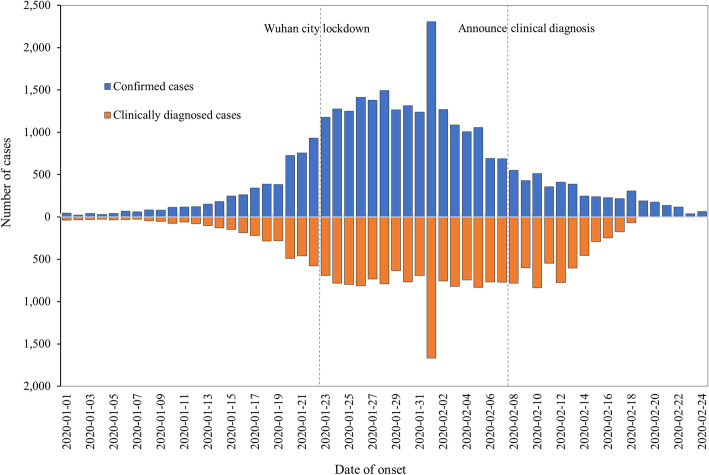
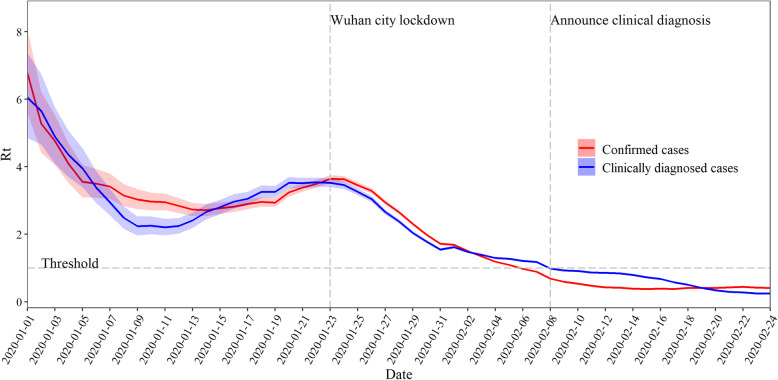
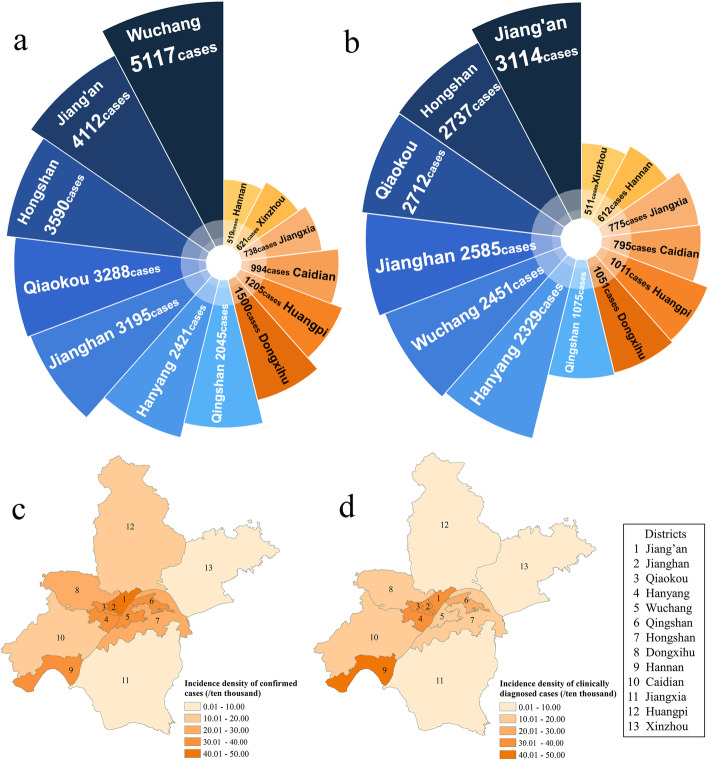
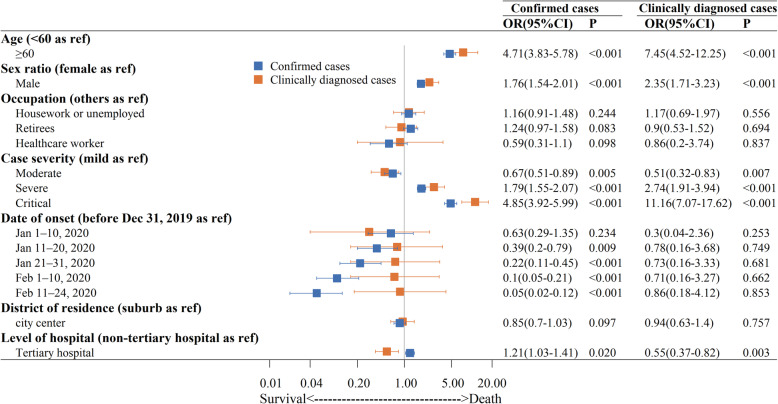
The age and occupation distribution of confirmed cases and clinically diagnosed cases were consistent, and their sex ratio were 1.0 and 0.9, respectively. The epidemic curve of clinical diagnosis cases was similar to that of confirmed cases, and the city centers had more cumulative cases and higher incidence density than suburbs in both of two groups. The proportion of severe and critical cases (21.5 % vs. 14.0 %, P < 0.0001) and case fatality rates (5.2 % vs. 1.2 %, P < 0.0001) of confirmed cases were all higher than those of clinically diagnosed cases. Risk factors for death we observed in both of two groups were older age, male, severe or critical cases. Rt showed the same trend in two groups, it dropped below 1.0 on February 6 among confirmed cases, and February 8 among clinically diagnosed cases.
The demographic characteristics and spatiotemporal distributions of confirmed and clinically diagnosed cases are roughly similar, but the disease severity and clinical outcome of clinically diagnosed cases are better than those of confirmed cases. In cases when detection kits are insufficient during the early epidemic, the implementation of clinical diagnosis is necessary and effective.
为了及时收治 COVID-19 患者,武汉在疫情早期就实施了临床诊断。本研究比较了武汉确诊病例和临床诊断病例的流行病学特征。
比较了 2019 年 12 月至 2020 年 2 月 24 日报告的 29886 例确诊病例和 21960 例临床诊断病例的人口统计学特征、病例严重程度和结局。估计了危险因素,并计算了 SARS-CoV-2 的有效繁殖数(Rt)。
确诊病例和临床诊断病例的年龄和职业分布一致,男女比例分别为 1.0 和 0.9。临床诊断病例的流行曲线与确诊病例相似,市中心的累计病例数和发病率密度均高于郊区。确诊病例的重症和危重症比例(21.5%比 14.0%,P<0.0001)和病死率(5.2%比 1.2%,P<0.0001)均高于临床诊断病例。两组中观察到的死亡危险因素均为年龄较大、男性、重症或危重症病例。Rt 在两组中呈相同趋势,确诊病例于 2 月 6 日降至 1.0 以下,临床诊断病例于 2 月 8 日降至 1.0 以下。
确诊病例和临床诊断病例的人口统计学特征和时空分布大致相似,但临床诊断病例的疾病严重程度和临床结局优于确诊病例。在疫情早期检测试剂盒不足的情况下,实施临床诊断是必要且有效的。