
转录组和代谢组揭示 叶片组织对盐胁迫的响应。
Transcriptome and Metabolome Reveal Salt-Stress Responses of Leaf Tissues from .
机构信息
Key Laboratory of South China Agricultural Plant Molecular Analysis and Gene Improvement, South China Botanical Garden, Chinese Academy of Sciences, Guangzhou 510650, China.
College of Biological Science and Agriculture, Qiannan Normal University for Nationalities, Duyun 558000, China.
出版信息
Biomolecules. 2021 May 15;11(5):736. doi: 10.3390/biom11050736.
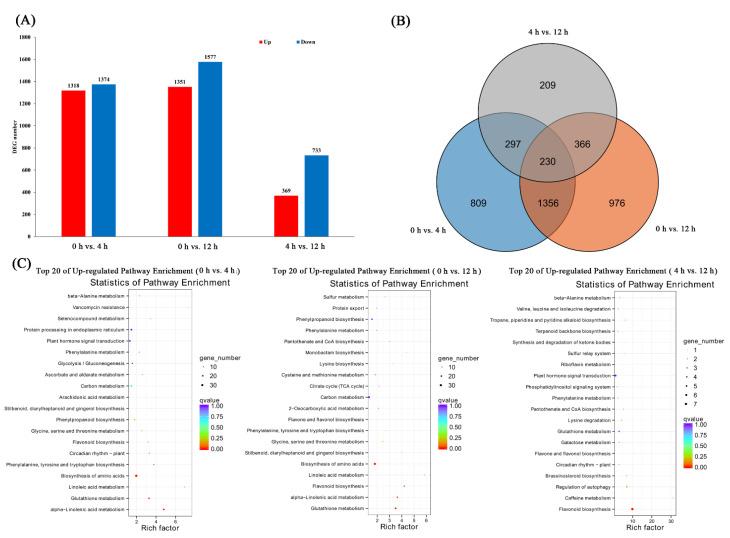
Kimura et Migo is a precious traditional Chinese medicine. Despite . displaying a good salt-tolerance level, the yield and growth of . were impaired drastically by the increasing soil secondary salinization. The molecular mechanisms of plants' adaptation to salt stress are not well documented. Therefore, in the present study, plants were treated with 250 mM NaCl. Transcriptome analysis showed that salt stress significantly altered various metabolic pathways, including phenylalanine metabolism, flavonoid biosynthesis, and α-linolenic acid metabolism, and significantly upregulated the mRNA expression levels of , , , , and involved in the jasmonic acid (JA) biosynthesis pathway, as well as rutin synthesis genes involved in the flavonoid synthesis pathway. In addition, metabolomics analysis showed that salt stress induced the accumulation of some compounds in leaves, especially flavonoids, sugars, and alkaloids, which may play an important role in salt-stress responses of leaf tissues from . Moreover, salt stress could trigger JA biosynthesis, and JA may act as a signal molecule that promotes flavonoid biosynthesis in leaves. To sum up, plants adapted to salt stress by enhancing the biosynthesis of secondary metabolites.
金米草是一种珍贵的中药。尽管金米草表现出很好的耐盐水平,但随着土壤次生盐渍化的加剧,其产量和生长受到严重损害。植物适应盐胁迫的分子机制尚未得到很好的记录。因此,在本研究中,用 250mM NaCl 处理金米草。转录组分析表明,盐胁迫显著改变了各种代谢途径,包括苯丙氨酸代谢、类黄酮生物合成和α-亚麻酸代谢,并显著上调了参与茉莉酸(JA)生物合成途径的 、 、 、 以及类黄酮合成途径中涉及芦丁合成的基因的 mRNA 表达水平。此外,代谢组学分析表明,盐胁迫诱导金米草叶片中一些化合物的积累,特别是类黄酮、糖和生物碱,它们可能在金米草叶片组织的盐胁迫反应中发挥重要作用。此外,盐胁迫可以触发 JA 的生物合成,JA 可能作为一种信号分子促进金米草叶片中类黄酮的生物合成。总之,金米草通过增强次生代谢物的生物合成来适应盐胁迫。



 Zotero 插件