Medical Biodynamics ProgramDivision of Sleep and Circadian DisordersBrigham and Women's Hospital Boston MA.
Division of Sleep Medicine Harvard Medical School Boston MA.
J Am Heart Assoc. 2021 Jun 15;10(12):e019037. doi: 10.1161/JAHA.120.019037. Epub 2021 Jun 2.
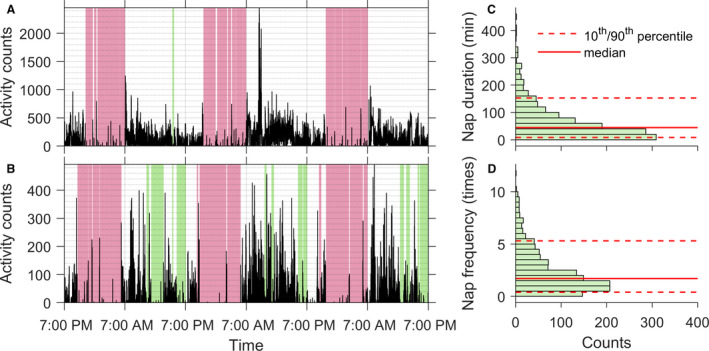
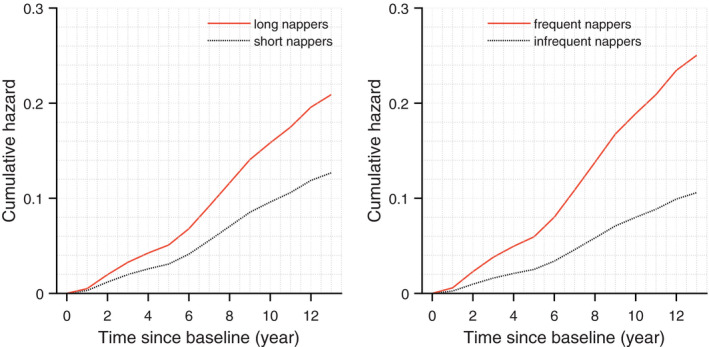
Background Disrupted nighttime sleep has been associated with heart failure (HF). However, the relationship between daytime napping, an important aspect of sleep behavior commonly seen in older adults, and HF remains unclear. We sought to investigate the association of objectively assessed daytime napping and risk of incident HF during follow-up. Methods and Results We studied 1140 older adults (age, 80.7±7.4 [SD] years; female sex, 867 [76.1%]) in the Rush Memory and Aging Project who had no HF at baseline and were followed annually for up to 14 years. Motor activity (ie, actigraphy) was recorded for ≈10 days at baseline. We assessed daytime napping episodes between 9 am and 7 pm objectively from actigraphy using a previously published algorithm for sleep detection. Cox proportional hazards models examined associations of daily napping duration and frequency with incident HF. Eighty-six participants developed incident HF, and the mean onset time was 5.7 years (SD, 3.4; range, 1-14). Participants who napped longer than 44.4 minutes (ie, the median daily napping duration) showed a 1.73-fold higher risk of developing incident HF than participants who napped <44.4 minutes. Consistently, participants who napped >1.7 times/day (ie, the median daily napping frequency) showed a 2.20-fold increase compared with participants who napped <1.7 times/day. These associations persisted after adjustment for covariates, including nighttime sleep, comorbidities, and cardiovascular disease/risk factors. Conclusions Longer and more frequent objective napping predicted elevated future risk of developing incident HF. Future studies are needed to establish underlying mechanisms.
夜间睡眠中断与心力衰竭(HF)有关。然而,日间小睡(老年人常见的睡眠行为的一个重要方面)与 HF 之间的关系尚不清楚。我们试图研究在随访期间,客观评估的日间小睡与 HF 事件风险之间的关联。
我们研究了 Rush 记忆与衰老项目中的 1140 名年龄在 80.7±7.4 岁(标准差)的老年人(女性 867 人[76.1%]),这些人在基线时没有 HF,并且在最多 14 年内每年接受一次随访。基线时大约有 10 天记录了运动活动(即活动记录仪)。我们使用之前发表的睡眠检测算法,从活动记录仪中客观评估了 9 am 至 7 pm 之间的日间小睡情况。Cox 比例风险模型研究了日间小睡持续时间和频率与 HF 事件的关联。86 名参与者发生了 HF 事件,平均发病时间为 5.7 年(标准差 3.4 年;范围 1-14 年)。与小睡 <44.4 分钟(即每日小睡时间中位数)的参与者相比,小睡超过 44.4 分钟(即每日小睡时间中位数)的参与者发生 HF 事件的风险高 1.73 倍。同样,与小睡 <1.7 次/天(即每日小睡频率中位数)的参与者相比,小睡 >1.7 次/天的参与者发生 HF 的风险增加了 2.20 倍。这些关联在调整了包括夜间睡眠、合并症和心血管疾病/危险因素在内的混杂因素后仍然存在。
更长和更频繁的客观小睡预示着未来发生 HF 的风险增加。需要进一步的研究来确定潜在的机制。