Hao Ruqian, Namdar Khashayar, Liu Lin, Khalvati Farzad
School of Optoelectronic Science and Engineering, University of Electronic Science and Technology of China, Chengdu, China.
Institute of Medical Science, University of Toronto, Toronto, ON, Canada.
Front Artif Intell. 2021 May 17;4:635766. doi: 10.3389/frai.2021.635766. eCollection 2021.
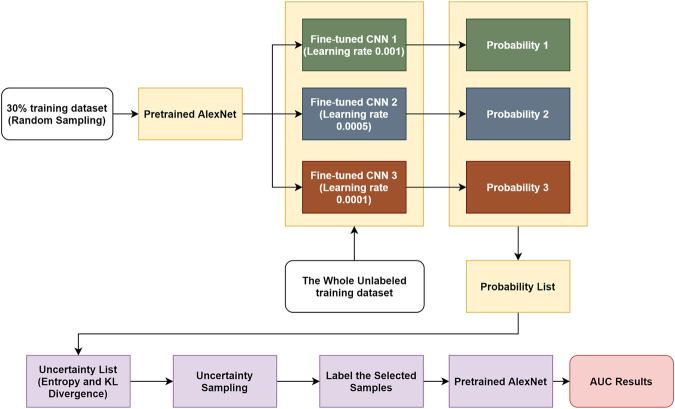
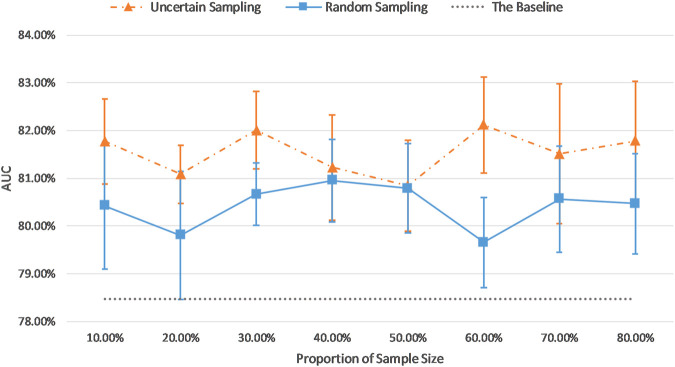
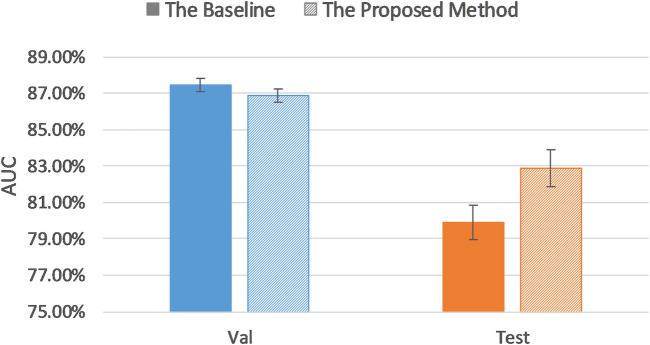
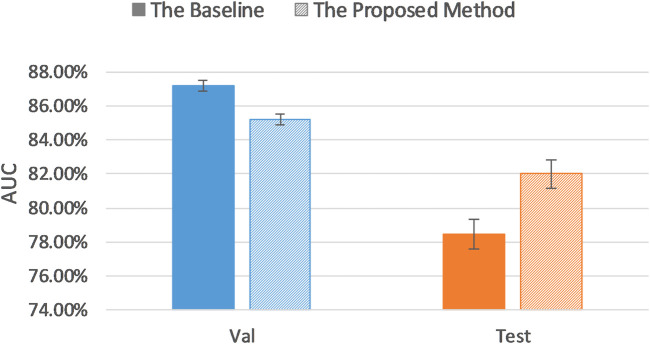
Brain tumor is one of the leading causes of cancer-related death globally among children and adults. Precise classification of brain tumor grade (low-grade and high-grade glioma) at an early stage plays a key role in successful prognosis and treatment planning. With recent advances in deep learning, artificial intelligence-enabled brain tumor grading systems can assist radiologists in the interpretation of medical images within seconds. The performance of deep learning techniques is, however, highly depended on the size of the annotated dataset. It is extremely challenging to label a large quantity of medical images, given the complexity and volume of medical data. In this work, we propose a novel transfer learning-based active learning framework to reduce the annotation cost while maintaining stability and robustness of the model performance for brain tumor classification. In this retrospective research, we employed a 2D slice-based approach to train and fine-tune our model on the magnetic resonance imaging (MRI) training dataset of 203 patients and a validation dataset of 66 patients which was used as the baseline. With our proposed method, the model achieved area under receiver operating characteristic (ROC) curve (AUC) of 82.89% on a separate test dataset of 66 patients, which was 2.92% higher than the baseline AUC while saving at least 40% of labeling cost. In order to further examine the robustness of our method, we created a balanced dataset, which underwent the same procedure. The model achieved AUC of 82% compared with AUC of 78.48% for the baseline, which reassures the robustness and stability of our proposed transfer learning augmented with active learning framework while significantly reducing the size of training data.
脑肿瘤是全球儿童和成人癌症相关死亡的主要原因之一。在早期精确分类脑肿瘤分级(低级别和高级别胶质瘤)对成功的预后和治疗规划起着关键作用。随着深度学习的最新进展,基于人工智能的脑肿瘤分级系统可以在几秒钟内协助放射科医生解读医学图像。然而,深度学习技术的性能高度依赖于标注数据集的大小。鉴于医学数据的复杂性和数量,标注大量医学图像极具挑战性。在这项工作中,我们提出了一种新颖的基于迁移学习的主动学习框架,以降低标注成本,同时保持脑肿瘤分类模型性能的稳定性和鲁棒性。在这项回顾性研究中,我们采用基于二维切片的方法,在203例患者的磁共振成像(MRI)训练数据集和66例患者的验证数据集上训练和微调我们的模型,该验证数据集用作基线。使用我们提出的方法,该模型在66例患者的单独测试数据集上实现了受试者操作特征(ROC)曲线下面积(AUC)为82.89%,比基线AUC高2.92%,同时至少节省了40%的标注成本。为了进一步检验我们方法的鲁棒性,我们创建了一个平衡数据集,并对其进行相同的操作。该模型的AUC为82%,而基线的AUC为78.48%,这再次证明了我们提出的结合主动学习框架的迁移学习的鲁棒性和稳定性,同时显著减小了训练数据的规模。