Brain Behavior Laboratory, Department of Psychiatry, Perelman School of Medicine, University of Pennsylvania, Philadelphia, Pennsylvania, USA.
Penn Statistics in Imaging and Visualization Endeavor, Center for Clinical Epidemiology and Biostatistics, Perelman School of Medicine, University of Pennsylvania, Philadelphia, Pennsylvania, USA.
Hum Brain Mapp. 2021 Sep;42(13):4092-4101. doi: 10.1002/hbm.25533. Epub 2021 Jun 30.
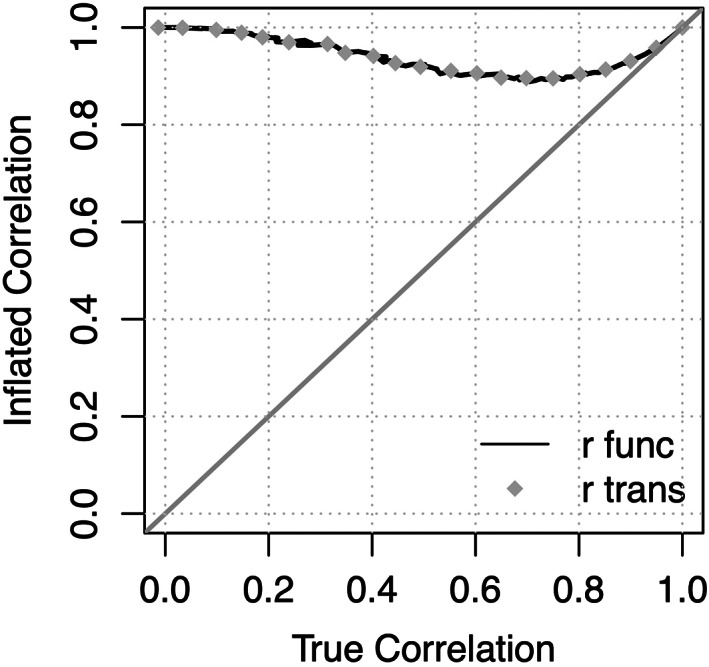
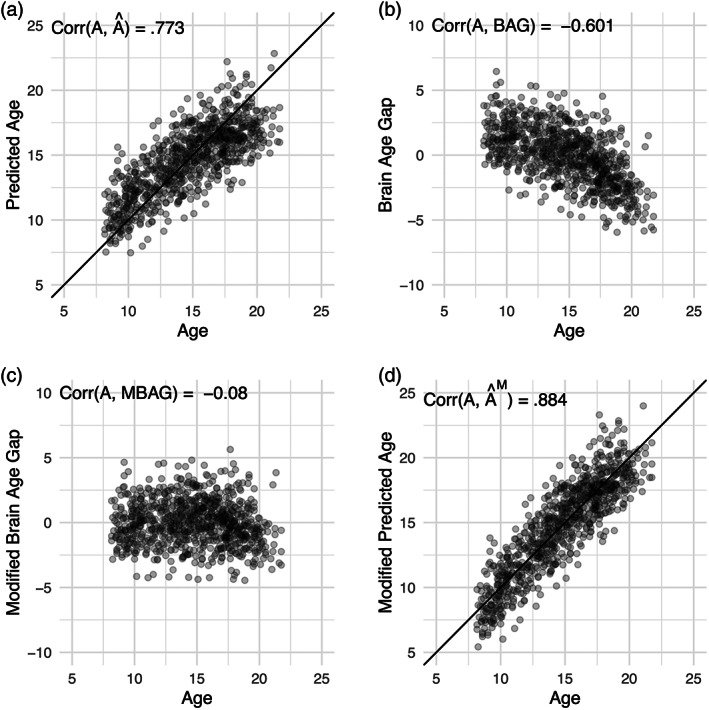
Over the past decade, there has been an abundance of research on the difference between age and age predicted using brain features, which is commonly referred to as the "brain age gap." Researchers have identified that the brain age gap, as a linear transformation of an out-of-sample residual, is dependent on age. As such, any group differences on the brain age gap could simply be due to group differences on age. To mitigate the brain age gap's dependence on age, it has been proposed that age be regressed out of the brain age gap. If this modified brain age gap is treated as a corrected deviation from age, model accuracy statistics such as R will be artificially inflated to the extent that it is highly improbable that an R value below .85 will be obtained no matter the true model accuracy. Given the limitations of proposed brain age analyses, further theoretical work is warranted to determine the best way to quantify deviation from normality.
在过去的十年中,已经有大量的研究关注了基于大脑特征预测的年龄与实际年龄之间的差异,通常被称为“大脑年龄差距”。研究人员已经确定,大脑年龄差距是样本外残差的线性变换,取决于年龄。因此,大脑年龄差距的任何组间差异都可能仅仅是由于年龄的组间差异。为了减轻大脑年龄差距对年龄的依赖,有人提出从大脑年龄差距中回归年龄。如果将这个经过修正的大脑年龄差距视为对年龄的修正偏差,那么模型准确性统计数据(如 R)将被人为夸大,以至于无论真实模型准确性如何,都极不可能获得低于.85 的 R 值。鉴于提出的大脑年龄分析的局限性,有必要进行进一步的理论研究,以确定量化偏离正态性的最佳方法。