Ginat Daniel
Department of Radiology, University of Chicago, Chicago, IL 60615, USA.
Brain Sci. 2021 Jun 23;11(7):832. doi: 10.3390/brainsci11070832.
Prompt identification of acute intracranial hemorrhage on CT is important. The goal of this study was to assess the impact of artificial intelligence software for prioritizing positive cases.
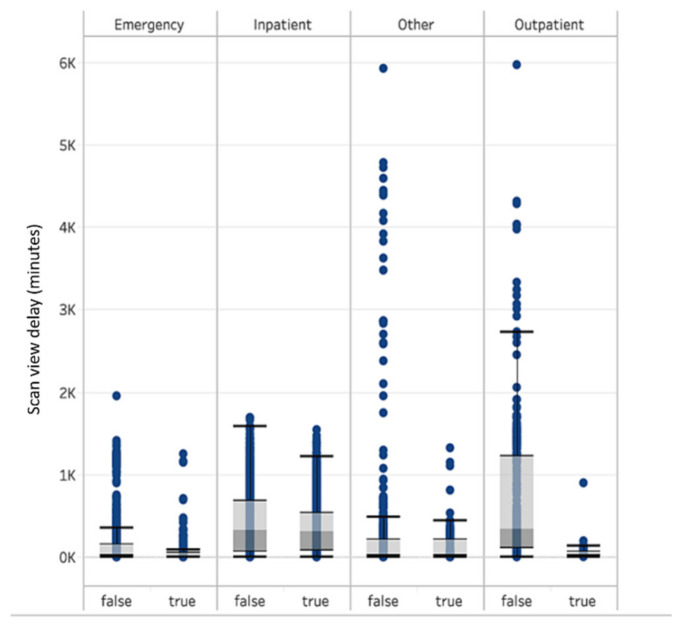
Cases analyzed by Aidoc (Tel Aviv, Israel) software for triaging acute intracranial hemorrhage cases on non-contrast head CT were retrospectively reviewed. The scan view delay time was calculated as the difference between the time the study was completed on PACS and the time the study was first opened by a radiologist. The scan view delay was stratified by scan location, including emergency, inpatient, and outpatient. The scan view delay times for cases flagged as positive by the software were compared to those that were not flagged.
A total of 8723 scans were assessed by the software, including 6894 cases that were not flagged and 1829 cases that were flagged as positive. Although there was no statistically significant difference in the scan view time for emergency cases, there was a significantly lower scan view time for positive outpatient and inpatient cases flagged by the software versus negative cases, with a reduction of 604 min on average, 90% in the scan view delay (-value < 0.0001) for outpatients, and a reduction of 38 min on average, and 10% in the scan view delay (-value <= 0.01) for inpatients.
The use of artificial intelligence triage software for acute intracranial hemorrhage on head CT scans is associated with a significantly shorter scan view delay for cases flagged as positive than cases not flagged among outpatients and inpatients at an academic medical center.
在CT上快速识别急性颅内出血很重要。本研究的目的是评估人工智能软件对阳性病例进行优先级排序的影响。
回顾性分析由以色列特拉维夫的Aidoc软件对非增强头部CT上的急性颅内出血病例进行分诊的病例。扫描查看延迟时间计算为研究在PACS上完成的时间与放射科医生首次打开研究的时间之差。扫描查看延迟按扫描部位分层,包括急诊、住院和门诊。将软件标记为阳性的病例的扫描查看延迟时间与未标记的病例进行比较。
该软件共评估了8723次扫描,其中6894例未被标记,1829例被标记为阳性。虽然急诊病例的扫描查看时间没有统计学上的显著差异,但软件标记为阳性的门诊和住院病例的扫描查看时间明显低于阴性病例,门诊病例的扫描查看延迟平均减少604分钟,减少90%(P值<0.0001),住院病例的扫描查看延迟平均减少38分钟,减少10%(P值<=0.01)。
在学术医疗中心,使用人工智能分诊软件对头部CT扫描中的急性颅内出血进行诊断,与未被标记的病例相比,被标记为阳性的病例的扫描查看延迟显著缩短。