Roth Christian, Rettenmaier Lukas, Behringer Michael
Department of Sports Medicine and Exercise Physiology, Institute of Sport Sciences, Goethe University Frankfurt, Frankfurt, Germany.
Front Sports Act Living. 2021 Jun 15;3:683327. doi: 10.3389/fspor.2021.683327. eCollection 2021.
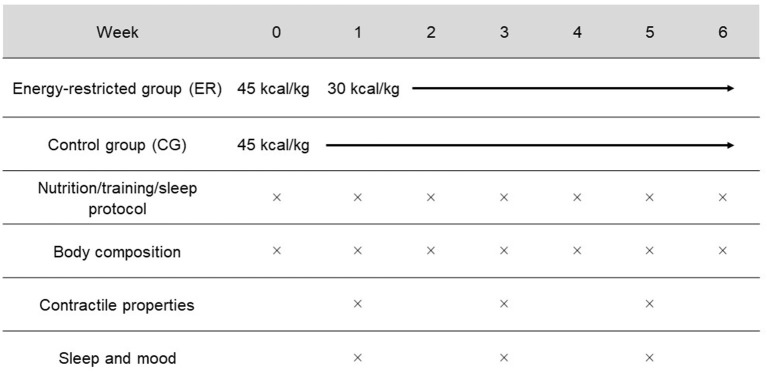
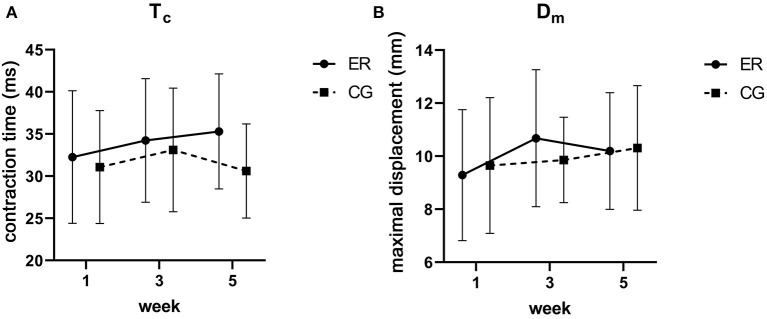
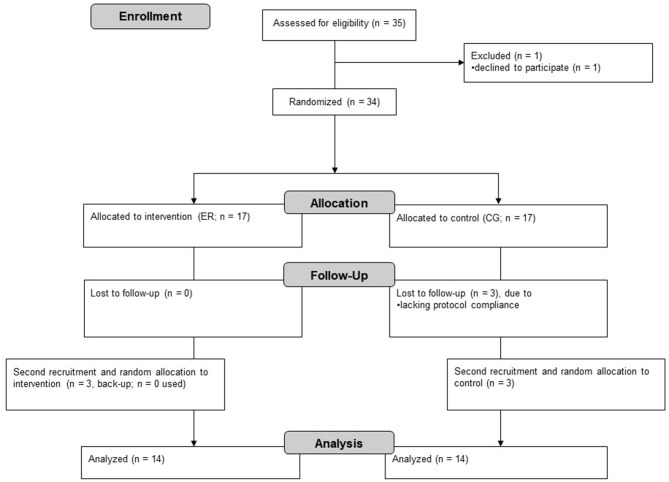
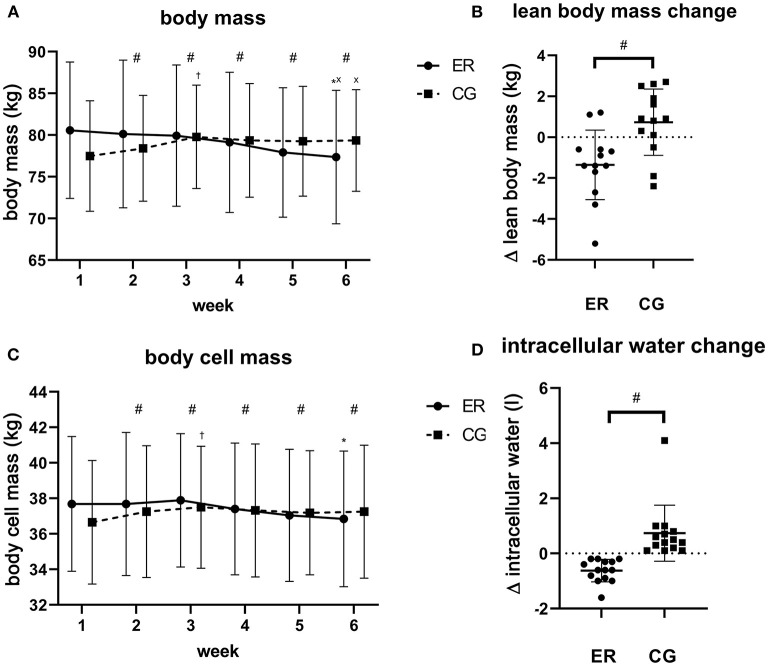
It is often advised to ensure a high-protein intake during energy-restricted diets. However, it is unclear whether a high-protein intake is able to maintain muscle mass and contractility in the absence of resistance training. After 1 week of body mass maintenance (45 kcal/kg), 28 male college students not performing resistance training were randomized to either the energy-restricted (ER, 30 kcal/kg, = 14) or the eucaloric control group (CG, 45 kcal/kg, = 14) for 6 weeks. Both groups had their protein intake matched at 2.8 g/kg fat-free-mass and continued their habitual training throughout the study. Body composition was assessed weekly using multifrequency bioelectrical impedance analysis. Contractile properties of the m. rectus femoris were examined with Tensiomyography and MyotonPRO at weeks 1, 3, and 5 along with sleep (PSQI) and mood (POMS). The ER group revealed greater reductions in body mass (Δ -3.22 kg vs. Δ 1.90 kg, < 0.001, partial = 0.360), lean body mass (Δ -1.49 kg vs. Δ 0.68 kg, < 0.001, partial = 0.152), body cell mass (Δ -0.85 kg vs. Δ 0.59 kg, < 0.001, partial = 0.181), intracellular water (Δ -0.58 l vs. Δ 0.55 l, < 0.001, partial = 0.445) and body fat percentage (Δ -1.74% vs. Δ 1.22%, < 0.001, partial = 433) compared to the CG. Contractile properties, sleep onset, sleep duration as well as depression, fatigue and hostility did not change ( > 0.05). The PSQI score (Δ -1.43 vs. Δ -0.64, = 0.006, partial = 0.176) and vigor (Δ -2.79 vs. Δ -4.71, = 0.040, partial = 0.116) decreased significantly in the ER group and the CG, respectively. The present data show that a high-protein intake alone was not able to prevent lean mass loss associated with a 6-week moderate energy restriction in college students. Notably, it is unknown whether protein intake at 2.8 g/kg fat-free-mass prevented larger decreases in lean body mass. Muscle contractility was not negatively altered by this form of energy restriction. Sleep quality improved in both groups. Whether these advantages are due to the high-protein intake cannot be clarified and warrants further study. Although vigor was negatively affected in both groups, other mood parameters did not change.
人们经常建议在能量限制饮食期间确保高蛋白摄入。然而,在没有抗阻训练的情况下,高蛋白摄入是否能够维持肌肉质量和收缩能力尚不清楚。在进行1周体重维持(45千卡/千克)后,将28名未进行抗阻训练的男性大学生随机分为能量限制组(ER,30千卡/千克,n = 14)或等热量对照组(CG,45千卡/千克,n = 14),为期6周。两组的蛋白质摄入量均匹配为2.8克/千克去脂体重,并且在整个研究过程中继续进行他们的习惯性训练。每周使用多频生物电阻抗分析评估身体成分。在第1、3和5周,使用张力肌电图和MyotonPRO检查股直肌的收缩特性,同时评估睡眠(PSQI)和情绪(POMS)。与CG组相比,ER组的体重(Δ -3.22千克对Δ 1.90千克,P < 0.001,偏η² = 0.360)、瘦体重(Δ -1.49千克对Δ 0.68千克,P < 0.001,偏η² = 0.152)、身体细胞质量(Δ -0.85千克对Δ 0.59千克,P < 0.001,偏η² = 0.181)、细胞内液(Δ -0.58升对Δ 0.55升,P < 0.001,偏η² = 0.445)和体脂百分比(Δ -1.74%对Δ 1.22%,P < 0.001,偏η² = 0.433)下降幅度更大。收缩特性、入睡时间、睡眠时间以及抑郁、疲劳和敌意没有变化(P > 0.05)。ER组和CG组的PSQI评分(Δ -1.43对Δ -0.64,P = 0.006,偏η² = 0.176)和活力(Δ -2.79对Δ -4.71,P = 0.040,偏η² = 0.116)分别显著下降。目前的数据表明,仅高蛋白摄入并不能预防大学生因6周中度能量限制而导致的瘦体重损失。值得注意的是,2.8克/千克去脂体重的蛋白质摄入是否能防止瘦体重更大幅度的下降尚不清楚。这种形式的能量限制并未对肌肉收缩能力产生负面影响。两组的睡眠质量均有所改善。这些益处是否归因于高蛋白摄入尚无法明确,值得进一步研究。尽管两组的活力均受到负面影响,但其他情绪参数并未改变。