Institute of Microbiology and Braunschweig Integrated Centre of Systems Biology (BRICS), Technische Universität Braunschweig, Braunschweig, Germany.
School of Biosciences, University of Kent, Canterbury, UK.
Appl Microbiol Biotechnol. 2021 Aug;105(14-15):5719-5737. doi: 10.1007/s00253-021-11424-6. Epub 2021 Jul 15.
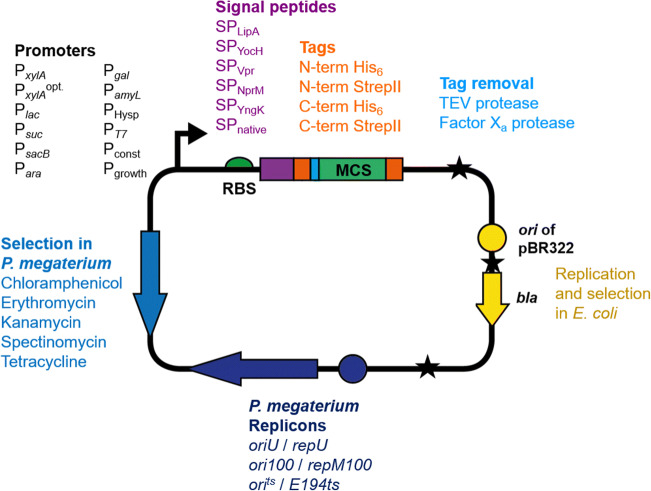
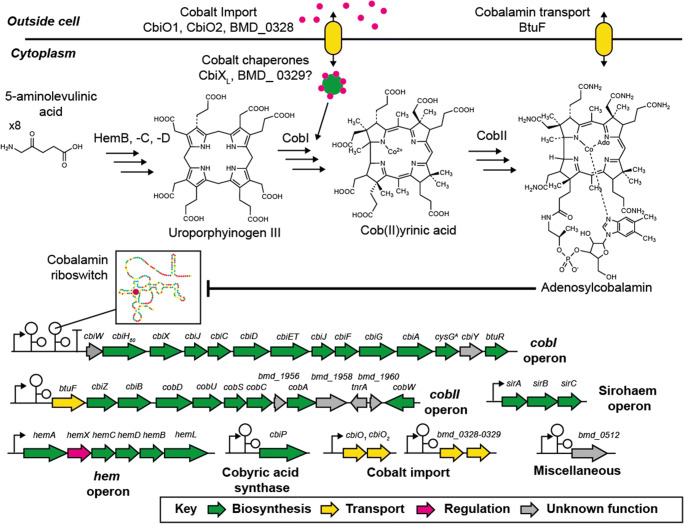
Over 30 years, the Gram-positive bacterium Priestia megaterium (previously known as Bacillus megaterium) was systematically developed for biotechnological applications ranging from the production of small molecules like vitamin B, over polymers like polyhydroxybutyrate (PHB) up to the in vivo and in vitro synthesis of multiple proteins and finally whole-cell applications. Here we describe the use of the natural vitamin B (cobalamin) producer P. megaterium for the elucidation of the biosynthetic pathway and the subsequent systematic knowledge-based development for production purposes. The formation of PHB, a natural product of P. megaterium and potential petro-plastic substitute, is covered and discussed. Further important biotechnological characteristics of P. megaterium for recombinant protein production including high protein secretion capacity and simple cultivation on value-added carbon sources are outlined. This includes the advanced system with almost 30 commercially available expression vectors for the intracellular and extracellular production of recombinant proteins at the g/L scale. We also revealed a novel P. megaterium transcription-translation system as a complementary and versatile biotechnological tool kit. As an impressive biotechnology application, the formation of various cytochrome P450 is also critically highlighted. Finally, whole cellular applications in plant protection are completing the overall picture of P. megaterium as a versatile giant cell factory. KEY POINTS: • The use of Priestia megaterium for the biosynthesis of small molecules and recombinant proteins through to whole-cell applications is reviewed. • P. megaterium can act as a promising alternative host in biotechnological production processes.
30 多年来,革兰氏阳性菌巨芽孢杆菌(以前称为巨大芽孢杆菌)被系统地开发用于生物技术应用,范围从生产小分子如维生素 B 到聚合物如聚羟基丁酸酯(PHB),再到体内和体外合成多种蛋白质,最后是全细胞应用。在这里,我们描述了使用天然维生素 B(钴胺素)生产者巨芽孢杆菌来阐明生物合成途径,并随后进行系统的基于知识的开发以用于生产目的。涵盖并讨论了 PHB 的形成,PHB 是巨芽孢杆菌的天然产物,也是潜在的石油塑料替代品。还概述了巨芽孢杆菌在重组蛋白生产方面的其他重要生物技术特性,包括高蛋白质分泌能力和简单地在增值碳源上培养。这包括具有近 30 种可商购的表达载体的先进系统,用于在克/升规模上进行细胞内和细胞外生产重组蛋白。我们还揭示了一种新型的巨芽孢杆菌转录翻译系统,作为一种互补的多功能生物技术工具包。作为令人印象深刻的生物技术应用,各种细胞色素 P450 的形成也得到了批判性的强调。最后,植物保护中的全细胞应用完成了巨芽孢杆菌作为多功能巨型细胞工厂的整体图景。要点:• 综述了利用巨芽孢杆菌通过全细胞应用合成小分子和重组蛋白的生物合成。• 巨芽孢杆菌可以作为生物技术生产过程中很有前途的替代宿主。