Conservation Ecology Group, Groningen Institute for Evolutionary Life Sciences (GELIFES), University of Groningen, Groningen, The Netherlands.
Alfred Wegener Institute, Helmholtz Centre for Polar and Marine Research, Telegrafenberg, Potsdam, Germany.
Nat Commun. 2021 Aug 6;12(1):4780. doi: 10.1038/s41467-021-25022-7.
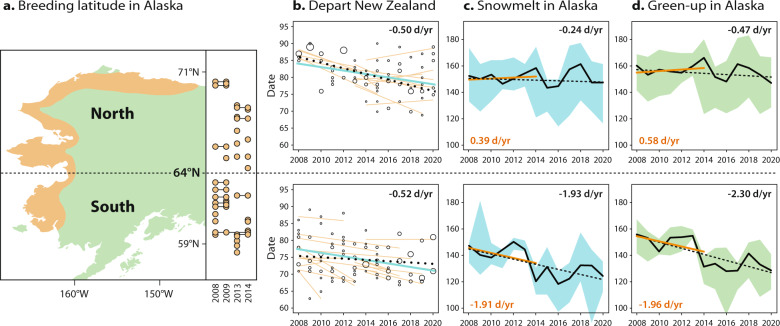
Globally, bird migration is occurring earlier in the year, consistent with climate-related changes in breeding resources. Although often attributed to phenotypic plasticity, there is no clear demonstration of long-term population advancement in avian migration through individual plasticity. Using direct observations of bar-tailed godwits (Limosa lapponica) departing New Zealand on a 16,000-km journey to Alaska, we show that migration advanced by six days during 2008-2020, and that within-individual advancement was sufficient to explain this population-level change. However, in individuals tracked for the entire migration (50 total tracks of 36 individuals), earlier departure did not lead to earlier arrival or breeding in Alaska, due to prolonged stopovers in Asia. Moreover, changes in breeding-site phenology varied across Alaska, but were not reflected in within-population differences in advancement of migratory departure. We demonstrate that plastic responses can drive population-level changes in timing of long-distance migration, but also that behavioral and environmental constraints en route may yet limit adaptive responses to global change.
全球范围内,鸟类的迁徙时间逐年提前,这与繁殖资源的气候变化有关。虽然通常归因于表型可塑性,但在鸟类迁徙的个体可塑性方面,并没有明确证明长期的种群提前。通过对从新西兰出发、飞行 16000 公里前往阿拉斯加的斑尾塍鹬(Limosa lapponica)的直接观察,我们发现 2008 年至 2020 年间,迁徙提前了六天,并且个体内部的提前足以解释这种种群水平的变化。然而,在整个迁徙过程中被跟踪的个体(36 只个体中的 50 条总轨迹)中,由于在亚洲停留时间延长,较早的出发并没有导致更早到达或在阿拉斯加繁殖。此外,阿拉斯加各地繁殖地物候的变化,但并未反映在迁徙出发的种群内提前的差异中。我们证明,可塑性反应可以推动远距离迁徙时间的种群水平变化,但途中的行为和环境限制可能仍然限制了对全球变化的适应性反应。