Tan Jerry, Beissert Stefan, Cook-Bolden Fran, Chavda Rajeev, Harper Julie, Hebert Adelaide, Lain Edward, Layton Alison, Rocha Marco, Weiss Jonathan, Dréno Brigitte
Schulich School of Medicine and Dentistry, Western University Canada, Windsor, Ontario, Canada.
Department of Dermatology, University Hospital Carl Gustav Carus, TU Dresden, Dresden, Germany.
JAAD Int. 2021 Apr 27;3:102-110. doi: 10.1016/j.jdin.2021.03.002. eCollection 2021 Jun.
Acne confers an increased risk of physical, psychiatric, and psychosocial sequelae, potentially affecting multiple dimensions of health-related quality of life (HRQoL). Morbidity associated with truncal acne is poorly understood.
To determine how severity and location of acne lesions impact the HRQoL of those who suffer from it.
A total of 694 subjects with combined facial and truncal acne (F+T) and 615 with facial acne only (F) participated in an online, international survey. Participants self-graded the severity of their acne at different anatomical locations and completed the dermatology life quality index (DLQI).
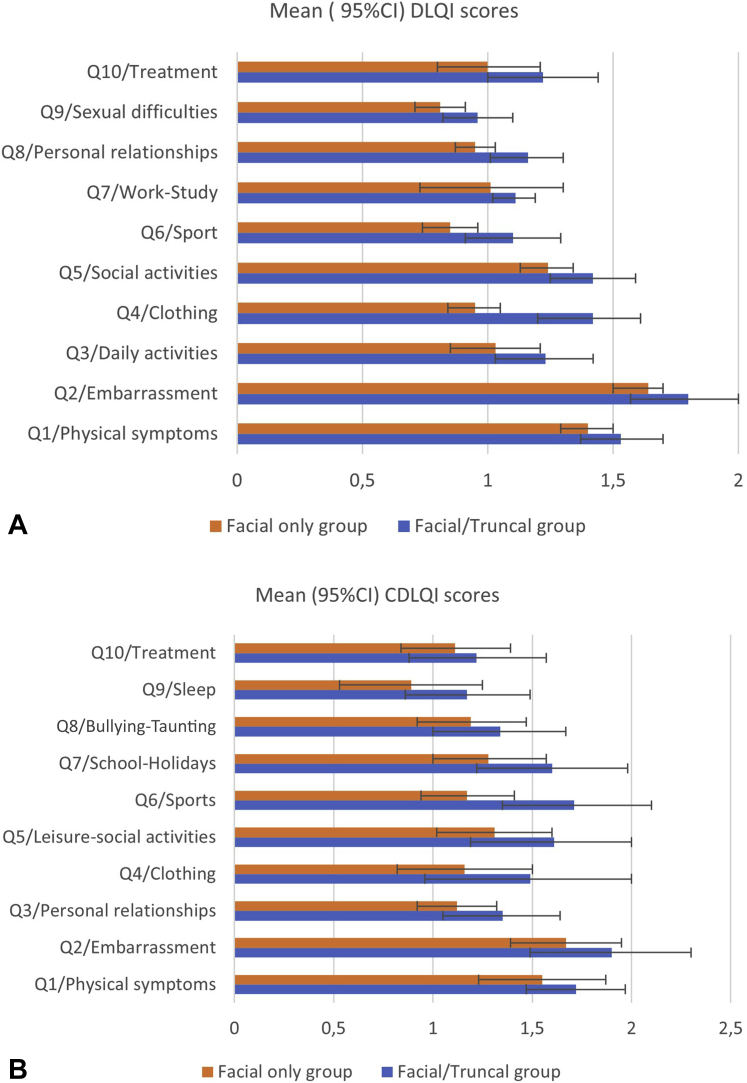
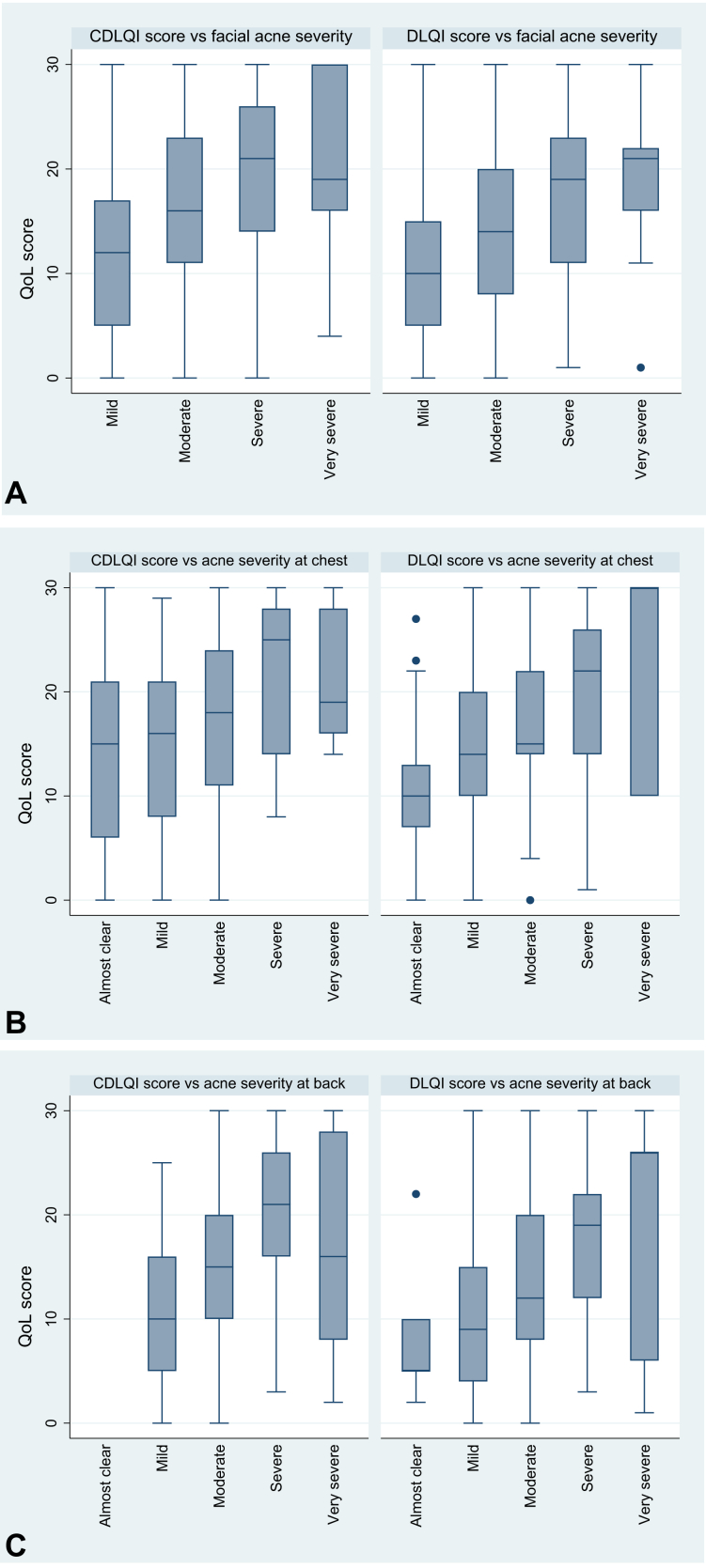
The F+T participants were twice as likely to report "very large" to "extremely large" impact on HRQoL (ie, DLQI > 10 and children's DLQI [CDLQI] > 12) as compared with the F participants (DLQI: odds ratio [OR] 1.61 [95% confidence interval {CI} 1.02-2.54]; CDLQI: OR 1.86 [95% CI 1.10-3.14]). The impact of acne on HRQoL increased with increasing acne severity on the face (DLQI and CDLQI values = .001 and .017, respectively), chest ( = .003; = .008), and back ( = .001; = .028).
Temporal evaluation of acne impact was not estimated.
Facial and truncal acne was associated with a greater impact on HRQoL than facial acne alone. Increasing severity of truncal acne increases the adverse impact on HRQoL irrespective of the severity of facial acne.
痤疮会增加身体、精神和心理社会后遗症的风险,可能会影响健康相关生活质量(HRQoL)的多个维度。人们对躯干痤疮相关的发病率了解甚少。
确定痤疮皮损的严重程度和部位如何影响痤疮患者的HRQoL。
共有694名面部和躯干联合痤疮(F+T)患者和615名单纯面部痤疮(F)患者参与了一项在线国际调查。参与者对不同解剖部位痤疮的严重程度进行自我分级,并完成皮肤病生活质量指数(DLQI)。
与F组参与者相比,F+T组参与者报告对HRQoL有“非常大”至“极其大”影响(即DLQI>10且儿童DLQI [CDLQI]>12)的可能性高出两倍(DLQI:比值比[OR] 1.61 [95%置信区间{CI} 1.02 - 2.54];CDLQI:OR 1.86 [95% CI 1.10 - 3.14])。痤疮对HRQoL的影响随着面部(DLQI和CDLQI值分别为0.001和0.017)、胸部(分别为0.003;0.008)和背部(分别为0.001;0.028)痤疮严重程度的增加而增加。
未评估痤疮影响的时间性。
面部和躯干痤疮对HRQoL的影响比单纯面部痤疮更大。无论面部痤疮的严重程度如何,躯干痤疮严重程度的增加都会增加对HRQoL的不利影响。