, 2224 Walker Road, Suite 300, Windsor, ON, N8W 5L7, Canada.
Department of Dermatology, University Hospital Carl Gustav Carus, TU Dresden, Fetscherstrasse 74, 01307, Dresden, Germany.
Am J Clin Dermatol. 2022 Jan;23(1):115-123. doi: 10.1007/s40257-021-00628-1. Epub 2021 Oct 27.
Acne affects more than 80% of adolescents and young adults, who most often develop acne scars. Supporting data on the effect of acne scars on patient's health-related quality of life (HRQOL) are limited.
The aim was to determine how the severity of acne scars impacts the HRQOL of afflicted individuals.
In this population-based cross-sectional study, 723 adults with facial acne scars but without active acne lesions self-completed the Self-assessment of Clinical Acne-Related Scars (SCARS) questionnaire formulated to investigate degree of acne scarring. The Facial Acne Scar Quality of Life (FASQoL), Dermatology Life Quality Index (DLQI), and Dysmorphic Concern Questionnaire (DCQ) were completed to assess the attitude of these patients toward their scars and the impact of scarring on their HRQOL.
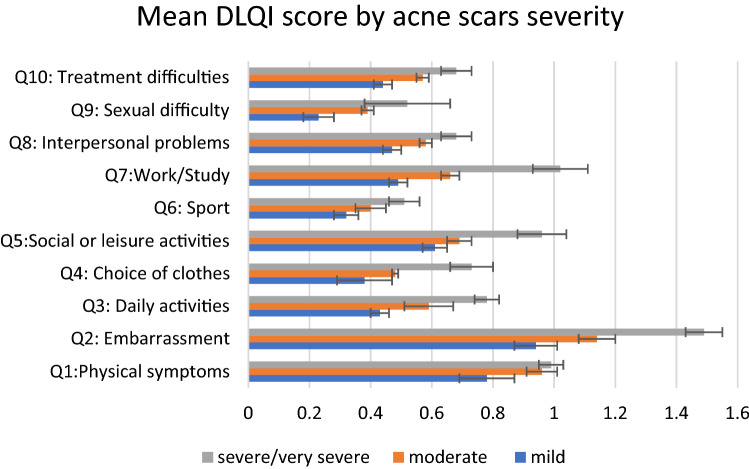
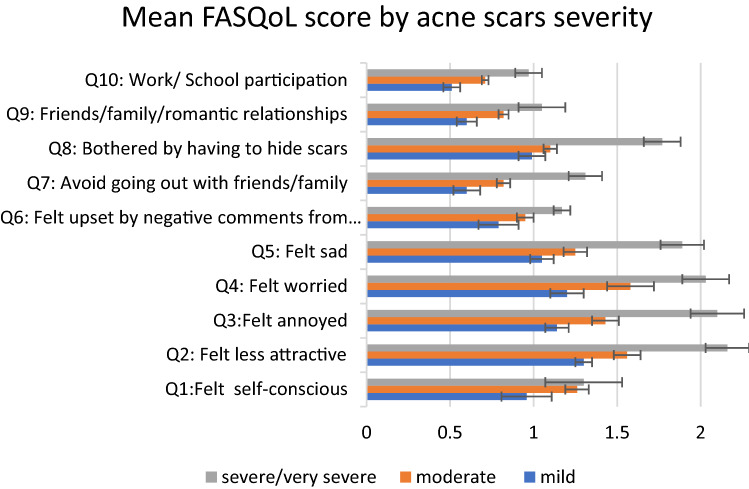
The mean (standard error) DLQI score for facial acne scars was 6.26 (0.22). Acne scars were considered a 'very large' or 'extremely large' concern by 19.3% of participants with mild scars as compared to 20.1% and 34.0% of participants with moderate and severe/very severe scars, respectively (P = 0.003). Higher FASQoL scores were associated with increased severity of scarring (P = 0.001). In total, 16.9% of participants had clinical features of dysmorphia (i.e., DCQ > 13). DCQ scores were significantly higher among participants with more severe scarring (mean DCQ score of 8.04 [0.28], 8.40 [0.18], and 10.13 [0.08] among participants with mild, moderate, and severe/very severe acne scars, respectively; P = 0.001). Most commonly reported signs of emotional distress were self-consciousness (68.0%) and worry about scars not going away (74.8%).
This study highlights the significant psychosocial impact of atrophic acne scars in the form of embarrassment and self-consciousness. Individuals with mild scars also expressed significant impact on quality of life that increased with aggravation of scar severity. Patient-reported outcomes provide an insight into the physical, functional, and psychological impact of acne scarring from the patient's perspective.
痤疮影响超过 80%的青少年和年轻人,他们最常出现痤疮瘢痕。关于痤疮瘢痕对患者健康相关生活质量(HRQOL)影响的支持数据有限。
旨在确定痤疮瘢痕的严重程度如何影响患者的 HRQOL。
在这项基于人群的横断面研究中,723 名患有面部痤疮瘢痕但无活动性痤疮皮损的成年人自行完成了自我评估临床痤疮相关瘢痕(SCARS)问卷,该问卷用于调查痤疮瘢痕的严重程度。完成面部痤疮瘢痕生活质量(FASQoL)、皮肤病生活质量指数(DLQI)和畸形担忧问卷(DCQ),以评估这些患者对其瘢痕的态度以及瘢痕对其 HRQOL 的影响。
面部痤疮瘢痕的平均(标准误差)DLQI 评分为 6.26(0.22)。与轻度瘢痕患者的 20.1%和 34.0%相比,19.3%的轻度瘢痕患者认为痤疮瘢痕是一个“非常大”或“极其大”的问题,分别为中度和重度/极重度瘢痕患者(P=0.003)。FASQoL 评分越高,瘢痕严重程度越高(P=0.001)。共有 16.9%的参与者有畸形的临床特征(即 DCQ>13)。瘢痕越严重,DCQ 评分越高(轻度瘢痕参与者的平均 DCQ 评分为 8.04(0.28),中度瘢痕参与者的平均 DCQ 评分为 8.40(0.18),重度/极重度瘢痕参与者的平均 DCQ 评分为 10.13(0.08);P=0.001)。最常报告的情绪困扰迹象是自我意识(68.0%)和担心疤痕不会消失(74.8%)。
本研究强调了萎缩性痤疮瘢痕的显著心理社会影响,表现为尴尬和自我意识。轻度瘢痕患者的生活质量也受到显著影响,且随着瘢痕严重程度的加重而增加。患者报告的结果提供了从患者角度了解痤疮瘢痕对身体、功能和心理影响的深入了解。