Noor Eye Hospital, Noor Ophthalmology Research Center, Tehran, Iran
Iran University of Medical Sciences, School of Rehabilitation, Department of Optometry, Tehran, Iran
Turk J Ophthalmol. 2021 Aug 27;51(4):199-205. doi: 10.4274/tjo.galenos.2020.52959.
To determine the prevalence of refractive errors and visual impairment in Down syndrome (DS) patients compared to normal controls.
Cycloplegic refraction was tested in 213 DS patients and 184 normal age- and gender-matched controls using autorefraction followed by retinoscopy. Data from the worse eye of each case were used in the analyses.
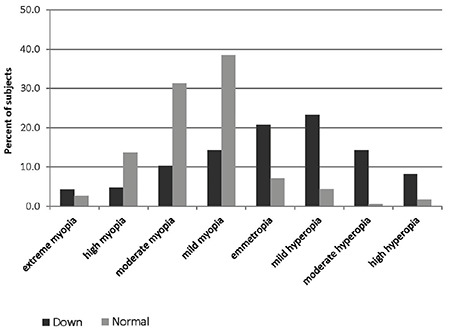
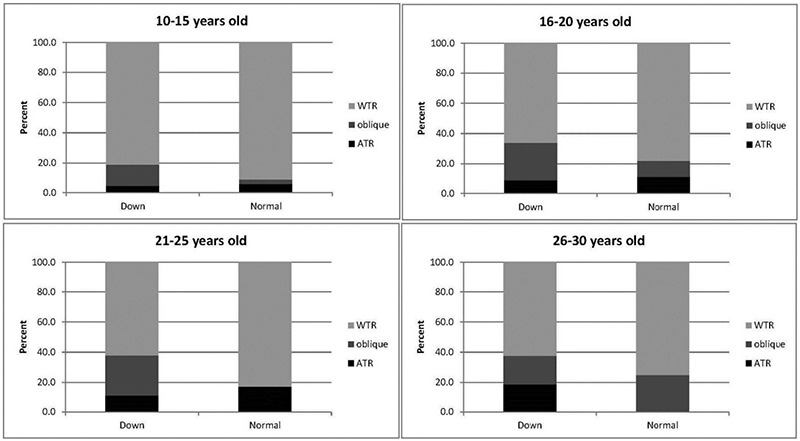
In the DS and control groups, respectively, mean age was 17.2±4.8 and 17.2±4.4 years (p=0.993) and 53.0% and 49.5% were male (p=0.473). In the DS and control groups, respectively, mean spherical equivalent (SE) was -5.13±4.47 and -4.15±3.04 diopters (D) in myopics (p=0.050) and 2.47±1.64 and 2.36±2.04 D in hyperopics (p=0.482), mean cylinder error was -2.17±1.39 and -2.05±1.57 D (p=0.451), mean J0 was -0.03±0.89 and 0.12±0.76 D (p=0.086), and mean J45 was 0.11±1.02 and -0.13±1.03 D (p=0.024). The prevalence of oblique astigmatism was higher in the DS group (20.4% vs. 6.1%) while against-the-rule astigmatism was more prevalent in the control group (84.0% vs. 71.6%) (p<0.001). The prevalence of anisometropia was not significantly different between the groups (19.4% vs. 13.8%). Visual impairment was detected in 11.7% of the DS and 0.5% of the control group (p<0.001). The prevalence of amblyopia was 36.3% and 3.8% in the DS and control groups, respectively (p<0.001). Based on the multiple model, only absolute SE inversely correlated with age and differed between males and females (all p<0.05).
In DS patients, the prevalence rates of refractive errors, amblyopia, and visual impairment are higher than those in non-DS individuals, and emmetropization appears to be either defective or slow. Cylinder error is stable in this age range, but the rotation of astigmatism axis is different from normal samples.
比较唐氏综合征(DS)患者与正常对照者的屈光不正和视力损害患病率。
对 213 例 DS 患者和 184 例年龄和性别匹配的正常对照者进行睫状肌麻痹下的自动折射和视网膜检影验光。对每个病例的较差眼的数据进行分析。
在 DS 和对照组中,平均年龄分别为 17.2±4.8 岁和 17.2±4.4 岁(p=0.993),53.0%和 49.5%为男性(p=0.473)。在 DS 和对照组中,近视者的平均等效球镜(SE)分别为-5.13±4.47 和-4.15±3.04 屈光度(D)(p=0.050),远视者的平均 SE 分别为 2.47±1.64 和 2.36±2.04 D(p=0.482),平均柱镜误差分别为-2.17±1.39 和-2.05±1.57 D(p=0.451),平均 J0 分别为-0.03±0.89 和 0.12±0.76 D(p=0.086),平均 J45 分别为 0.11±1.02 和-0.13±1.03 D(p=0.024)。DS 组的斜轴散光患病率较高(20.4% vs. 6.1%),而逆规散光在对照组中更为常见(84.0% vs. 71.6%)(p<0.001)。两组之间的屈光参差患病率无显著差异(19.4% vs. 13.8%)。DS 组有 11.7%的患者视力损害,对照组为 0.5%(p<0.001)。DS 组和对照组弱视的患病率分别为 36.3%和 3.8%(p<0.001)。基于多元模型,只有绝对 SE 与年龄呈负相关,且在男性和女性之间存在差异(均 p<0.05)。
在 DS 患者中,屈光不正、弱视和视力损害的患病率高于非 DS 个体,且正视化似乎存在缺陷或迟缓。在这个年龄范围内,柱镜误差稳定,但散光轴的旋转与正常样本不同。