Department of Nutrition, Food Science and Physiology/Center for Nutrition Research, Faculty of Pharmacy and Nutrition, University of Navarra, Pamplona, Spain.
Navarra Institute for Health Research (IdiSNA), Pamplona, Spain.
J Physiol Biochem. 2022 May;78(2):485-499. doi: 10.1007/s13105-021-00837-6. Epub 2021 Sep 2.
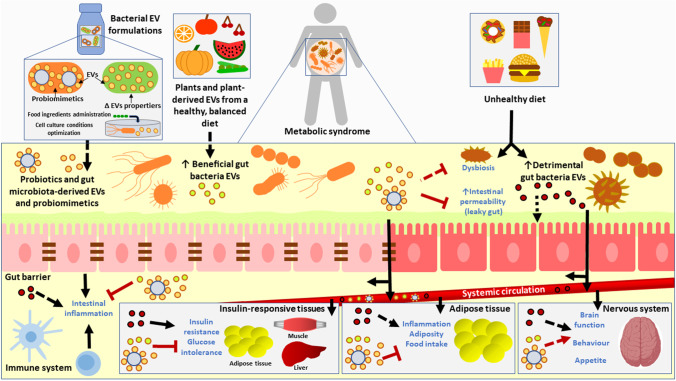
Obesity and diabetes incidence rates are increasing dramatically, reaching pandemic proportions. Therefore, there is an urgent need to unravel the mechanisms underlying their pathophysiology. Of particular interest is the close interconnection between gut microbiota dysbiosis and obesity and diabetes progression. Hence, microbiota manipulation through diet has been postulated as a promising therapeutic target. In this regard, secretion of gut microbiota-derived extracellular vesicles is gaining special attention, standing out as key factors that could mediate gut microbiota-host communication. Extracellular vesicles (EVs) derived from gut microbiota and probiotic bacteria allow to encapsulate a wide range of bioactive molecules (such as/or including proteins and nucleic acids) that could travel short and long distances to modulate important biological functions with the overall impact on the host health. EV-derived from specific bacteria induce differential physiological responses. For example, a high-fat diet-induced increase of the proteobacterium Pseudomonas panacis-derived EV is closely associated with the progression of metabolic dysfunction in mice. In contrast, Akkermansia muciniphila EV are linked with the alleviation of high-fat diet-induced obesity and diabetes in mice. Here, we review the newest pieces of evidence concerning the potential role of gut microbiota and probiotic-derived EV on obesity and diabetes onset, progression, and management, through the modulation of inflammation, metabolism, and gut permeability. In addition, we discuss the role of certain dietary patterns on gut microbiota-derived EV profile and the clinical implication that dietary habits could have on metabolic diseases progression through the shaping of gut microbiota-derived EV.
肥胖和糖尿病的发病率正在急剧上升,达到了流行的程度。因此,迫切需要揭示其病理生理学的机制。特别有趣的是肠道微生物失调与肥胖和糖尿病进展之间的密切联系。因此,通过饮食来操纵微生物群被认为是一种有前途的治疗靶点。在这方面,肠道微生物群衍生的细胞外囊泡的分泌引起了特别的关注,它们是介导肠道微生物群-宿主通讯的关键因素。肠道微生物群和益生菌细菌衍生的细胞外囊泡允许封装广泛的生物活性分子(如/包括蛋白质和核酸),这些分子可以短距离和长距离运输,以调节重要的生物学功能,从而对宿主健康产生整体影响。来自特定细菌的 EV 诱导不同的生理反应。例如,高脂肪饮食诱导的假单胞菌属 Panacis 衍生 EV 的增加与小鼠代谢功能障碍的进展密切相关。相比之下,阿克曼氏菌属 Muciniphila 的 EV 与缓解高脂肪饮食诱导的肥胖和糖尿病有关。在这里,我们回顾了关于肠道微生物群和益生菌衍生的 EV 在肥胖和糖尿病发病、进展和管理中的潜在作用的最新证据,这些 EV 通过调节炎症、代谢和肠道通透性来发挥作用。此外,我们还讨论了某些饮食模式对肠道微生物群衍生 EV 谱的作用,以及饮食习惯通过塑造肠道微生物群衍生 EV 对代谢疾病进展的临床意义。