Molecular Physiology and Biophysics, Vanderbilt University School of Medicine, Nashville, TN.
J Gen Physiol. 2021 Nov 1;153(11). doi: 10.1085/jgp.201711954. Epub 2021 Sep 16.
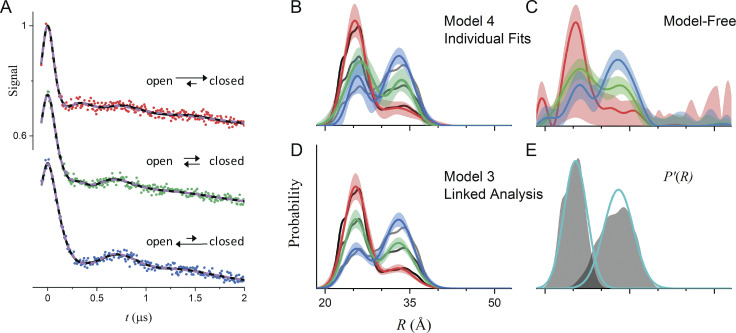
The potential of spin labeling to reveal the dynamic dimension of macromolecules has been recognized since the dawn of the methodology in the 1960s. However, it was the development of pulsed electron paramagnetic resonance spectroscopy to detect dipolar coupling between spin labels and the availability of turnkey instrumentation in the 21st century that realized the full promise of spin labeling. Double electron-electron resonance (DEER) spectroscopy has seen widespread applications to channels, transporters, and receptors. In these studies, distance distributions between pairs of spin labels obtained under different biochemical conditions report the conformational states of macromolecules, illuminating the key movements underlying biological function. These experimental studies have spurred the development of methods for the rigorous analysis of DEER spectroscopic data along with methods for integrating these distributions into structural models. In this tutorial, we describe a model-based approach to obtaining a minimum set of components of the distance distribution that correspond to functionally relevant protein conformations with a set of fractional amplitudes that define the equilibrium between these conformations. Importantly, we review and elaborate on the error analysis reflecting the uncertainty in the various parameters, a critical step in rigorous structural interpretation of the spectroscopic data.
自旋标记技术揭示生物大分子动态维度的潜力自 20 世纪 60 年代该方法问世以来就已被认识到。然而,直到 21 世纪脉冲电子顺磁共振波谱学发展并能够检测自旋标记之间的偶极耦合,以及整套仪器的出现,才真正实现了自旋标记的全部潜力。双电子电子共振(DEER)光谱学已经广泛应用于通道、转运蛋白和受体。在这些研究中,在不同生化条件下获得的自旋标记对之间的距离分布报告了生物大分子的构象状态,揭示了生物功能的关键运动。这些实验研究促进了严格分析 DEER 光谱数据的方法的发展,以及将这些分布集成到结构模型中的方法的发展。在本教程中,我们描述了一种基于模型的方法,用于获得与功能相关的蛋白质构象对应的距离分布的最小组件集,这些构象具有定义这些构象之间平衡的分数幅度。重要的是,我们回顾并详细阐述了反映各种参数不确定性的误差分析,这是对光谱数据进行严格结构解释的关键步骤。