Global Health, School of Public Health and Community Medicine, Institute of Medicine, Sahlgrenska Academy, University of Gothenburg, Gothenburg, Sweden.
Centre for Medicine and Society, Albert-Ludwigs-Universität Freiburg, Freiburg, Germany.
PLoS Negl Trop Dis. 2021 Sep 16;15(9):e0009686. doi: 10.1371/journal.pntd.0009686. eCollection 2021 Sep.
Early warning systems (EWSs) are of increasing importance in the context of outbreak-prone diseases such as chikungunya, dengue, malaria, yellow fever, and Zika. A scoping review has been undertaken for all 5 diseases to summarize existing evidence of EWS tools in terms of their structural and statistical designs, feasibility of integration and implementation into national surveillance programs, and the users' perspective of their applications.
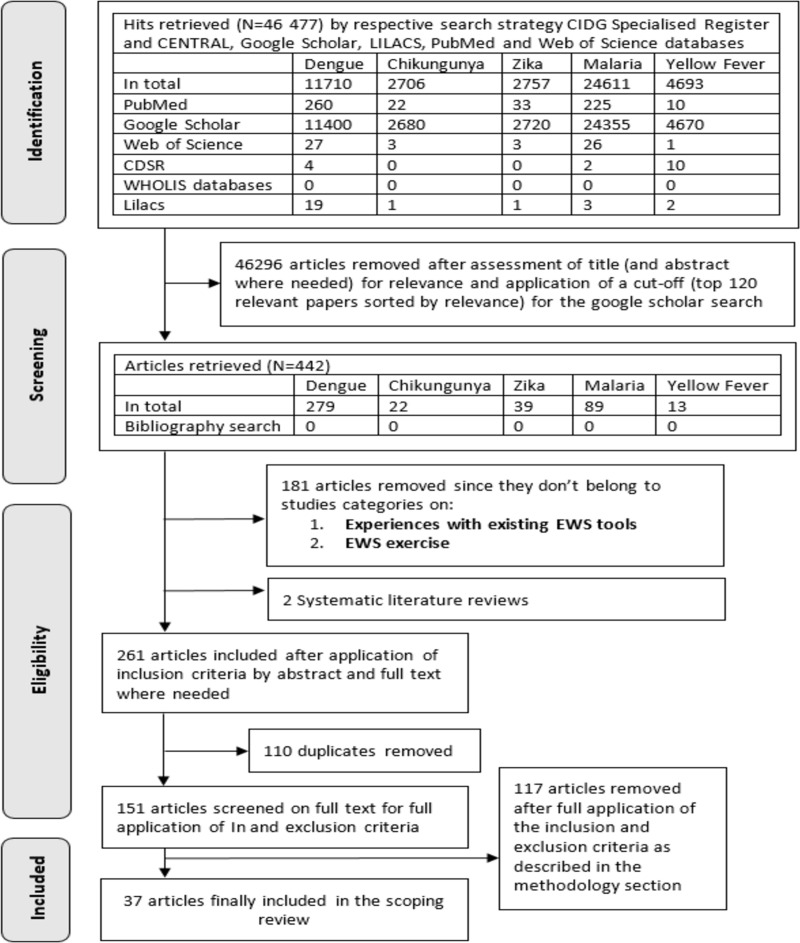
Data were extracted from Cochrane Database of Systematic Reviews (CDSR), Google Scholar, Latin American and Caribbean Health Sciences Literature (LILACS), PubMed, Web of Science, and WHO Library Database (WHOLIS) databases until August 2019. Included were studies reporting on (a) experiences with existing EWS, including implemented tools; and (b) the development or implementation of EWS in a particular setting. No restrictions were applied regarding year of publication, language or geographical area.
Through the first screening, 11,710 documents for dengue, 2,757 for Zika, 2,706 for chikungunya, 24,611 for malaria, and 4,963 for yellow fever were identified. After applying the selection criteria, a total of 37 studies were included in this review. Key findings were the following: (1) a large number of studies showed the quality performance of their prediction models but except for dengue outbreaks, only few presented statistical prediction validity of EWS; (2) while entomological, epidemiological, and social media alarm indicators are potentially useful for outbreak warning, almost all studies focus primarily or exclusively on meteorological indicators, which tends to limit the prediction capacity; (3) no assessment of the integration of the EWS into a routine surveillance system could be found, and only few studies addressed the users' perspective of the tool; (4) almost all EWS tools require highly skilled users with advanced statistics; and (5) spatial prediction remains a limitation with no tool currently able to map high transmission areas at small spatial level.
In view of the escalating infectious diseases as global threats, gaps and challenges are significantly present within the EWS applications. While some advanced EWS showed high prediction abilities, the scarcity of tool assessments in terms of integration into existing national surveillance systems as well as of the feasibility of transforming model outputs into local vector control or action plans tends to limit in most cases the support of countries in controlling disease outbreaks.
在容易爆发的疾病(如基孔肯雅热、登革热、疟疾、黄热病和寨卡病毒)的背景下,预警系统(EWS)的重要性日益增加。对所有 5 种疾病进行了范围界定审查,以总结现有 EWS 工具在结构和统计设计、纳入国家监测计划的可行性以及用户对其应用的看法方面的证据。
从 Cochrane 系统评价数据库(CDSR)、Google Scholar、拉丁美洲和加勒比卫生科学文献(LILACS)、PubMed、Web of Science 和世界卫生组织图书馆数据库(WHOLIS)中提取数据,直至 2019 年 8 月。包括报告(a)现有 EWS 经验的研究,包括实施的工具;以及(b)在特定环境中开发或实施 EWS 的研究。对出版物年份、语言或地理区域没有任何限制。
通过初次筛选,共发现登革热相关文献 11710 篇、寨卡病毒相关文献 2757 篇、基孔肯雅热相关文献 2706 篇、疟疾相关文献 24611 篇和黄热病相关文献 4963 篇。在应用选择标准后,共有 37 项研究纳入本综述。主要研究结果如下:(1)大量研究显示了其预测模型的质量性能,但除了登革热疫情外,几乎没有研究报告 EWS 的统计预测有效性;(2)虽然昆虫学、流行病学和社交媒体警报指标对疫情预警具有潜在的用处,但几乎所有研究主要或专门关注气象指标,这往往限制了预测能力;(3)没有发现评估 EWS 纳入常规监测系统的情况,只有少数研究涉及工具用户的看法;(4)几乎所有 EWS 工具都需要具备高级统计技能的高技能用户;(5)空间预测仍然是一个限制,目前没有工具能够在小空间尺度上绘制高传播区域。
鉴于传染病日益成为全球威胁,预警系统的应用存在明显的差距和挑战。虽然一些先进的 EWS 显示出较高的预测能力,但在将工具纳入现有国家监测系统的评估以及将模型输出转化为地方病媒控制或行动计划的可行性方面,大多数情况下都限制了对国家控制疾病爆发的支持。