National Psychotrauma Center for Children and Youth, University Medical Center Utrecht, Utrecht, The Netherlands.
Department of Social Dentistry and Behavioral Sciences, University of Amsterdam and Vrije Universiteit, Amsterdam, The Netherlands.
Eur J Psychotraumatol. 2021 Sep 9;12(1):1943188. doi: 10.1080/20008198.2021.1943188. eCollection 2021.
About 40% of rape victims develop post-traumatic stress disorder (PTSD) within three months after the assault. Considering the high personal and societal impact of PTSD, there is an urgent need for early (i.e. within three months after the incident) interventions to reduce post-traumatic stress in victims of rape.
To assess the effectiveness of early intervention with eye movement desensitization and reprocessing (EMDR) therapy to reduce symptoms of post-traumatic stress, feelings of guilt and shame, sexual dysfunction, and other psychological dysfunction (i.e. general psychopathology, anxiety, depression, and dissociative symptoms) in victims of rape.
This randomized controlled trial included 57 victims of rape, who were randomly allocated to either two sessions of EMDR therapy or treatment as usual ('watchful waiting') between 14 and 28 days post-rape. Psychological symptoms were assessed at pre-treatment, post-treatment, and 8 and 12 weeks post-rape. Linear mixed models and ANCOVAs were used to analyse differences between conditions over time.
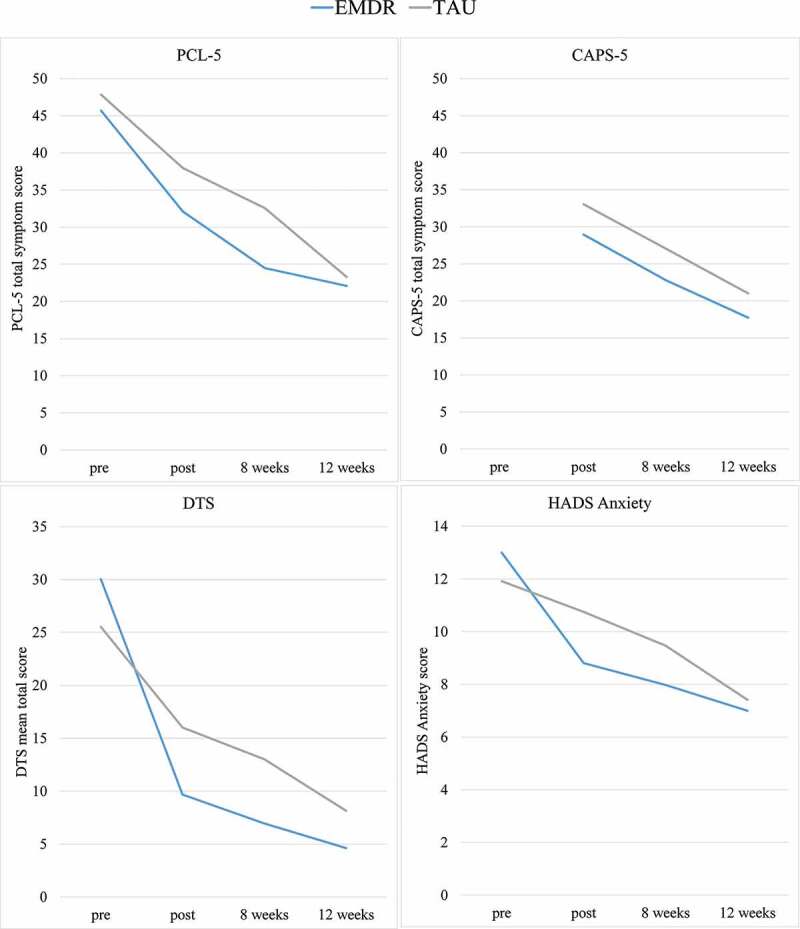
Within-group effect sizes of the EMDR condition ( = 0.89 to 1.57) and control condition ( = 0.79 to 1.54) were large, indicating that both conditions were effective. However, EMDR therapy was not found to be more effective than watchful waiting in reducing post-traumatic stress symptoms, general psychopathology, depression, sexual dysfunction, and feelings of guilt and shame. Although EMDR therapy was found to be more effective than watchful waiting in reducing anxiety and dissociative symptoms in the post-treatment assessment, this effect disappeared over time.
The findings do not support the notion that early intervention with EMDR therapy in victims of rape is more effective than watchful waiting for the reduction of psychological symptoms, including symptoms of post-traumatic stress. Further research on the effectiveness of early interventions, including watchful waiting, for this specific target group is needed.
大约 40%的强奸受害者在袭击后三个月内会出现创伤后应激障碍(PTSD)。鉴于 PTSD 对个人和社会的巨大影响,迫切需要在强奸受害者中进行早期(即在事件发生后三个月内)干预,以减少创伤后应激。
评估眼动脱敏再处理(EMDR)疗法对减少强奸受害者创伤后应激症状、内疚和羞耻感、性功能障碍和其他心理障碍(即一般心理病理学、焦虑、抑郁和分离症状)的早期干预效果。
本随机对照试验纳入了 57 名强奸受害者,他们在强奸后 14 至 28 天内随机分配至两次 EMDR 治疗或常规治疗(“观察等待”)。在治疗前、治疗后以及强奸后 8 周和 12 周评估心理症状。采用线性混合模型和协方差分析比较不同时间条件之间的差异。
EMDR 组( = 0.89 至 1.57)和对照组( = 0.79 至 1.54)的组内效应大小较大,表明两种治疗均有效。然而,EMDR 治疗并未被发现比观察等待更能有效减少创伤后应激症状、一般心理病理学、抑郁、性功能障碍和内疚感。尽管 EMDR 治疗在治疗后评估中被发现比观察等待更能有效减少焦虑和分离症状,但这种效果随时间推移而消失。
这些发现不支持这样一种观点,即强奸受害者的早期 EMDR 治疗比观察等待更能有效减少心理症状,包括创伤后应激症状。需要进一步研究早期干预措施,包括观察等待,对这一特定目标群体的有效性。