Barrafrem Kinga, Tinghög Gustav, Västfjäll Daniel
JEDI Lab, Division of Economics, Department of Management and Engineering, Linköping University, 581 83 Linköping, Sweden.
JEDI Lab, Division of Economics, Department of Management and Engineering, Linköping University, Sweden.
J Behav Exp Finance. 2021 Sep;31:100514. doi: 10.1016/j.jbef.2021.100514. Epub 2021 May 15.
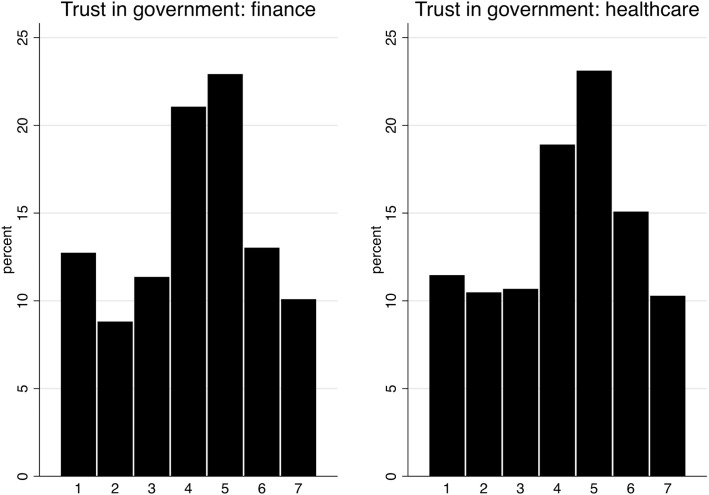
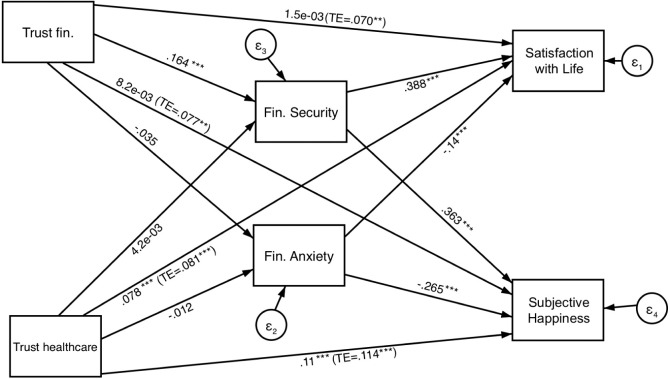
We investigate the antecedents of subjective financial well-being and general well-being during the ongoing COVID-19 pandemic. In an online survey conducted in the midst of COVID-19 pandemic with over 1000 Swedish participants we found that distrust in the government to cope with financial (but not healthcare) challenges of the pandemic was negatively related to the feeling of financial security. In a structural equation model, we also show that trust in government to deal with financial challenges of COVID-19 pandemic has a significant impact on general well-being through the mediating channel of financial well-being. In addition, trust in government to deal with healthcare challenges of COVID-19 pandemic has a significant direct impact on individuals' general well-being. Our findings have important implications for public policy as they highlight the importance of citizens' trust in well-functioning governmental institutions to help cope with not only healthcare, but also financial challenges of an ongoing pandemic.
我们调查了在当前新冠疫情期间主观财务幸福感和总体幸福感的影响因素。在新冠疫情期间对1000多名瑞典参与者进行的一项在线调查中,我们发现,对政府应对疫情财务(而非医疗)挑战的不信任与财务安全感呈负相关。在一个结构方程模型中,我们还表明,对政府应对新冠疫情财务挑战的信任通过财务幸福感这一中介渠道对总体幸福感有显著影响。此外,对政府应对新冠疫情医疗挑战的信任对个人的总体幸福感有显著的直接影响。我们的研究结果对公共政策具有重要意义,因为它们凸显了公民对运作良好的政府机构的信任不仅有助于应对医疗挑战,也有助于应对当前疫情的财务挑战的重要性。