Liu Hao, Mei Yijun, Zhao Qingqing, Zhang Aining, Tang Lu, Gao Hongbin, Wang Wei
Department of Pharmacy, Guangdong Food and Drug Vocational College, Guangzhou 510520, China.
State Key Laboratory of Natural Medicines, Department of Pharmaceutics, School of Pharmacy, China Pharmaceutical University, Nanjing 210009, China.
Pharmaceutics. 2021 Aug 27;13(9):1344. doi: 10.3390/pharmaceutics13091344.
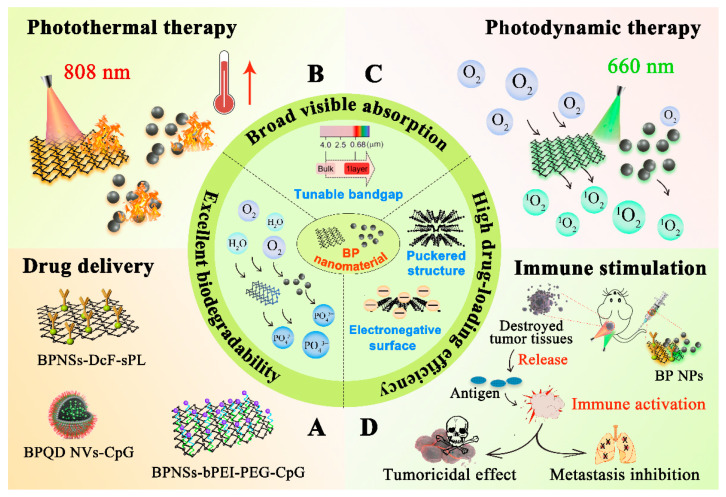
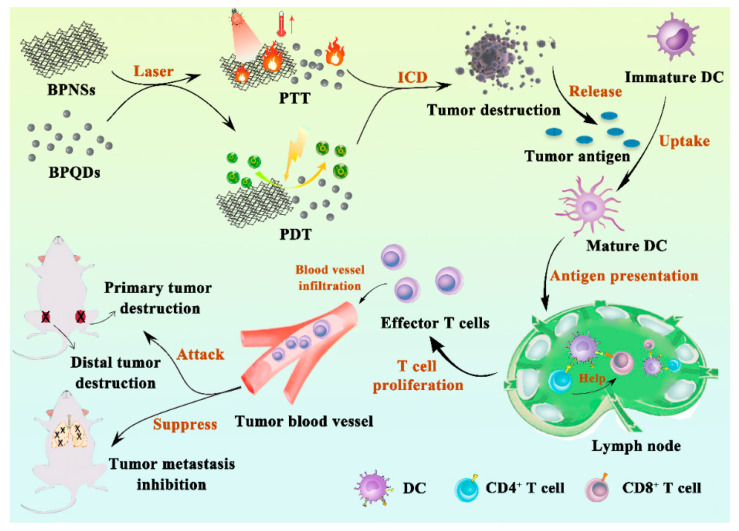
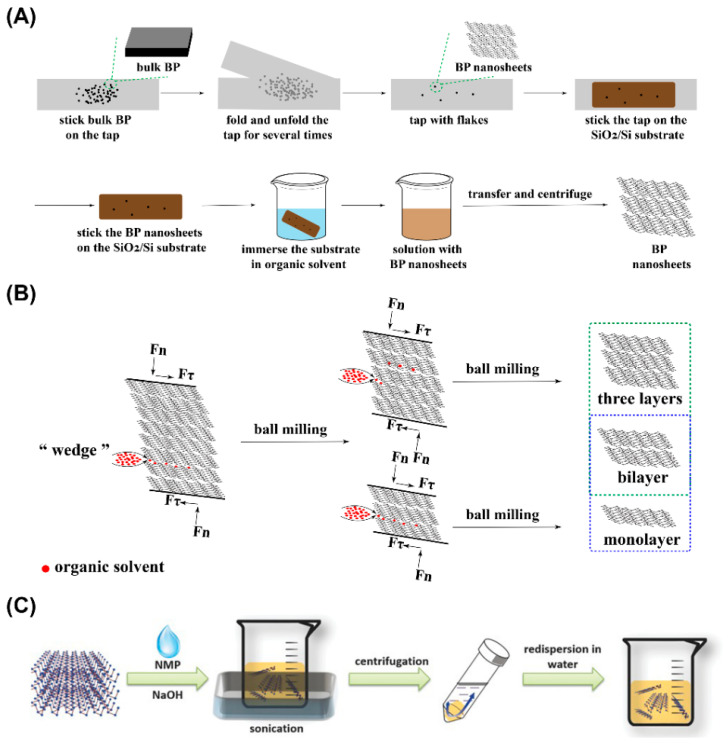
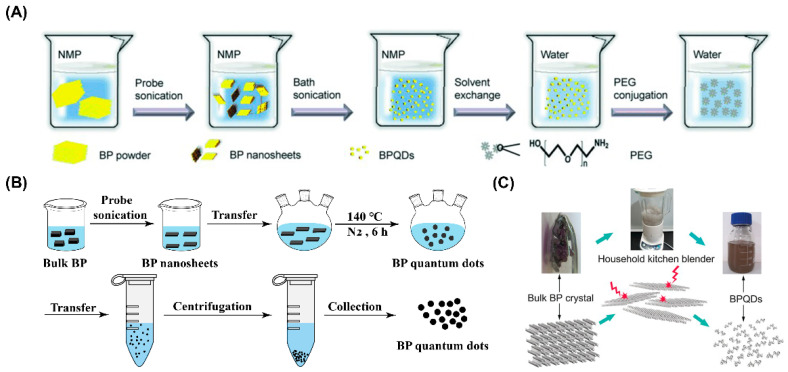
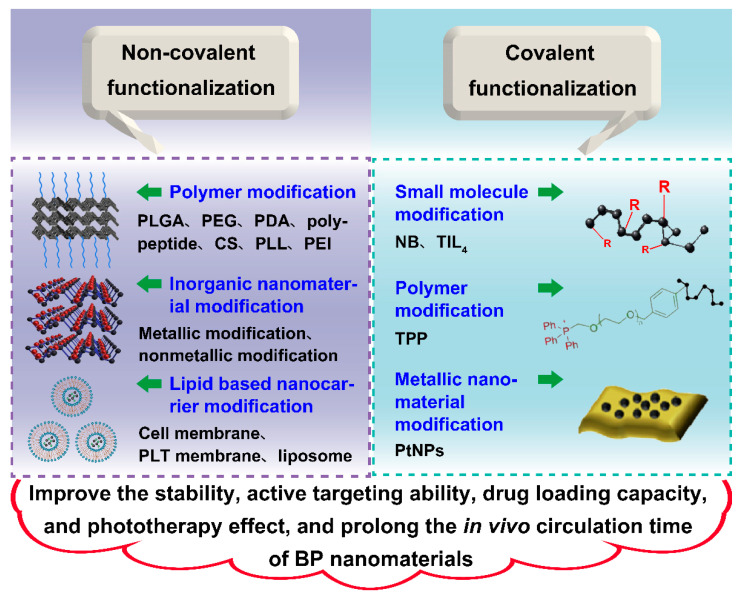
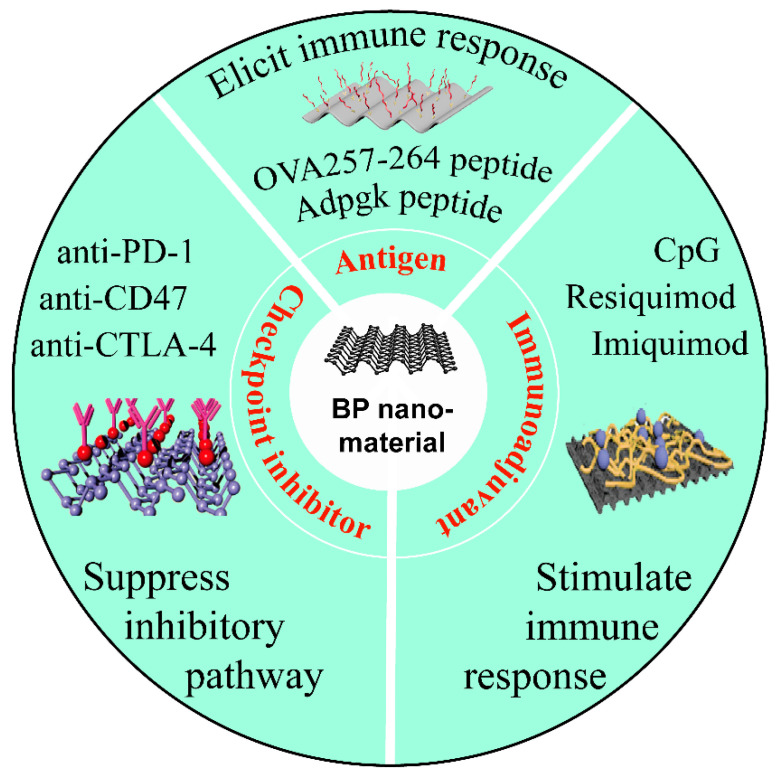
Black phosphorus (BP) is one of the emerging versatile nanomaterials with outstanding biocompatibility and biodegradability, exhibiting great potential as a promising inorganic nanomaterial in the biomedical field. BP nanomaterials possess excellent ability for valid bio-conjugation and molecular loading in anticancer therapy. Generally, BP nanomaterials can be classified into BP nanosheets (BPNSs) and BP quantum dots (BPQDs), both of which can be synthesized through various preparation routes. In addition, BP nanomaterials can be applied as photothermal agents (PTA) for the photothermal therapy (PTT) due to their high photothermal conversion efficiency and larger extinction coefficients. The generated local hyperpyrexia leads to thermal elimination of tumor. Besides, BP nanomaterials are capable of producing singlet oxygen, which enable its application as a photosensitizer for photodynamic therapy (PDT). Moreover, BP nanomaterials can be oxidized and degraded to nontoxic phosphonates and phosphate under physiological conditions, improving their safety as a nano drug carrier in cancer therapy. Recently, it has been reported that BP-based PTT is capable of activating immune responses and alleviating the immunosuppressive tumor microenvironment by detection of T lymphocytes and various immunocytokines, indicating that BP-based nanocomposites not only serve as effective PTAs to ablate large solid tumors but also function as an immunomodulation agent to eliminate discrete tumorlets. Therefore, BP-mediated immunotherapy would provide more possibilities for synergistic cancer treatment.
黑磷(BP)是一种新兴的多功能纳米材料,具有出色的生物相容性和生物降解性,作为一种有前途的无机纳米材料在生物医学领域展现出巨大潜力。BP纳米材料在抗癌治疗中具有出色的生物共轭和分子负载能力。一般来说,BP纳米材料可分为BP纳米片(BPNSs)和BP量子点(BPQDs),两者均可通过多种制备途径合成。此外,BP纳米材料因其高光热转换效率和较大的消光系数,可作为光热剂(PTA)用于光热治疗(PTT)。产生的局部高热导致肿瘤的热消融。此外,BP纳米材料能够产生单线态氧,使其能够作为光动力治疗(PDT)的光敏剂应用。此外,BP纳米材料在生理条件下可被氧化降解为无毒的膦酸盐和磷酸盐,提高了其作为癌症治疗纳米药物载体的安全性。最近有报道称,基于BP的PTT能够通过检测T淋巴细胞和各种免疫细胞因子激活免疫反应并缓解免疫抑制性肿瘤微环境,这表明基于BP的纳米复合材料不仅可作为有效的PTA来消融大型实体瘤,还可作为免疫调节剂来消除离散的小肿瘤。因此,BP介导的免疫疗法将为协同癌症治疗提供更多可能性。