Department of Arbovirology, Bernhard Nocht Institute for Tropical Medicine, 20359 Hamburg, Germany.
Institute for Parasitology, Center for Infection Medicine, University of Veterinary Medicine Hannover, 30559 Hanover, Germany.
Viruses. 2021 Aug 27;13(9):1702. doi: 10.3390/v13091702.
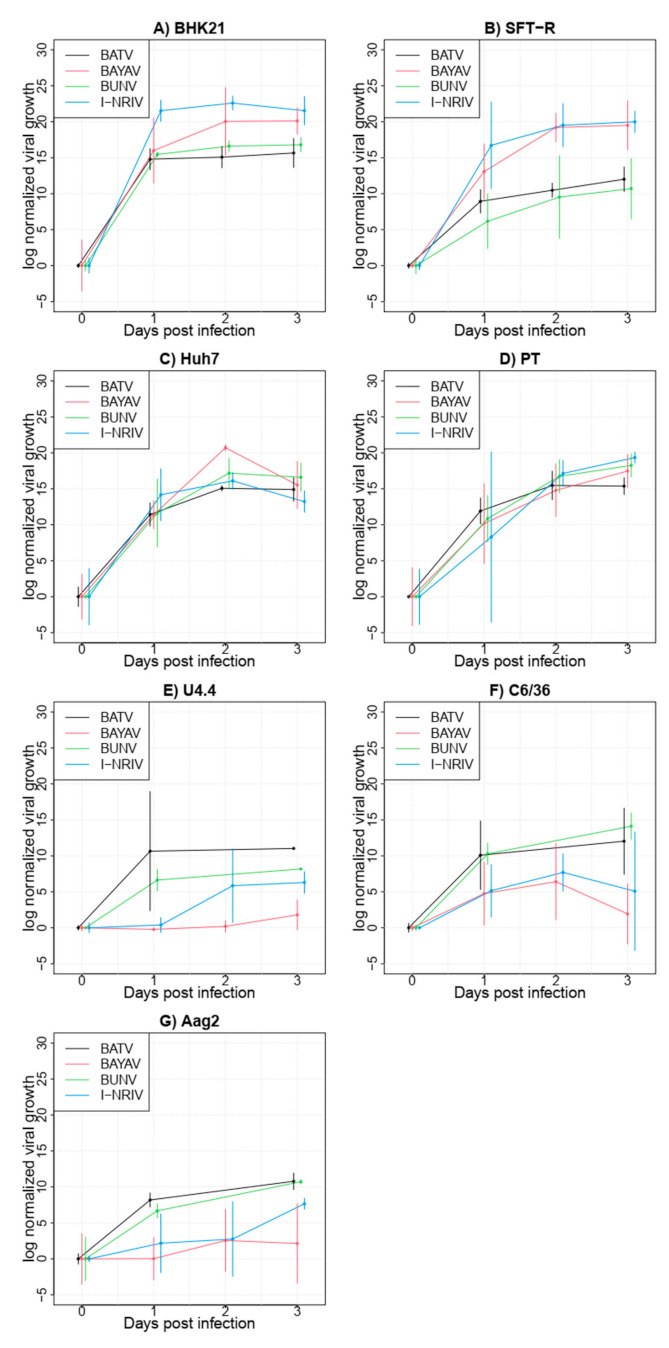
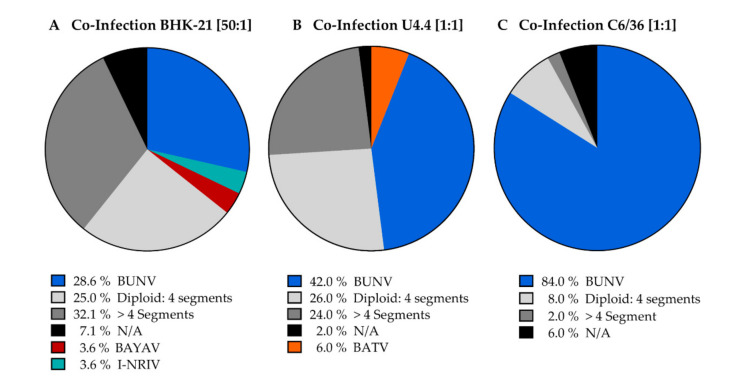
Reassortment is a viral genome-segment recomposition known for many viruses, including the orthobunyaviruses. The co-infection of a host cell with two viruses of the same serogroup, such as the and the can give rise to novel viruses. One example is the Ngari virus, which has caused major outbreaks of human infections in Central Africa. This study aimed to investigate the potential for reassortment of and the during co-infection studies and the replication properties of the reassortants in different mammalian and insect cell lines. In the co-infection studies, a Ngari-like virus reassortant and a novel reassortant virus, the Batunya virus, arose in BHK-21 cells (). In contrast, no reassortment was observed in the examined insect cells from (Aag2) and (U4.4 and C6/36). The growth kinetic experiments show that both reassortants are replicated to higher titers in some mammalian cell lines than the parental viruses but show impaired growth in insect cell lines.
重配是一种病毒基因组片段重组,许多病毒都存在这种现象,包括正粘病毒。当同一血清群的两种病毒同时感染宿主细胞时,可能会产生新的病毒。例如,纳里病毒已导致中非地区发生了多起人类感染的重大疫情。本研究旨在探讨在共感染研究中 和 之间发生重配的可能性,以及重组病毒在不同哺乳动物和昆虫细胞系中的复制特性。在共感染研究中,一种类似纳里病毒的重组病毒和一种新的重组病毒——蝙蝠尼亚病毒,在 BHK-21 细胞()中出现。相比之下,在 examined insect cells 中没有观察到重组现象,这些昆虫细胞来自(Aag2)和(U4.4 和 C6/36)。生长动力学实验表明,与亲本病毒相比,两种重组病毒在一些哺乳动物细胞系中的复制滴度更高,但在昆虫细胞系中的生长能力受损。