Haruna Hussein, Okoye Kingsley, Zainuddin Zamzami, Hu Xiao, Chu Samuel, Hosseini Samira
Writing Lab, Institute for the Future of Education, Tecnologico de Monterrey, Monterrey, Mexico.
Faculty of Education, The University of Hong Kong, Hong Kong, Hong Kong.
JMIR Serious Games. 2021 Oct 12;9(4):e19614. doi: 10.2196/19614.
Sexual education has become increasingly important as unhealthy sexual practices and subsequent health risks become more prevalent during adolescence. Traditional sex education teaching methodologies are limiting for digital natives exposed to various digital technologies. Harnessing the power of technology applications attractive to the younger generation may be a useful approach for teaching sex education.
The aim of this study was to improve sexual health knowledge and understanding of the problems associated with unhealthy sexual practices and address sexual and reproductive health challenges experienced in a low-tech setting.
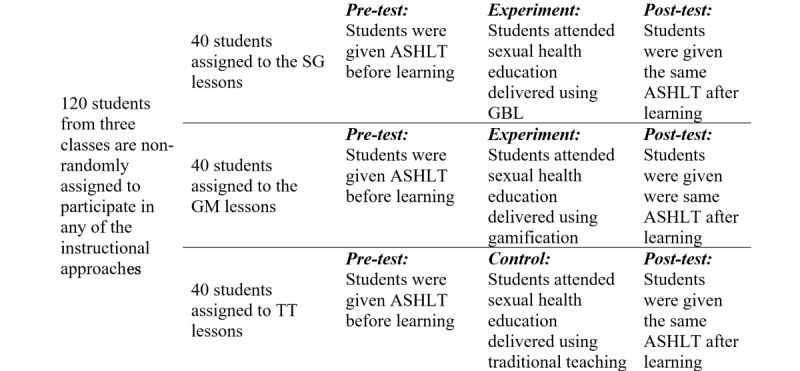
A participatory design approach was used to develop the digital gamified methodology. A sample of 120 secondary school students aged 11-15 were randomly assigned to either experimental or control group for each of the 3 teaching approaches: (1) gamified instruction (actual serious games [SG] in teaching); (2) gamification (GM; making nongames, such as game-like learning); and (3) traditional teaching (TT) methods.
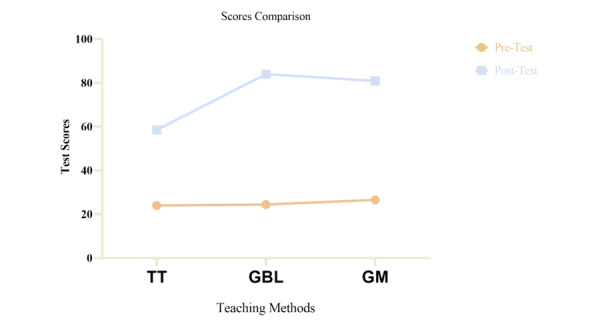
The SG and GM approaches were more effective than TT methods in teaching sexual health education. Specifically, the average scores across groups demonstrated an increase of mean scores from the pre- to posttest (25.10 [SD 5.50] versus 75.86 [SD 13.16]; t=41.252; P<.001 [2 tailed]). Analysis of variance indicated no significant differences across groups for pretest scores (F=1.048, P=.35). Significant differences across groups were evident in the posttest scores. Students in the SG and GM groups had higher average scores than the TT group (F=83.98; P<.001). Students reported increased learning motivation, attitude, know-how, and participation in learning (P<.001) when using SG and GM approaches.
Digital health technologies (particularly teaching and learning through gamified instruction and other novel approaches) may improve sexual health education. These findings may also be applied by practitioners in health care settings and by researchers wishing to further the development of sex education.
随着不健康的性行为及其后续健康风险在青少年时期愈发普遍,性教育变得越来越重要。传统的性教育教学方法对于接触各种数字技术的数字原住民来说具有局限性。利用对年轻一代有吸引力的技术应用的力量可能是一种有效的性教育教学方法。
本研究的目的是提高性健康知识,增进对与不健康性行为相关问题的理解,并应对在低技术环境中遇到的性与生殖健康挑战。
采用参与式设计方法来开发数字游戏化方法。120名年龄在11至15岁的中学生样本被随机分配到三种教学方法中的实验组或对照组:(1)游戏化教学(在教学中使用实际的严肃游戏[SG]);(2)游戏化(GM;将非游戏内容,如类游戏学习);以及(3)传统教学(TT)方法。
在性健康教育教学中,SG和GM方法比TT方法更有效。具体而言,各组的平均分数显示从测试前到测试后的平均分数有所增加(25.10[标准差5.50]对75.86[标准差13.16];t = 41.252;P <.001[双侧])。方差分析表明,测试前分数在各组之间没有显著差异(F = 1.048,P =.35)。测试后分数在各组之间存在显著差异。SG组和GM组的学生平均分数高于TT组(F = 83.98;P <.001)。学生报告说,使用SG和GM方法时,学习动机、态度、技能和学习参与度有所提高(P <.001)。
数字健康技术(特别是通过游戏化教学和其他新颖方法进行教学和学习)可能会改善性健康教育。这些发现也可供医疗保健环境中的从业者以及希望进一步发展性教育的研究人员应用。