Department of Population Medicine, University of Guelph, Guelph, Canada.
Munk School of Global Affairs & Public Policy, University of Toronto, Toronto, Canada.
BMC Public Health. 2021 Nov 8;21(1):2040. doi: 10.1186/s12889-021-12080-1.
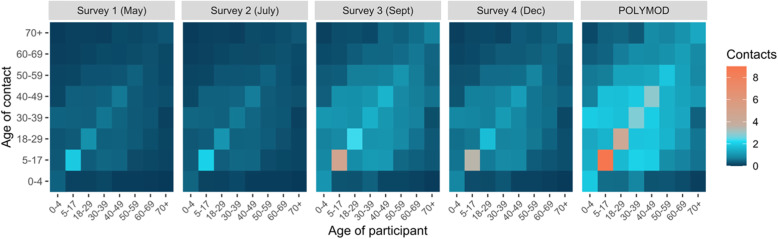
A variety of public health measures have been implemented during the COVID-19 pandemic in Canada to reduce contact between individuals. The objective of this study was to provide empirical contact pattern data to evaluate the impact of public health measures, the degree to which social contacts rebounded to normal levels, as well as direct public health efforts toward age- and location-specific settings.
Four population-based cross-sectional surveys were administered to members of a paid panel representative of Canadian adults by age, gender, official language, and region of residence during May (Survey 1), July (Survey 2), September (Survey 3), and December (Survey 4) 2020. A total of 4981 (Survey 1), 2493 (Survey 2), 2495 (Survey 3), and 2491 (Survey 4) respondents provided information about the age and setting for each direct contact made in a 24-h period. Contact matrices were constructed and contacts for those under the age of 18 years imputed. The next generation matrix approach was used to estimate the reproduction number (R) for each survey. Respondents with children under 18 years estimated the number of contacts their children made in school and extracurricular settings.
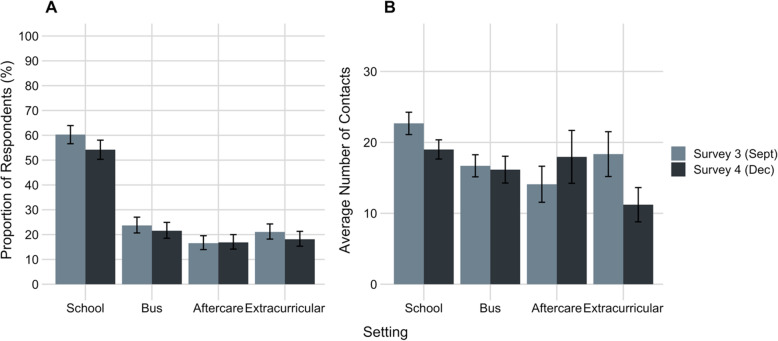
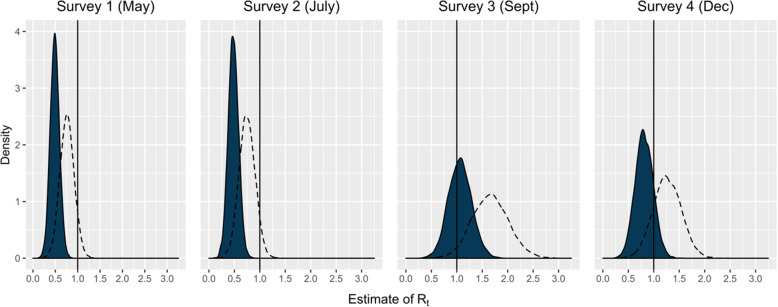
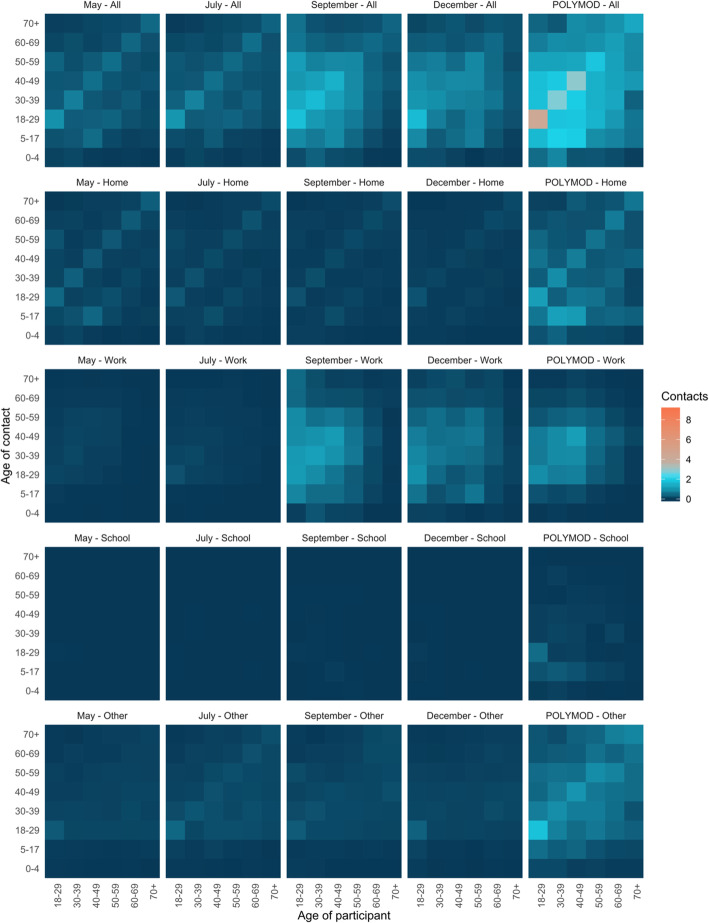
Estimated R values were 0.49 (95% CI: 0.29-0.69) for May, 0.48 (95% CI: 0.29-0.68) for July, 1.06 (95% CI: 0.63-1.52) for September, and 0.81 (0.47-1.17) for December. The highest proportion of reported contacts occurred within the home (51.3% in May), in 'other' locations (49.2% in July) and at work (66.3 and 65.4% in September and December). Respondents with children reported an average of 22.7 (95% CI: 21.1-24.3) (September) and 19.0 (95% CI 17.7-20.4) (December) contacts at school per day per child in attendance.
The skewed distribution of reported contacts toward workplace settings in September and December combined with the number of reported school-related contacts suggest that these settings represent important opportunities for transmission emphasizing the need to support and ensure infection control procedures in both workplaces and schools.
在加拿大 COVID-19 大流行期间,实施了各种公共卫生措施,以减少个人之间的接触。本研究的目的是提供经验接触模式数据,以评估公共卫生措施的影响,社会接触反弹到正常水平的程度,以及针对特定年龄和地点的直接公共卫生努力。
在 2020 年 5 月(调查 1)、7 月(调查 2)、9 月(调查 3)和 12 月(调查 4)期间,通过年龄、性别、官方语言和居住地区对付费小组的加拿大成年人代表进行了四次基于人群的横断面调查。共有 4981 名(调查 1)、2493 名(调查 2)、2495 名(调查 3)和 2491 名(调查 4)受访者提供了在 24 小时内与每个直接接触者的年龄和地点信息。构建了接触矩阵,并对 18 岁以下的接触者进行了推断。下一代矩阵方法用于估计每个调查的繁殖数(R)。有 18 岁以下儿童的受访者估计了他们的孩子在学校和课外活动中的接触次数。
5 月估计的 R 值为 0.49(95%CI:0.29-0.69),7 月为 0.48(95%CI:0.29-0.68),9 月为 1.06(95%CI:0.63-1.52),12 月为 0.81(0.47-1.17)。报告的接触者中,在家中的比例最高(5 月为 51.3%),在“其他”地点(7 月为 49.2%)和工作场所(9 月和 12 月为 66.3%和 65.4%)。有孩子的受访者报告说,每天平均每个上学的孩子有 22.7(95%CI:21.1-24.3)(9 月)和 19.0(95%CI 17.7-20.4)(12 月)在学校接触。
9 月和 12 月报告的接触者向工作场所设置的倾斜分布加上报告的与学校相关的接触数量表明,这些设置代表了重要的传播机会,强调需要支持和确保工作场所和学校的感染控制程序。