Africa Centres for Disease Control and Prevention, Addis Ababa, Ethiopia.
Redeemer's University, Ede, Nigeria.
Nat Rev Immunol. 2021 Dec;21(12):823-828. doi: 10.1038/s41577-021-00640-w. Epub 2021 Oct 25.
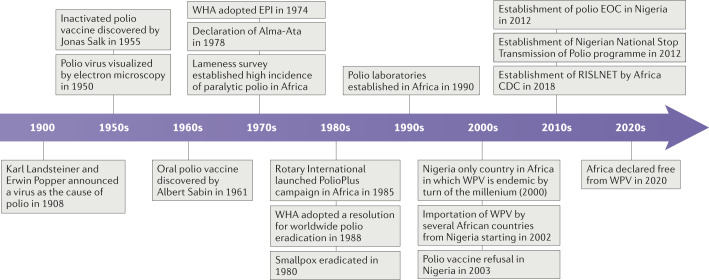
In August 2020, Africa was declared free of poliomyelitis (polio), bringing to fruition a goal that took more than 30 years to achieve. This Perspective chronicles global, continental, national and community actions taken by diverse stakeholders that finally led to the elimination of transmission of wild poliovirus in Africa. The cascade of events started with the development of polio vaccines and the realization that polio, much like smallpox, could be eradicated. After a 1988 pledge by the World Health Assembly to eradicate polio globally, concerted and deliberate efforts were made in Africa to achieve this goal. This included the use of evidence-based approaches for the harmonization and standardization of public health strategies, using a network of polio laboratories and emergency operation centres and actively pursuing underserved populations. Innovative solutions to counter challenges such as conflict and vaccine hesitancy may be of use in future public health interventions.
2020 年 8 月,非洲宣布消灭脊髓灰质炎(脊灰),实现了这一目标,这一目标历经 30 多年才得以实现。本文记录了全球、非洲大陆、国家和社区的各种利益攸关方为消除非洲野生脊灰病毒传播而采取的行动,最终促成了这一目标的实现。这一系列事件始于脊灰疫苗的开发,以及脊灰像天花一样可以被消灭这一认识。世界卫生大会于 1988 年承诺在全球消灭脊灰后,非洲为实现这一目标做出了协调一致的深思熟虑的努力。这包括采用循证方法协调和标准化公共卫生战略,利用脊灰实验室和应急行动中心网络,并积极关注服务不足的人群。解决冲突和疫苗犹豫等挑战的创新解决方案可能对未来的公共卫生干预措施有用。