Teodoro Arthur A M, Silva Douglas H, Saadi Muhammad, Okey Ogobuchi D, Rosa Renata L, Otaibi Sattam Al, Rodríguez Demóstenes Z
Department of Computer Science, Federal University of Lavras, Lavras, MG Brazil.
Department of Electrical Engineering, University of Central Punjab, Lahore, 54000 Pakistan.
J Signal Process Syst. 2023;95(2-3):101-113. doi: 10.1007/s11265-021-01714-7. Epub 2021 Nov 8.
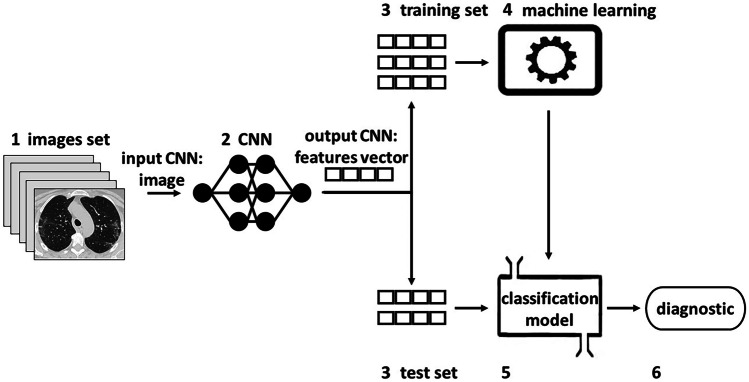
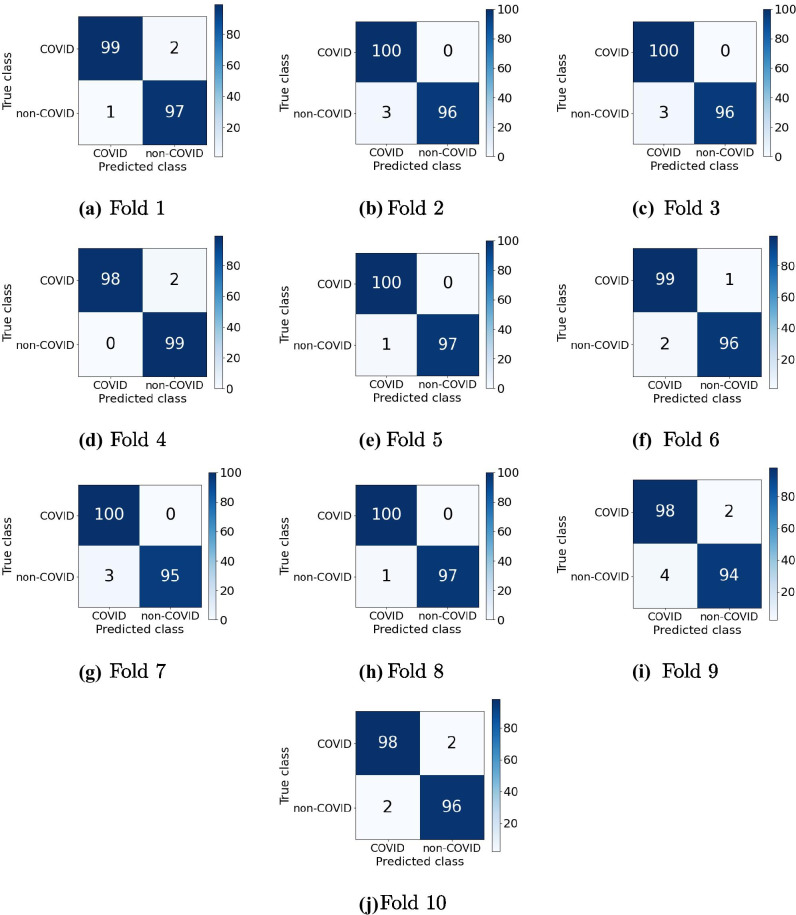
The SARS-CoV-2 virus causes a respiratory disease in humans, known as COVID-19. The confirmatory diagnostic of this disease occurs through the real-time reverse transcription and polymerase chain reaction test (RT-qPCR). However, the period of obtaining the results limits the application of the mass test. Thus, chest X-ray computed tomography (CT) images are analyzed to help diagnose the disease. However, during an outbreak of a disease that causes respiratory problems, radiologists may be overwhelmed with analyzing medical images. In the literature, some studies used feature extraction techniques based on CNNs, with classification models to identify COVID-19 and non-COVID-19. This work compare the performance of applying pre-trained CNNs in conjunction with classification methods based on machine learning algorithms. The main objective is to analyze the impact of the features extracted by CNNs, in the construction of models to classify COVID-19 and non-COVID-19. A SARS-CoV-2 CT data-set is used in experimental tests. The CNNs implemented are visual geometry group (VGG-16 and VGG-19), inception V3 (IV3), and EfficientNet-B0 (EB0). The classification methods were k-nearest neighbor (KNN), support vector machine (SVM), and explainable deep neural networks (xDNN). In the experiments, the best results were obtained by the EfficientNet model used to extract data and the SVM with an RBF kernel. This approach achieved an average performance of 0.9856 in the precision macro, 0.9853 in the sensitivity macro, 0.9853 in the specificity macro, and 0.9853 in the F1 score macro.
严重急性呼吸综合征冠状病毒2(SARS-CoV-2)病毒会引发人类的一种呼吸道疾病,即2019冠状病毒病(COVID-19)。该疾病的确诊诊断通过实时逆转录聚合酶链反应检测(RT-qPCR)进行。然而,获取结果的时间限制了大规模检测的应用。因此,会对胸部X线计算机断层扫描(CT)图像进行分析以辅助疾病诊断。然而,在引发呼吸道问题的疾病爆发期间,放射科医生可能会因分析医学图像而不堪重负。在文献中,一些研究使用了基于卷积神经网络(CNN)的特征提取技术以及分类模型来识别COVID-19和非COVID-19。这项工作比较了应用预训练的CNN结合基于机器学习算法的分类方法的性能。主要目的是分析CNN提取的特征在构建用于对COVID-19和非COVID-19进行分类的模型中的影响。在实验测试中使用了一个SARS-CoV-2 CT数据集。所实现的CNN包括视觉几何组(VGG-16和VGG-19)、Inception V3(IV3)和EfficientNet-B0(EB0)。分类方法有k近邻(KNN)、支持向量机(SVM)和可解释深度神经网络(xDNN)。在实验中,用于提取数据的EfficientNet模型和带有径向基函数(RBF)核的SVM取得了最佳结果。这种方法在宏精度上的平均性能为0.9856,宏敏感度为0.9853,宏特异性为0.9853,宏F1分数为0.9853。