Tecnológico de Monterrey, School of Engineering and Sciences, Campus Querétaro, Av. Epigmenio González, No. 500 Fracc. San Pablo, CP 76130 Querétaro, México.
Tecnológico de Monterrey, School of Engineering and Sciences, Campus Querétaro, Av. Epigmenio González, No. 500 Fracc. San Pablo, CP 76130 Querétaro, México.
Virus Res. 2022 Jan 15;308:198631. doi: 10.1016/j.virusres.2021.198631. Epub 2021 Nov 14.
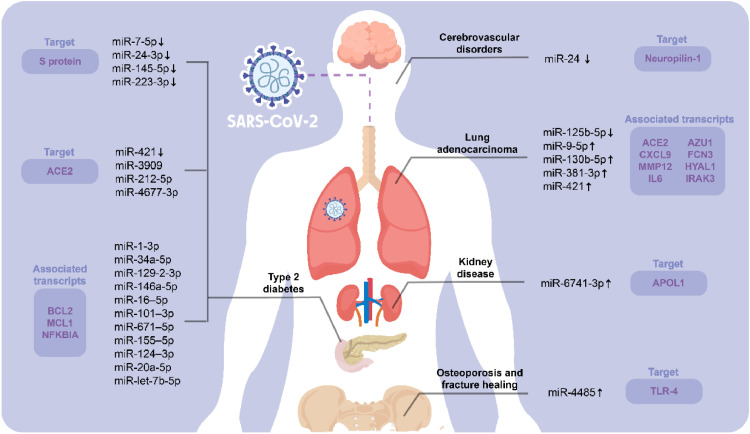
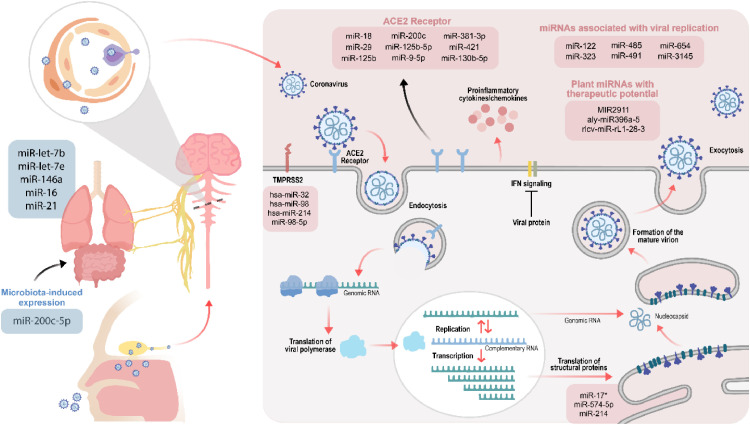
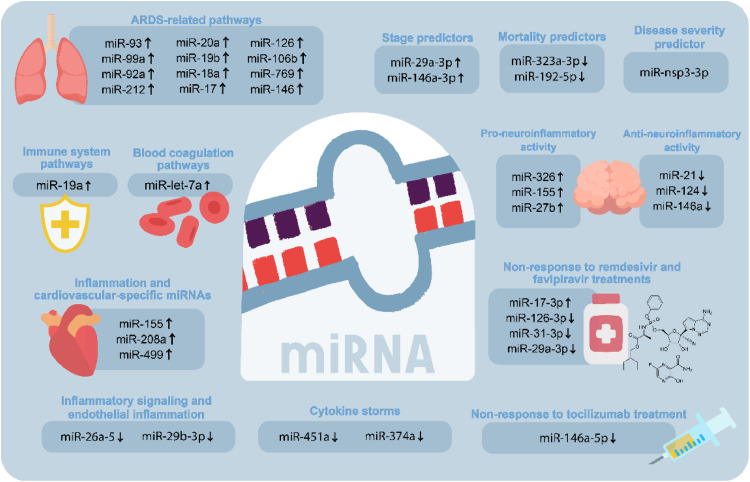
Nowadays, one of the major global health concerns is coronavirus disease 2019 (COVID-19), which is caused by the severe acute respiratory syndrome coronavirus 2 (SARS-CoV-2). Even though numerous treatments and vaccines to combat this virus are currently under development, the detailed molecular mechanisms underlying the pathogenesis of this disease are yet to be elucidated to design future therapeutic tools against SARS-CoV-2 variants. MicroRNAs (miRNAs) are small (20-24 nucleotides), non-coding RNA molecules that regulate post-transcriptional gene expression. Recently, it has been demonstrated that both host and viral-encoded miRNAs are crucial for the successful infection of SARS-CoV-2. For instance, dysregulation of miRNAs that modulate multiple genes expressed in COVID-19 patients with comorbidities (e.g., type 2 diabetes, lung adenocarcinoma, and cerebrovascular disorders) could affect the severity of the disease. Thus, altered expression levels of circulating miRNAs might be helpful to diagnose this illness and forecast whether a COVID-19 patient could develop a severe state of the disease. Besides, researchers have found a number of miRNAs could inhibit the expression of proteins, such as ACE2, TMPRSS2, spike, and Nsp12, involved in the life cycle of SARS-CoV-2. Accordingly, miRNAs represent potential biomarkers and therapeutic targets for this devastating viral disease. Therefore, in this current review, we present the recent discoveries regarding the clinical relevance and biological roles of miRNAs in COVID-19.
如今,全球主要的健康问题之一是由严重急性呼吸系统综合症冠状病毒 2(SARS-CoV-2)引起的 2019 年冠状病毒病(COVID-19)。尽管目前正在开发许多针对该病毒的治疗方法和疫苗,但为了设计针对 SARS-CoV-2 变体的未来治疗工具,仍需阐明该疾病发病机制的详细分子机制。微小 RNA(miRNA)是调节转录后基因表达的小(20-24 个核苷酸)非编码 RNA 分子。最近已经证实,宿主和病毒编码的 miRNA 对于 SARS-CoV-2 的成功感染都是至关重要的。例如,调节 COVID-19 合并症患者(如 2 型糖尿病、肺腺癌和脑血管疾病)多个基因表达的 miRNA 的失调可能会影响疾病的严重程度。因此,循环 miRNA 的表达水平改变可能有助于诊断这种疾病,并预测 COVID-19 患者是否会发展为严重疾病状态。此外,研究人员发现了许多 miRNA 可以抑制 ACE2、TMPRSS2、刺突和 Nsp12 等参与 SARS-CoV-2 生命周期的蛋白质的表达。因此,miRNA 是针对这种破坏性病毒疾病的潜在生物标志物和治疗靶点。因此,在本综述中,我们介绍了 miRNA 在 COVID-19 中的临床相关性和生物学作用的最新发现。