Zheng Bingbing, Liu Yaoqi, Zhu Yu, Yu Fuli, Jiang Tianjiao, Yang Dawei, Xu Tao
School of Information Science and EngineeringEast China University of Science and Technology Shanghai 200237 China.
The Affiliated Hospital of Qingdao University Qingdao 266000 China.
IEEE Access. 2020 Sep 29;8:185786-185795. doi: 10.1109/ACCESS.2020.3027738. eCollection 2020.
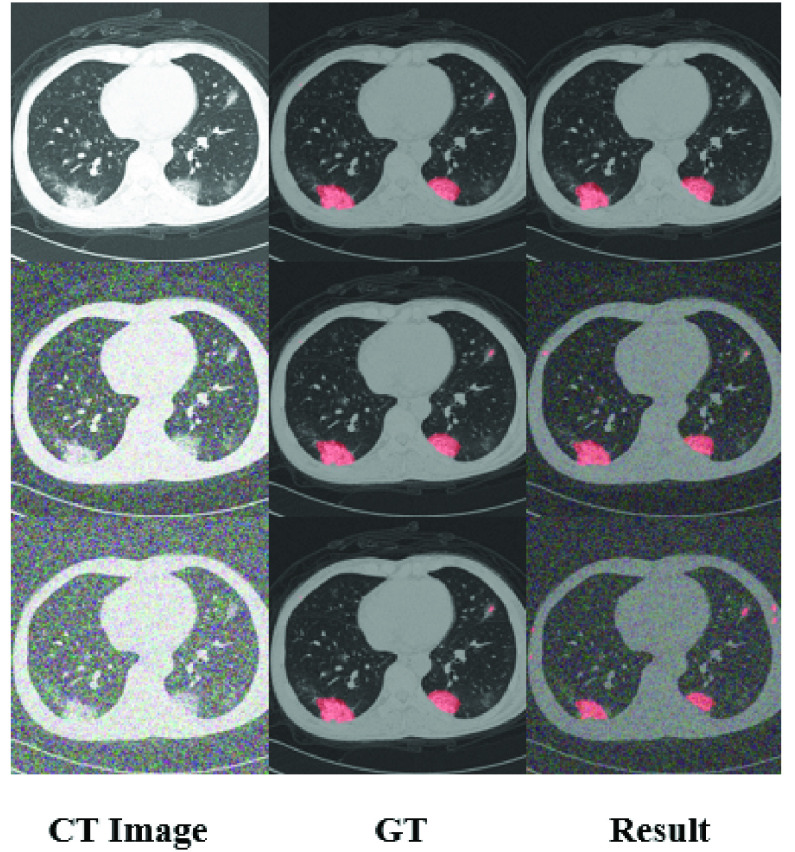
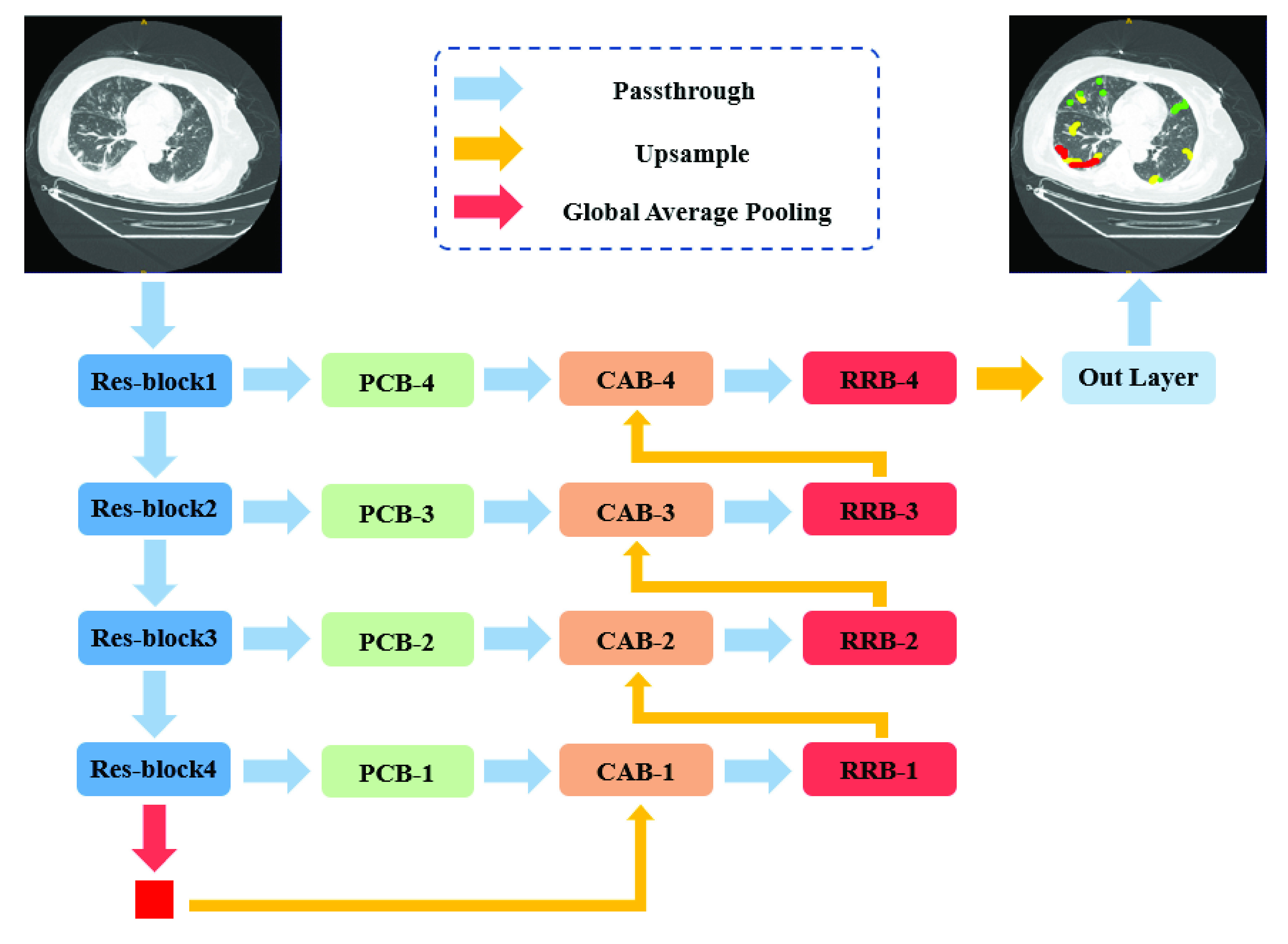
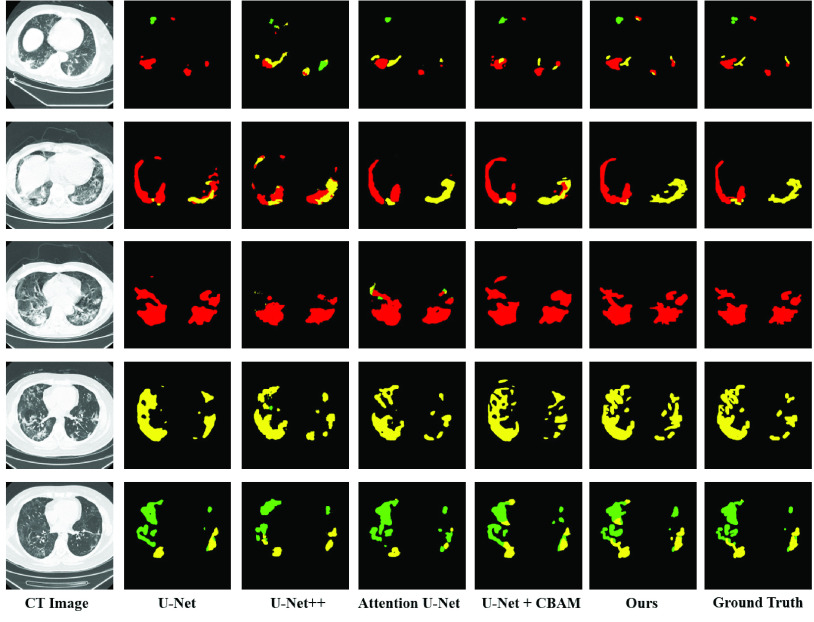
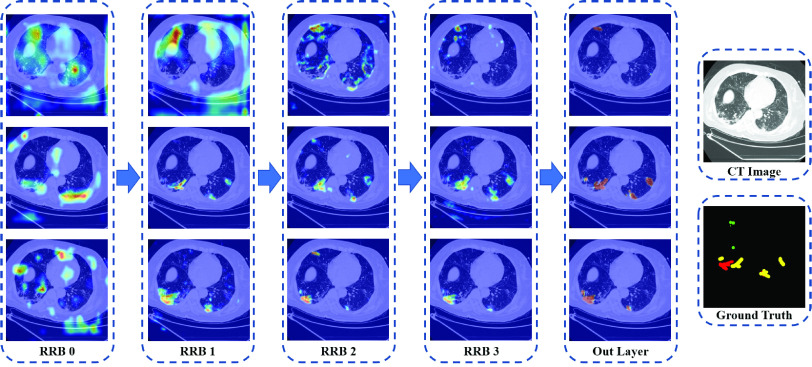
Since the first patient reported in December 2019, 2019 novel coronavirus disease (COVID-19) has become global pandemic with more than 10 million total confirmed cases and 500 thousand related deaths. Using deep learning methods to quickly identify COVID-19 and accurately segment the infected area can help control the outbreak and assist in treatment. Computed tomography (CT) as a fast and easy clinical method, it is suitable for assisting in diagnosis and treatment of COVID-19. According to clinical manifestations, COVID-19 lung infection areas can be divided into three categories: ground-glass opacities, interstitial infiltrates and consolidation. We proposed a multi-scale discriminative network (MSD-Net) for multi-class segmentation of COVID-19 lung infection on CT. In the MSD-Net, we proposed pyramid convolution block (PCB), channel attention block (CAB) and residual refinement block (RRB). The PCB can increase the receptive field by using different numbers and different sizes of kernels, which strengthened the ability to segment the infected areas of different sizes. The CAB was used to fusion the input of the two stages and focus features on the area to be segmented. The role of RRB was to refine the feature maps. Experimental results showed that the dice similarity coefficient (DSC) of the three infection categories were 0.7422,0.7384,0.8769 respectively. For sensitivity and specificity, the results of three infection categories were (0.8593, 0.9742), (0.8268,0.9869) and (0.8645,0.9889) respectively. The experimental results demonstrated that the network proposed in this paper can effectively segment the COVID-19 infection on CT images. It can be adopted for assisting in diagnosis and treatment of COVID-19.
自2019年12月报告首例患者以来,新型冠状病毒肺炎(COVID-19)已成为全球大流行疾病,确诊病例总数超过1000万例,相关死亡病例达50万例。使用深度学习方法快速识别COVID-19并准确分割感染区域有助于控制疫情爆发并辅助治疗。计算机断层扫描(CT)作为一种快速简便的临床检查方法,适用于辅助COVID-19的诊断和治疗。根据临床表现,COVID-19肺部感染区域可分为三类:磨玻璃影、间质浸润和实变。我们提出了一种多尺度判别网络(MSD-Net)用于对CT上的COVID-19肺部感染进行多类别分割。在MSD-Net中,我们提出了金字塔卷积块(PCB)、通道注意力块(CAB)和残差细化块(RRB)。PCB通过使用不同数量和不同大小的内核来增加感受野,增强了分割不同大小感染区域的能力。CAB用于融合两个阶段的输入并将特征聚焦在待分割区域。RRB的作用是细化特征图。实验结果表明,三种感染类别的骰子相似系数(DSC)分别为0.7422、0.7384、0.8769。对于敏感性和特异性,三种感染类别的结果分别为(0.8593,0.9742)、(0.8268,0.9869)和(0.8645,0.9889)。实验结果表明,本文提出的网络能够有效分割CT图像上的COVID-19感染区域。可用于辅助COVID-19的诊断和治疗。