Faculty of Economics, Tohoku Gakuin University, 1-3-1 Tsuchitoi, Aoba-ku, Sendai, Miyagi 985-8537, Japan; Center for Infectious Disease Education and Research, Osaka University, Japan.
Center for Emergency Preparedness and Response, National Institute of Infectious Diseases, Japan.
Soc Sci Med. 2022 Jan;292:114561. doi: 10.1016/j.socscimed.2021.114561. Epub 2021 Nov 10.
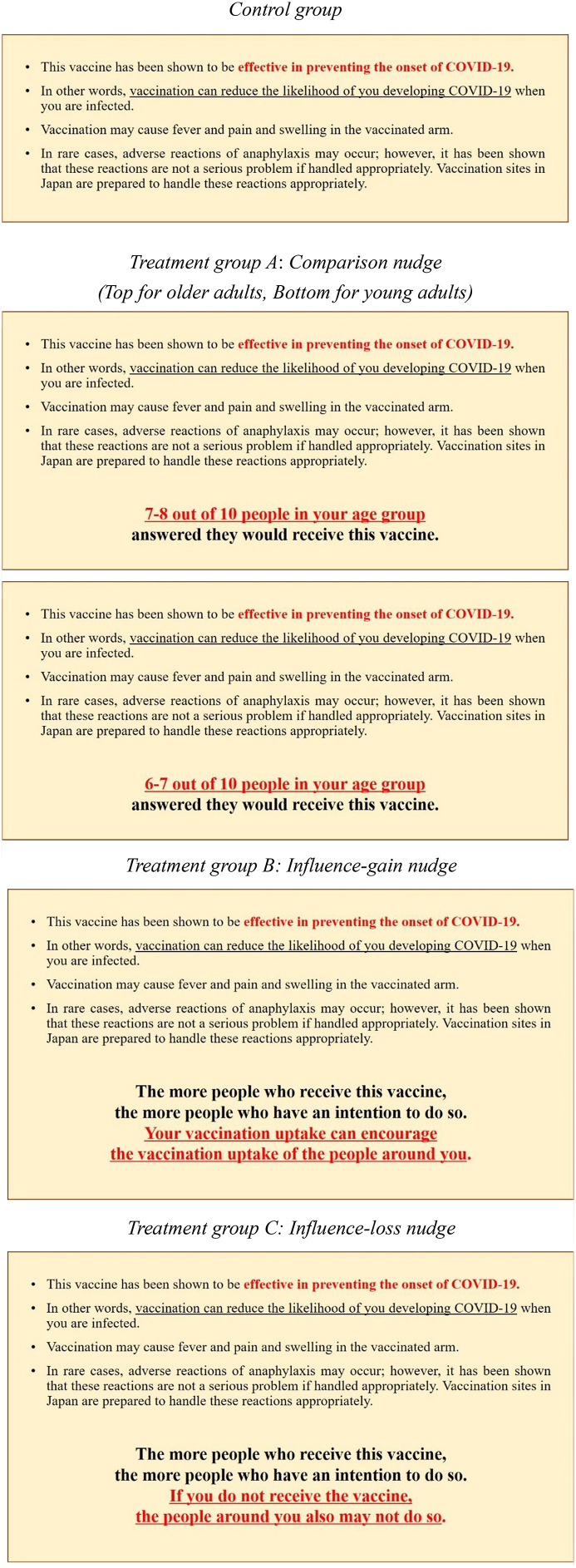
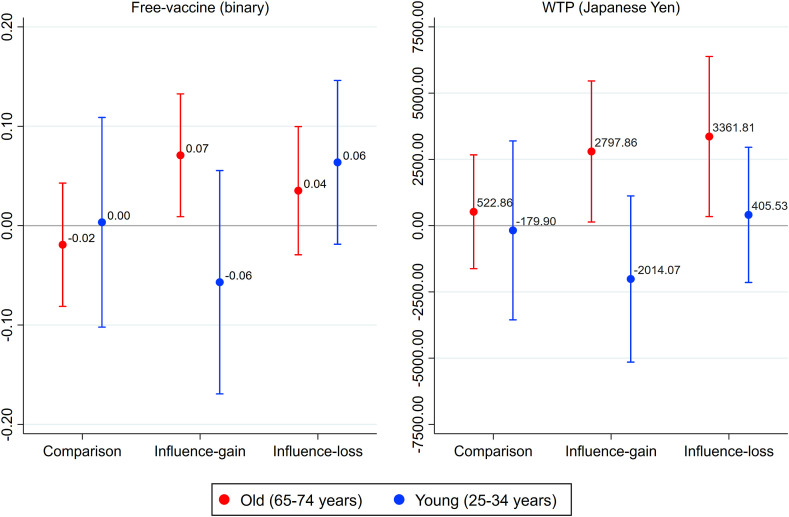
Vaccination promotion is a crucial strategy to end the COVID-19 pandemic; however, individual autonomy should also be respected. This study aimed to discover other-regarding information nudges that can reinforce people's intention to receive the COVID-19 vaccine without impeding their autonomous decision-making. In March 2021, we conducted an online experiment with 1595 people living throughout Japan, and randomly assigned them either of one control group and three treatment groups that received messages differently describing peer information: control, comparison, influence-gain, and influence-loss. We compared each message's effects on vaccination intention, autonomous decision-making, and emotional response. We found that the influence-gain nudge was effective in increasing the number of older adults who newly decided to receive the vaccine. The comparison and influence-loss nudges further reinforced the intention of older adults who had already planned to receive it. However, the influence-loss nudge, which conveys similar information to the influence-gain nudge but with loss-framing, increased viewers' negative emotion. These messages had no promoting effect for young adults with lower vaccination intentions at baseline. Based on the findings, we propose governments should use different messages depending on their purposes and targets, such as comparison instead of influence-loss, to encourage voluntary vaccination behavior.
疫苗接种推广是结束 COVID-19 大流行的关键策略;然而,也应该尊重个人自主权。本研究旨在发现其他相关信息提示,可以在不影响自主决策的情况下,增强人们接种 COVID-19 疫苗的意愿。2021 年 3 月,我们在日本各地进行了一项涉及 1595 人的在线实验,将参与者随机分配到一个对照组和三个治疗组,分别接受不同描述同伴信息的消息:对照组、比较组、利益影响组和利益损失组。我们比较了每个消息对疫苗接种意愿、自主决策和情绪反应的影响。我们发现,利益影响提示有效地增加了新决定接种疫苗的老年人的数量。比较和利益损失提示进一步增强了已经计划接种疫苗的老年人的意愿。然而,传递类似信息但采用损失框架的利益损失提示增加了观众的负面情绪。这些信息对基础接种意愿较低的年轻成年人没有促进作用。基于这些发现,我们建议政府根据目的和目标使用不同的信息,例如使用比较而不是利益损失,来鼓励自愿接种疫苗的行为。