Sharma Atul, Mishra Rupesh Kumar, Goud K Yugender, Mohamed Mona A, Kummari Shekher, Tiwari Swapnil, Li Zhanhong, Narayan Roger, Stanciu Lia A, Marty Jean Louis
Department of Pharmaceutical Chemistry, SGT College of Pharmacy, SGT University, Budhera, Gurugram 122505, Haryana, India.
Bindley Bio-Science Center, Lab 222, 1203 W. State St., Purdue University, West Lafayette, IN 47907, USA.
Diagnostics (Basel). 2021 Nov 10;11(11):2083. doi: 10.3390/diagnostics11112083.
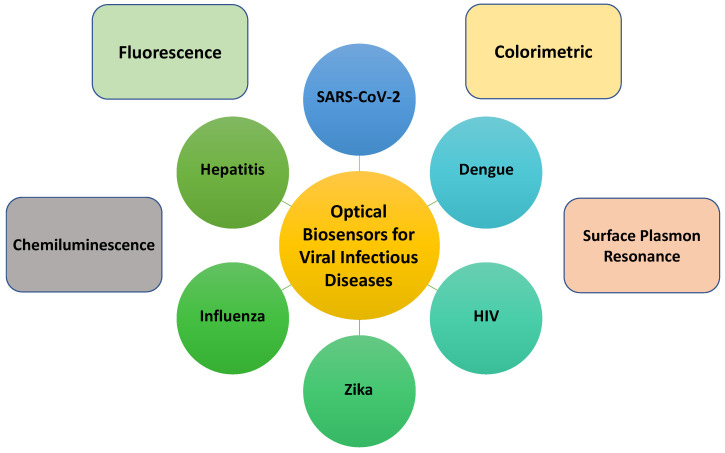
The design and development of biosensors, analytical devices used to detect various analytes in different matrices, has emerged. Biosensors indicate a biorecognition element with a physicochemical analyzer or detector, i.e., a transducer. In the present scenario, various types of biosensors have been deployed in healthcare and clinical research, for instance, biosensors for blood glucose monitoring. Pathogenic microbes are contributing mediators of numerous infectious diseases that are becoming extremely serious worldwide. The recent outbreak of COVID-19 is one of the most recent examples of such communal and deadly diseases. In efforts to work towards the efficacious treatment of pathogenic viral contagions, a fast and precise detection method is of the utmost importance in biomedical and healthcare sectors for early diagnostics and timely countermeasures. Among various available sensor systems, optical biosensors offer easy-to-use, fast, portable, handy, multiplexed, direct, real-time, and inexpensive diagnosis with the added advantages of specificity and sensitivity. Many progressive concepts and extremely multidisciplinary approaches, including microelectronics, microelectromechanical systems (MEMSs), nanotechnologies, molecular biology, and biotechnology with chemistry, are used to operate optical biosensors. A portable and handheld optical biosensing device would provide fast and reliable results for the identification and quantitation of pathogenic virus particles in each sample. In the modern day, the integration of intelligent nanomaterials in the developed devices provides much more sensitive and highly advanced sensors that may produce the results in no time and eventually help clinicians and doctors enormously. This review accentuates the existing challenges engaged in converting laboratory research to real-world device applications and optical diagnostics methods for virus infections. The review's background and progress are expected to be insightful to the researchers in the sensor field and facilitate the design and fabrication of optical sensors for life-threatening viruses with broader applicability to any desired pathogens.
用于检测不同基质中各种分析物的分析装置——生物传感器的设计与开发应运而生。生物传感器是一种将生物识别元件与物理化学分析仪或检测器(即换能器)相结合的装置。在当前情况下,各种类型的生物传感器已应用于医疗保健和临床研究,例如用于血糖监测的生物传感器。致病微生物是许多传染病的致病媒介,这些传染病在全球范围内正变得极其严重。最近爆发的新冠疫情就是此类公共性致命疾病的最新例子之一。为了有效治疗致病性病毒感染,快速准确的检测方法在生物医学和医疗保健领域对于早期诊断和及时采取对策至关重要。在各种可用的传感器系统中,光学生物传感器具有易于使用、快速、便携、方便、可多路复用、直接、实时且成本低廉的诊断特点,还具有特异性和灵敏度等额外优势。许多先进的概念和极具多学科性的方法,包括微电子学、微机电系统(MEMS)、纳米技术、分子生物学以及化学与生物技术,都被用于操作光学生物传感器。一种便携式手持光学生物传感设备将为每个样本中致病病毒颗粒的识别和定量提供快速可靠的结果。在现代,将智能纳米材料集成到已开发的设备中可提供更灵敏、高度先进的传感器,这些传感器可能会立即产生结果,并最终极大地帮助临床医生和医生。本综述着重阐述了将实验室研究转化为实际设备应用以及病毒感染光学诊断方法所面临的现有挑战。预计该综述的背景和进展将为传感器领域的研究人员提供有价值的见解,并有助于设计和制造适用于威胁生命的病毒且对任何所需病原体具有更广泛适用性的光学传感器。