• 文献检索
  • 文档翻译
  • 深度研究
  • 学术资讯
  • Suppr Zotero 插件Zotero 插件
  • 邀请有礼
  • 套餐&价格
  • 历史记录
应用&插件
Suppr Zotero 插件Zotero 插件浏览器插件Mac 客户端Windows 客户端微信小程序
定价
高级版会员购买积分包购买API积分包
服务
文献检索文档翻译深度研究API 文档MCP 服务
关于我们
关于 Suppr公司介绍联系我们用户协议隐私条款
关注我们

Suppr 超能文献

核心技术专利:CN118964589B侵权必究
粤ICP备2023148730 号-1Suppr @ 2026

文献检索

告别复杂PubMed语法,用中文像聊天一样搜索,搜遍4000万医学文献。AI智能推荐,让科研检索更轻松。

立即免费搜索

文件翻译

保留排版,准确专业,支持PDF/Word/PPT等文件格式,支持 12+语言互译。

免费翻译文档

深度研究

AI帮你快速写综述,25分钟生成高质量综述,智能提取关键信息,辅助科研写作。

立即免费体验

一张描述新冠疫情的动态图。

A dynamical map to describe COVID-19 epidemics.

作者信息

Dos Reis Eduardo V M, Savi Marcelo A

机构信息

Department of Mechanical Engineering, Center for Nonlinear Mechanics, Universidade Federal do Rio de Janeiro, COPPE, P.O. Box 68 503, Rio de Janeiro, RJ Brazil.

出版信息

Eur Phys J Spec Top. 2022;231(5):893-904. doi: 10.1140/epjs/s11734-021-00340-5. Epub 2021 Nov 25.

DOI:10.1140/epjs/s11734-021-00340-5
PMID:34849187
原文链接:https://pmc.ncbi.nlm.nih.gov/articles/PMC8614223/
Abstract

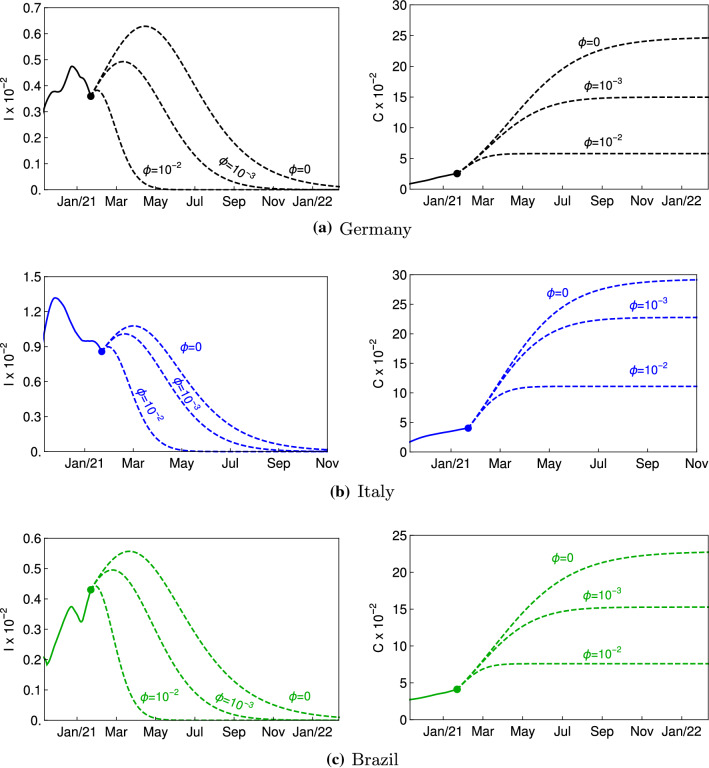
Nonlinear dynamics perspective is an interesting approach to describe COVID-19 epidemics, providing information to support strategic decisions. This paper proposes a dynamical map to describe COVID-19 epidemics based on the classical susceptible-exposed-infected-recovered (SEIR) differential model, incorporating vaccinated population. On this basis, the novel map represents COVID-19 discrete-time dynamics by adopting three populations: infected, cumulative infected and vaccinated. The map promotes a dynamical description based on algebraic equations with a reduced number of variables and, due to its simplicity, it is easier to perform parameter adjustments. In addition, the map description allows analytical calculations of useful information to evaluate the epidemic scenario, being important to support strategic decisions. In this regard, it should be pointed out the estimation of the number deaths, infection rate and the herd immunization point. Numerical simulations show the model capability to describe COVID-19 dynamics, capturing the main features of the epidemic evolution. Reported data from Germany, Italy and Brazil are of concern showing the map ability to describe different scenario patterns that include multi-wave pattern with bell shape and plateaus characteristics. The effect of vaccination is analyzed considering different campaign strategies, showing its importance to control the epidemics.

摘要

非线性动力学视角是描述新冠疫情的一种有趣方法,可为战略决策提供支持信息。本文基于经典的易感-暴露-感染-康复(SEIR)微分模型,纳入接种疫苗人群,提出了一种描述新冠疫情的动态映射。在此基础上,该新型映射通过采用感染人群、累计感染人群和接种疫苗人群这三类人群来表示新冠疫情的离散时间动态。该映射促进了基于变量数量减少的代数方程的动态描述,并且由于其简单性,更容易进行参数调整。此外,该映射描述允许对评估疫情形势的有用信息进行解析计算,这对于支持战略决策很重要。在这方面,应指出死亡人数、感染率和群体免疫点的估计。数值模拟显示了该模型描述新冠疫情动态的能力,捕捉到了疫情演变的主要特征。来自德国、意大利和巴西的报告数据令人关注,显示了该映射描述不同情景模式的能力,这些模式包括具有钟形和平原特征的多波模式。考虑不同的疫苗接种策略分析了疫苗接种的效果,显示了其对控制疫情的重要性。

https://cdn.ncbi.nlm.nih.gov/pmc/blobs/7a15/8614223/57919f940b4c/11734_2021_340_Fig9_HTML.jpg
https://cdn.ncbi.nlm.nih.gov/pmc/blobs/7a15/8614223/16f65d7f2baa/11734_2021_340_Fig1_HTML.jpg
https://cdn.ncbi.nlm.nih.gov/pmc/blobs/7a15/8614223/ac2d15cad6ee/11734_2021_340_Fig2_HTML.jpg
https://cdn.ncbi.nlm.nih.gov/pmc/blobs/7a15/8614223/a104f8a11183/11734_2021_340_Fig3_HTML.jpg
https://cdn.ncbi.nlm.nih.gov/pmc/blobs/7a15/8614223/4d49c17b7fa5/11734_2021_340_Fig4_HTML.jpg
https://cdn.ncbi.nlm.nih.gov/pmc/blobs/7a15/8614223/dd9fb0f57ffa/11734_2021_340_Fig5_HTML.jpg
https://cdn.ncbi.nlm.nih.gov/pmc/blobs/7a15/8614223/6938f8ef276f/11734_2021_340_Fig6_HTML.jpg
https://cdn.ncbi.nlm.nih.gov/pmc/blobs/7a15/8614223/ede7ab64d10a/11734_2021_340_Fig7_HTML.jpg
https://cdn.ncbi.nlm.nih.gov/pmc/blobs/7a15/8614223/9b3c5a2f4043/11734_2021_340_Fig8_HTML.jpg
https://cdn.ncbi.nlm.nih.gov/pmc/blobs/7a15/8614223/57919f940b4c/11734_2021_340_Fig9_HTML.jpg
https://cdn.ncbi.nlm.nih.gov/pmc/blobs/7a15/8614223/16f65d7f2baa/11734_2021_340_Fig1_HTML.jpg
https://cdn.ncbi.nlm.nih.gov/pmc/blobs/7a15/8614223/ac2d15cad6ee/11734_2021_340_Fig2_HTML.jpg
https://cdn.ncbi.nlm.nih.gov/pmc/blobs/7a15/8614223/a104f8a11183/11734_2021_340_Fig3_HTML.jpg
https://cdn.ncbi.nlm.nih.gov/pmc/blobs/7a15/8614223/4d49c17b7fa5/11734_2021_340_Fig4_HTML.jpg
https://cdn.ncbi.nlm.nih.gov/pmc/blobs/7a15/8614223/dd9fb0f57ffa/11734_2021_340_Fig5_HTML.jpg
https://cdn.ncbi.nlm.nih.gov/pmc/blobs/7a15/8614223/6938f8ef276f/11734_2021_340_Fig6_HTML.jpg
https://cdn.ncbi.nlm.nih.gov/pmc/blobs/7a15/8614223/ede7ab64d10a/11734_2021_340_Fig7_HTML.jpg
https://cdn.ncbi.nlm.nih.gov/pmc/blobs/7a15/8614223/9b3c5a2f4043/11734_2021_340_Fig8_HTML.jpg
https://cdn.ncbi.nlm.nih.gov/pmc/blobs/7a15/8614223/57919f940b4c/11734_2021_340_Fig9_HTML.jpg

相似文献

1
A dynamical map to describe COVID-19 epidemics.一张描述新冠疫情的动态图。
Eur Phys J Spec Top. 2022;231(5):893-904. doi: 10.1140/epjs/s11734-021-00340-5. Epub 2021 Nov 25.
2
Dynamics of partially mitigated multi-phasic epidemics at low susceptible depletion: phases of COVID-19 control in Italy as case study.低易感性消耗下部分缓解的多阶段传染病动力学:以意大利的 COVID-19 控制为例。
Math Biosci. 2021 Oct;340:108671. doi: 10.1016/j.mbs.2021.108671. Epub 2021 Jul 21.
3
A modified model to predict the COVID-19 outbreak in Spain and Italy: Simulating control scenarios and multi-scale epidemics.一种用于预测西班牙和意大利新冠疫情爆发的改进模型:模拟控制情景和多尺度疫情。
Results Phys. 2021 Feb;21:103746. doi: 10.1016/j.rinp.2020.103746. Epub 2020 Dec 25.
4
Deterministic and stochastic models for the epidemic dynamics of COVID-19 in Wuhan, China.中国武汉 COVID-19 传染病动力学的确定性和随机性模型。
Math Biosci Eng. 2021 Jan 4;18(1):950-967. doi: 10.3934/mbe.2021050.
5
COVID-19 dynamics considering the influence of hospital infrastructure: an investigation into Brazilian scenarios.考虑医院基础设施影响的COVID-19动态:对巴西情况的调查
Nonlinear Dyn. 2021;106(2):1325-1346. doi: 10.1007/s11071-021-06323-4. Epub 2021 Mar 13.
6
[Analysis on dynamical mechanism of multi outbreaks of COVID-19].[新型冠状病毒肺炎多次暴发的动力学机制分析]
Zhonghua Liu Xing Bing Xue Za Zhi. 2021 Jun 10;42(6):966-976. doi: 10.3760/cma.j.cn112338-20210219-00123.
7
Exploring the potential of learning methods and recurrent dynamic model with vaccination: A comparative case study of COVID-19 in Austria, Brazil, and China.探索学习方法和带有疫苗接种的递归动态模型的潜力:COVID-19 在奥地利、巴西和中国的对比案例研究。
Phys Rev E. 2024 Jan;109(1-1):014212. doi: 10.1103/PhysRevE.109.014212.
8
Local immunization program for susceptible-infected-recovered network epidemic model.针对易感-感染-康复网络传播模型的局部免疫计划。
Chaos. 2016 Feb;26(2):023108. doi: 10.1063/1.4941670.
9
SEIR order parameters and eigenvectors of the three stages of completed COVID-19 epidemics: with an illustration for Thailand January to May 2020.完成的 COVID-19 传染病三个阶段的 SEIR 序参量和特征向量:以 2020 年 1 月至 5 月泰国为例。
Phys Biol. 2021 May 13;18(4). doi: 10.1088/1478-3975/abf426.
10
Stability Analysis of an Extended SEIR COVID-19 Fractional Model with Vaccination Efficiency.带疫苗接种效率的扩展 SEIR COVID-19 分数阶模型的稳定性分析。
Comput Math Methods Med. 2022 Sep 20;2022:3754051. doi: 10.1155/2022/3754051. eCollection 2022.

引用本文的文献

1
Response of vaccination on community transmission of COVID-19: a dynamical approach.疫苗接种对新冠病毒社区传播的影响:一种动态方法。
Eur Phys J Spec Top. 2022;231(18-20):3749-3765. doi: 10.1140/epjs/s11734-022-00652-0. Epub 2022 Aug 16.
2
Estimation of the basic reproduction number of COVID-19 from the incubation period distribution.根据潜伏期分布估算新型冠状病毒肺炎的基本再生数
Eur Phys J Spec Top. 2022;231(18-20):3741-3748. doi: 10.1140/epjs/s11734-022-00650-2. Epub 2022 Aug 12.
3
Long-term prediction of the sporadic COVID-19 epidemics induced by -virus in China based on a novel non-autonomous delayed SIR model.

本文引用的文献

1
A Time-Dependent SIR Model for COVID-19 With Undetectable Infected Persons.一种针对新冠病毒病(COVID-19)且存在未被检测出感染者的时间依赖性易感-感染-康复(SIR)模型
IEEE Trans Netw Sci Eng. 2020 Sep 18;7(4):3279-3294. doi: 10.1109/TNSE.2020.3024723. eCollection 2020 Oct 1.
2
Mathematical modeling of the COVID-19 pandemic with intervention strategies.采用干预策略对新冠疫情进行数学建模。
Results Phys. 2021 Jun;25:104285. doi: 10.1016/j.rinp.2021.104285. Epub 2021 May 6.
3
COVID-19 dynamics considering the influence of hospital infrastructure: an investigation into Brazilian scenarios.
基于新型非自治延迟SIR模型对中国由新冠病毒引起的散发性COVID-19疫情的长期预测
Eur Phys J Spec Top. 2022;231(18-20):3649-3662. doi: 10.1140/epjs/s11734-022-00622-6. Epub 2022 Jul 4.
4
Complex bio rhythms.复杂的生物节律
Eur Phys J Spec Top. 2022;231(5):815-818. doi: 10.1140/epjs/s11734-022-00540-7. Epub 2022 Apr 20.
考虑医院基础设施影响的COVID-19动态:对巴西情况的调查
Nonlinear Dyn. 2021;106(2):1325-1346. doi: 10.1007/s11071-021-06323-4. Epub 2021 Mar 13.
4
Impact of social media advertisements on the transmission dynamics of COVID-19 pandemic in India.社交媒体广告对印度新冠疫情传播动态的影响。
J Appl Math Comput. 2022;68(1):19-44. doi: 10.1007/s12190-021-01507-y. Epub 2021 Feb 27.
5
A Mathematical Description of the Dynamics of Coronavirus Disease 2019 (COVID-19): A Case Study of Brazil.《2019 年冠状病毒病(COVID-19)动力学的数学描述:巴西案例研究》。
Comput Math Methods Med. 2020 Sep 30;2020:9017157. doi: 10.1155/2020/9017157. eCollection 2020.
6
Nonlinear dynamics of COVID-19 pandemic: modeling, control, and future perspectives.新型冠状病毒肺炎大流行的非线性动力学:建模、控制及未来展望
Nonlinear Dyn. 2020;101(3):1525-1526. doi: 10.1007/s11071-020-05919-6. Epub 2020 Sep 3.
7
A machine learning forecasting model for COVID-19 pandemic in India.印度新冠肺炎疫情的机器学习预测模型。
Stoch Environ Res Risk Assess. 2020;34(7):959-972. doi: 10.1007/s00477-020-01827-8. Epub 2020 May 30.
8
Mathematical modeling of the spread of the coronavirus disease 2019 (COVID-19) taking into account the undetected infections. The case of China.考虑未检测到感染情况的2019冠状病毒病(COVID-19)传播的数学模型。以中国为例。
Commun Nonlinear Sci Numer Simul. 2020 Sep;88:105303. doi: 10.1016/j.cnsns.2020.105303. Epub 2020 Apr 30.
9
Modeling and forecasting of epidemic spreading: The case of Covid-19 and beyond.疫情传播的建模与预测:以新冠疫情及其他情况为例。
Chaos Solitons Fractals. 2020 Jun;135:109794. doi: 10.1016/j.chaos.2020.109794. Epub 2020 Apr 6.
10
A conceptual model for the coronavirus disease 2019 (COVID-19) outbreak in Wuhan, China with individual reaction and governmental action.中国武汉市 2019 年冠状病毒病(COVID-19)爆发的概念模型,包括个体反应和政府行动。
Int J Infect Dis. 2020 Apr;93:211-216. doi: 10.1016/j.ijid.2020.02.058. Epub 2020 Mar 4.