Rollins School of Public Health, Emory University, Atlanta, GA, USA.
School of Biological Sciences, Georgia Institute of Technology, Atlanta, GA, USA.
Nat Commun. 2021 Dec 3;12(1):7063. doi: 10.1038/s41467-021-26774-y.
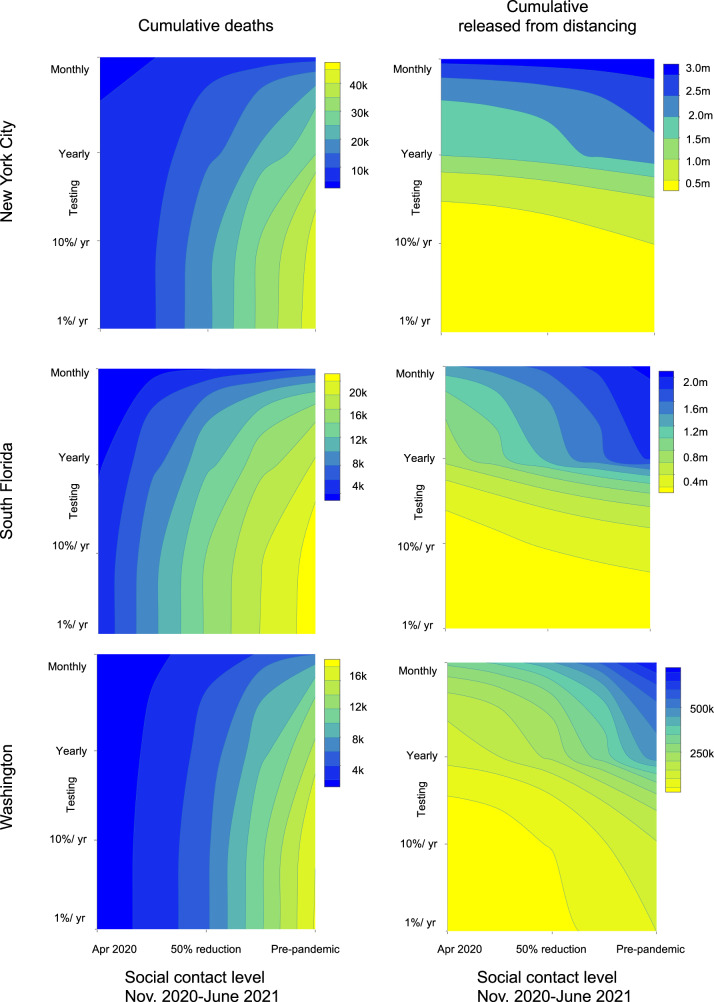
Serological testing remains a passive component of the public health response to the COVID-19 pandemic. Using a transmission model, we examine how serological testing could have enabled seropositive individuals to increase their relative levels of social interaction while offsetting transmission risks. We simulate widespread serological testing in New York City, South Florida, and Washington Puget Sound and assume seropositive individuals partially restore their social contacts. Compared to no intervention, our model suggests that widespread serological testing starting in late 2020 would have averted approximately 3300 deaths in New York City, 1400 deaths in South Florida and 11,000 deaths in Washington State by June 2021. In all sites, serological testing blunted subsequent waves of transmission. Findings demonstrate the potential benefit of widespread serological testing, had it been implemented in the pre-vaccine era, and remain relevant now amid the potential for emergence of new variants.
血清学检测仍然是应对 COVID-19 大流行的公共卫生措施中的一个被动环节。本文利用传播模型,研究了血清学检测如何使血清阳性个体在抵消传播风险的同时,增加其相对社会互动水平。我们模拟了在纽约市、南佛罗里达州和华盛顿普吉特海湾进行广泛的血清学检测,并假设血清阳性个体部分恢复了他们的社会联系。与不干预相比,我们的模型表明,从 2020 年底开始广泛进行血清学检测,到 2021 年 6 月,将可避免纽约市约 3300 人死亡、南佛罗里达州 1400 人死亡和华盛顿州 11000 人死亡。在所有地点,血清学检测都减缓了随后的传播波。研究结果表明,如果在疫苗问世之前实施广泛的血清学检测,那么在新变种出现的情况下,这种检测具有潜在的益处。