Zhang Xiaodong, Lu Zhufeng, Zhang Teng, Li Hanzhe, Wang Yachun, Tao Qing
School of Mechanical Engineering, Xi'an Jiaotong University, Xi'an, China.
Shaanxi Key Laboratory of Intelligent Robot, Xi'an Jiaotong University, Xi'an, China.
Front Neurosci. 2021 Nov 11;15:727394. doi: 10.3389/fnins.2021.727394. eCollection 2021.
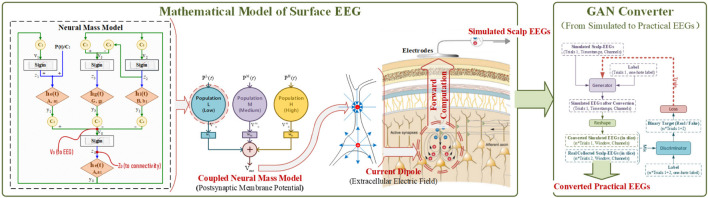
Electroencephalogram (EEG) modeling in brain-computer interface (BCI) provides a theoretical foundation for its development. However, limited by the lack of guidelines in model parameter selection and the inability to obtain personal tissue information in practice, EEG modeling in BCI is mainly focused on the theoretical qualitative level which shows a gap between the theory and its application. Based on such problems, this work combined the surface EEG simulation with a converter based on the generative adversarial network (GAN), to establish the connection from simulated EEG to its application in BCI classification. For the scalp EEGs modeling, a mathematical model was built according to the physics of surface EEG, which consisted of the parallel 3-population neural mass model, the equivalent dipole, and the forward computation. For application, a converter based on the conditional GAN was designed, to transfer the simulated theoretical-only EEG to its practical version, in the lack of individual bio-information. To verify the feasibility, based on the latest microexpression-assisted BCI paradigm proposed by our group, the converted simulated EEGs were used in the training of BCI classifiers. The results indicated that, compared with training with insufficient real data, by adding the simulated EEGs, the overall performance showed a significant improvement ( = 0.04 < 0.05), and the test performance can be improved by 2.17% ± 4.23, in which the largest increase was up to 12.60% ± 1.81. Through this work, the link from theoretical EEG simulation to BCI classification has been initially established, providing an enhanced novel solution for the application of EEG modeling in BCI.
脑机接口(BCI)中的脑电图(EEG)建模为其发展提供了理论基础。然而,由于缺乏模型参数选择的指导方针,且在实际中无法获取个人组织信息,BCI中的EEG建模主要集中在理论定性层面,这导致理论与应用之间存在差距。基于这些问题,这项工作将表面EEG模拟与基于生成对抗网络(GAN)的转换器相结合,以建立从模拟EEG到其在BCI分类中的应用的联系。对于头皮EEG建模,根据表面EEG的物理原理建立了一个数学模型,该模型由并行三群体神经团模型、等效偶极子和正向计算组成。对于应用,设计了一种基于条件GAN的转换器,在缺乏个体生物信息的情况下,将仅模拟的理论EEG转换为其实际版本。为了验证可行性,基于我们团队提出的最新微表情辅助BCI范式,将转换后的模拟EEG用于BCI分类器的训练。结果表明,与使用不足的真实数据进行训练相比,通过添加模拟EEG,整体性能有显著提高(=0.04<0.05),测试性能可提高2.17%±4.23,其中最大增幅高达12.60%±1.81。通过这项工作,初步建立了从理论EEG模拟到BCI分类的联系,为EEG建模在BCI中的应用提供了一种增强的新颖解决方案。