Kuo Pei-Lun, Moore Ann Zenobia, Lin Frank R, Ferrucci Luigi
Translational Gerontology Branch, National Institute on Aging, National Institutes of Health, Baltimore, MD, United States.
Department of Otolaryngology-Head and Neck Surgery, Johns Hopkins University School of Medicine, Baltimore, MD, United States.
Front Aging Neurosci. 2021 Dec 15;13:790926. doi: 10.3389/fnagi.2021.790926. eCollection 2021.
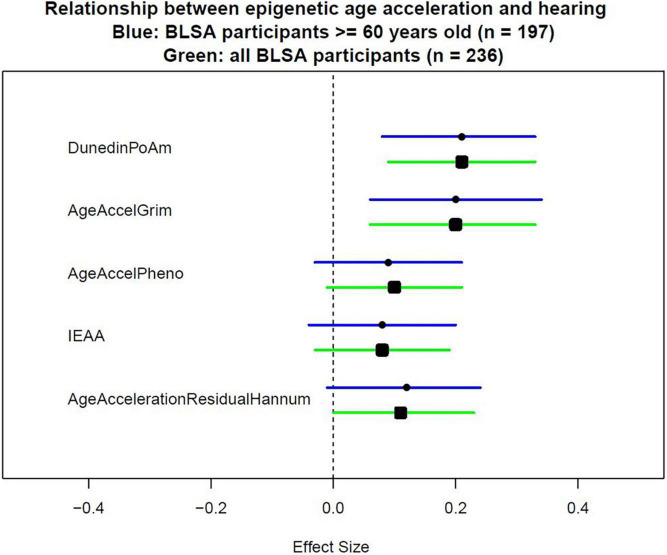
Age-related hearing loss (ARHL) is highly prevalent among older adults, but the potential mechanisms and predictive markers for ARHL are lacking. Epigenetic age acceleration has been shown to be predictive of many age-associated diseases and mortality. However, the association between epigenetic age acceleration and hearing remains unknown. Our study aims to investigate the relationship between epigenetic age acceleration and audiometric hearing in the Baltimore Longitudinal Study of Aging (BLSA). Participants with both DNA methylation and audiometric hearing measurements were included. The main independent variables are epigenetic age acceleration measures, including intrinsic epigenetic age acceleration-"IEAA," Hannum age acceleration-"AgeAccelerationResidualHannum," PhenoAge acceleration-"AgeAccelPheno," GrimAge acceleration-"AgeAccelGrim," and methylation-based pace of aging estimation-"DunedinPoAm." The main dependent variable is speech-frequency pure tone average. Linear regression was used to assess the association between epigenetic age acceleration and hearing. Among the 236 participants (52.5% female), after adjusting for age, sex, race, time difference between measurements, cardiovascular factors, and smoking history, the effect sizes were 0.11 995% CI: (-0.00, 0.23), = 0.054] for Hannum's clock, 0.08 [95% CI: (-0.03, 0.19), = 0.143] for Horvath's clock, 0.10 [95% CI: (-0.01, 0.21), = 0.089] for PhenoAge, 0.20 [95% CI: (0.06, 0.33), = 0.004] for GrimAge, and 0.21 [95% CI: (0.09, 0.33), = 0.001] for DunedinPoAm. The present study suggests that some epigenetic age acceleration measurements are associated with hearing. Future research is needed to study the potential subclinical cardiovascular causes of hearing and to investigate the longitudinal relationship between DNA methylation and hearing.
年龄相关性听力损失(ARHL)在老年人中极为普遍,但ARHL的潜在机制和预测标志物尚不明确。表观遗传年龄加速已被证明可预测多种与年龄相关的疾病和死亡率。然而,表观遗传年龄加速与听力之间的关联仍不清楚。我们的研究旨在调查巴尔的摩纵向衰老研究(BLSA)中表观遗传年龄加速与听力测定之间的关系。纳入了同时有DNA甲基化和听力测定数据的参与者。主要自变量是表观遗传年龄加速指标,包括内在表观遗传年龄加速——“IEAA”、汉纳姆年龄加速——“AgeAccelerationResidualHannum”、PhenoAge加速——“AgeAccelPheno”、GrimAge加速——“AgeAccelGrim”以及基于甲基化的衰老速度估计——“DunedinPoAm”。主要因变量是言语频率纯音平均值。采用线性回归评估表观遗传年龄加速与听力之间的关联。在236名参与者(52.5%为女性)中,在调整年龄、性别、种族、测量时间差、心血管因素和吸烟史后,汉纳姆时钟的效应量为0.11 [995%置信区间:(-0.00,0.23),P = 0.054],霍瓦特时钟的效应量为0.08 [95%置信区间:(-0.03,0.19),P = 0.143],PhenoAge的效应量为0.10 [95%置信区间:(-0.01,0.21),P = 0.089],GrimAge的效应量为0.20 [95%置信区间:(0.06,0.33),P = 0.004],DunedinPoAm的效应量为0.21 [95%置信区间:(0.09,0.33),P = 0.001]。本研究表明,一些表观遗传年龄加速测量与听力有关。未来需要开展研究,以探究听力潜在的亚临床心血管病因,并调查DNA甲基化与听力之间的纵向关系。