Innovations for Poverty Action, Yangon 11111, Myanmar.
Department of Global Health and Development, London School of Hygiene and Tropical Medicine, London WC1E 7HT, UK.
Int J Environ Res Public Health. 2021 Dec 31;19(1):427. doi: 10.3390/ijerph19010427.
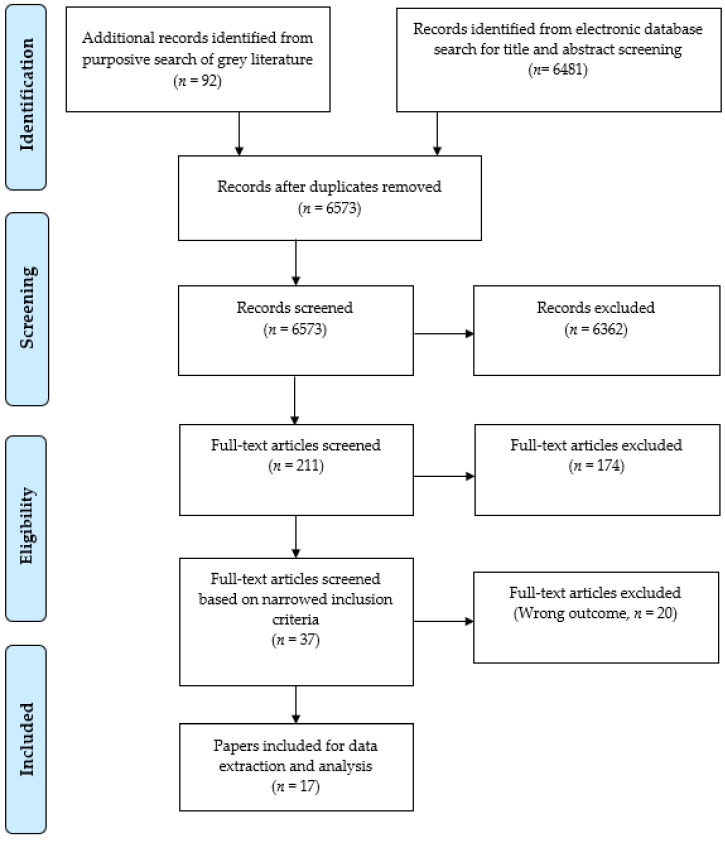
This rapid systematic review describes violence and health outcomes among child domestic workers (CDWs) taken from 17 studies conducted in low- and middle-income countries. Our analysis estimated the median reported rates of violence in CDWs aged 5-17-year-olds to be 56.2% (emotional; range: 13-92%), 18.9% (physical; range: 1.7-71.4%), and 2.2% (sexual; range: 0-62%). Both boys and girls reported emotional abuse and sexual violence with emotional abuse being the most common. In Ethiopia and India, violence was associated with severe physical injuries and sexual insecurity among a third to half of CDWs. CDWs in India and Togo reported lower levels of psycho-social well-being than controls. In India, physical punishment was correlated with poor psycho-social well-being of CDWs [OR: 3.6; 95% CI: 3.2-4; < 0.0001]. Across the studies, between 7% and 68% of CDWs reported work-related illness and injuries, and one third to half had received no medical treatment. On average, children worked between 9 and 15 h per day with no rest days. Findings highlight that many CDWs are exposed to abuse and other health hazards but that conditions vary substantially by context. Because of the often-hidden nature of child domestic work, future initiatives will need to be specifically designed to reach children in private households. Young workers will also benefit from strategies to change social norms around the value and vulnerability of children in domestic work and the long-term implications of harm during childhood.
本快速系统评价描述了来自 17 项在中低收入国家开展的研究中,儿童家政工人(CDWs)所经历的暴力和健康后果。我们的分析估计,报告的 5-17 岁儿童家政工人遭受暴力的中位数比率为 56.2%(情绪;范围:13-92%)、18.9%(身体;范围:1.7-71.4%)和 2.2%(性;范围:0-62%)。男孩和女孩都报告了情绪虐待和性暴力,其中情绪虐待最为常见。在埃塞俄比亚和印度,暴力与三分之一到一半的 CDWs 遭受严重的身体伤害和性不安全有关。印度和多哥的 CDWs 报告的心理社会幸福感水平低于对照组。在印度,体罚与 CDWs 的不良心理社会幸福感相关[OR:3.6;95%CI:3.2-4;<0.0001]。在所有研究中,7%至 68%的 CDWs 报告工作相关疾病和伤害,三分之一至一半的 CDWs 未接受任何治疗。平均而言,儿童每天工作 9 至 15 小时,没有休息日。研究结果表明,许多 CDWs 遭受虐待和其他健康危害,但具体情况因背景而异。由于儿童家政工作的性质往往是隐蔽的,未来的举措将需要专门设计,以接触到私人家庭中的儿童。年轻工人也将受益于旨在改变社会规范的战略,这些规范涉及儿童在家庭佣工中的价值和脆弱性,以及童年时期受到伤害的长期影响。