R Sakthivel, Thaseen I Sumaiya, M Vanitha, M Deepa, M Angulakshmi, R Mangayarkarasi, Mahendran Anand, Alnumay Waleed, Chatterjee Puspita
School of Electronics Engineering, Vellore Institute of Technology, Vellore, Tamil Nadu, India.
School of Information Technology and Engineering, Vellore Institute of Technology, Vellore, Tamil Nadu, India.
Sustain Cities Soc. 2022 May;80:103713. doi: 10.1016/j.scs.2022.103713. Epub 2022 Feb 3.
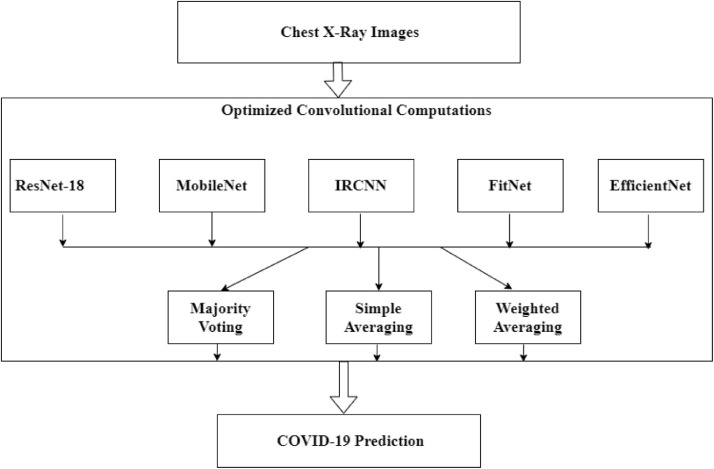
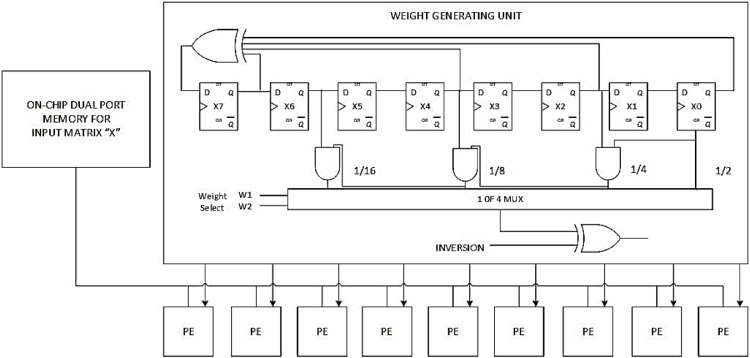
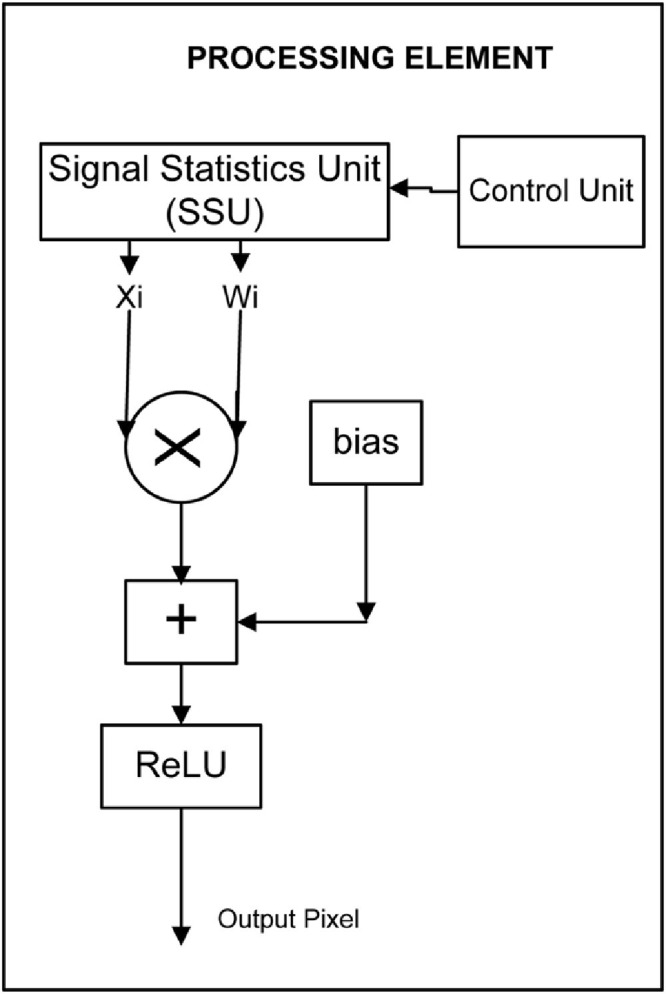
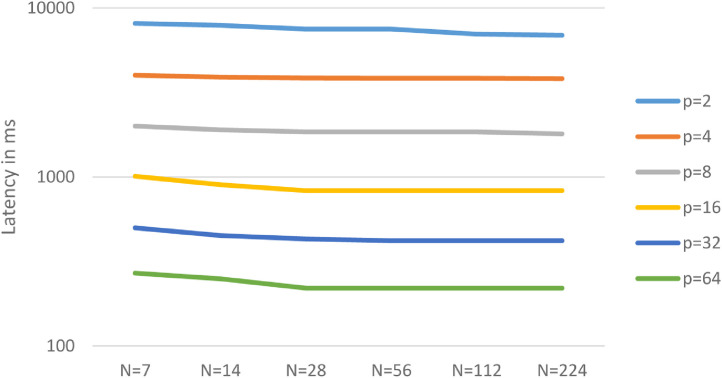
Deep learning models demonstrate superior performance in image classification problems. COVID-19 image classification is developed using single deep learning models. In this paper, an efficient hardware architecture based on an ensemble deep learning model is built to identify the COVID-19 using chest X-ray (CXR) records. Five deep learning models namely ResNet, fitness, IRCNN (Inception Recurrent Convolutional Neural Network), effectiveness, and Fitnet are ensembled for fine-tuning and enhancing the performance of the COVID-19 identification; these models are chosen as they individually perform better in other applications. Experimental analysis shows that the accuracy, precision, recall, and F1 for COVID-19 detection are 0.99,0.98,0.98, and 0.98 respectively. An application-specific hardware architecture incorporates the pipeline, parallel processing, reusability of computational resources by carefully exploiting the data flow and resource availability. The processing element (PE) and the CNN architecture are modeled using Verilog, simulated, and synthesized using cadence with Taiwan Semiconductor Manufacturing Co Ltd (TSMC) 90 nm tech file. The simulated results show a 40% reduction in the latency and number of clock cycles. The computations and power consumptions are minimized by designing the PE as a data-aware unit. Thus, the proposed architecture is best suited for Covid-19 prediction and diagnosis.
深度学习模型在图像分类问题中表现出卓越的性能。新冠病毒病(COVID-19)图像分类是使用单一深度学习模型开发的。在本文中,构建了一种基于集成深度学习模型的高效硬件架构,以利用胸部X光(CXR)记录识别新冠病毒病。集成了五个深度学习模型,即残差网络(ResNet)、适应度、红外卷积神经网络(IRCNN)、有效性和适配网络(Fitnet),用于微调并提高新冠病毒病识别的性能;选择这些模型是因为它们在其他应用中各自表现更佳。实验分析表明,新冠病毒病检测的准确率、精确率、召回率和F1值分别为0.99、0.98、0.98和0.98。一种特定应用的硬件架构通过仔细利用数据流和资源可用性,纳入了流水线、并行处理以及计算资源的可重用性。处理元件(PE)和卷积神经网络(CNN)架构使用Verilog进行建模,使用台积电(TSMC)90纳米技术文件在Cadence中进行仿真和综合。仿真结果表明,延迟和时钟周期数减少了40%。通过将PE设计为数据感知单元,使计算和功耗最小化。因此,所提出的架构最适合用于新冠病毒病的预测和诊断。