Pérez-Domínguez Ignacio, Del Prado Agustin, Mittenzwei Klaus, Hristov Jordan, Frank Stefan, Tabeau Andrzej, Witzke Peter, Havlik Petr, van Meijl Hans, Lynch John, Stehfest Elke, Pardo Guillermo, Barreiro-Hurle Jesus, Koopman Jason F L, Sanz-Sánchez María José
JRC, Joint Research Centre, European Commission, Seville, Spain.
BC3, Basque Centre for Climate Change, Bilbao, Spain.
Nat Food. 2021 Dec;2(12):970-980. doi: 10.1038/s43016-021-00385-8. Epub 2021 Dec 13.
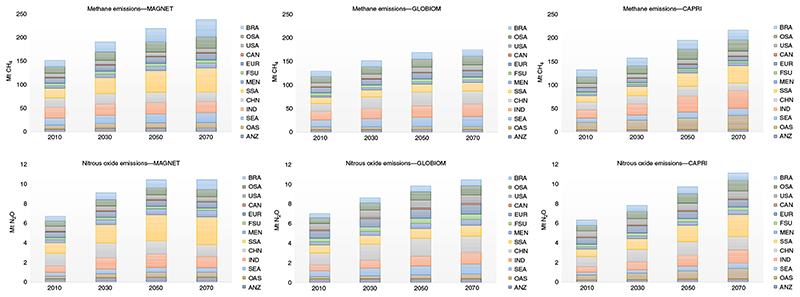
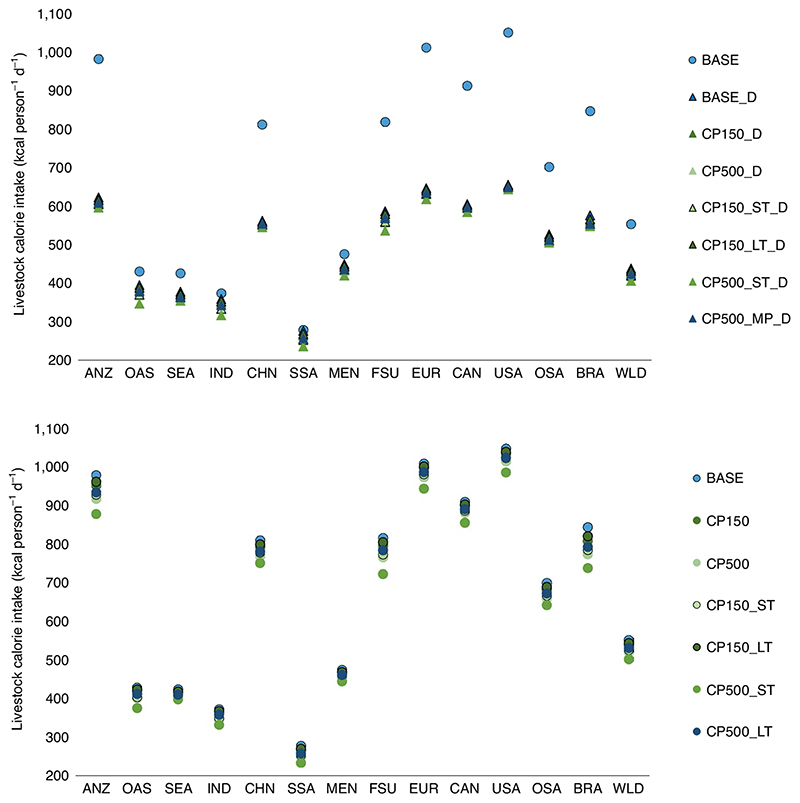
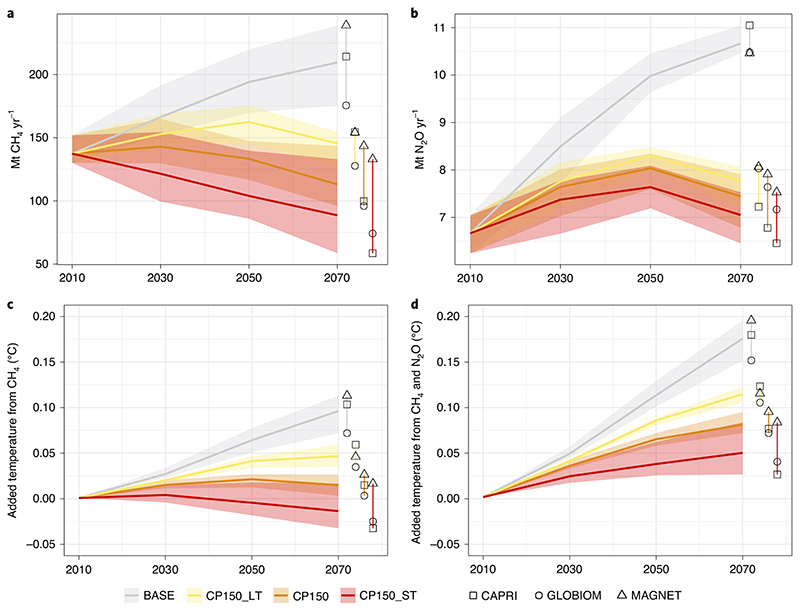
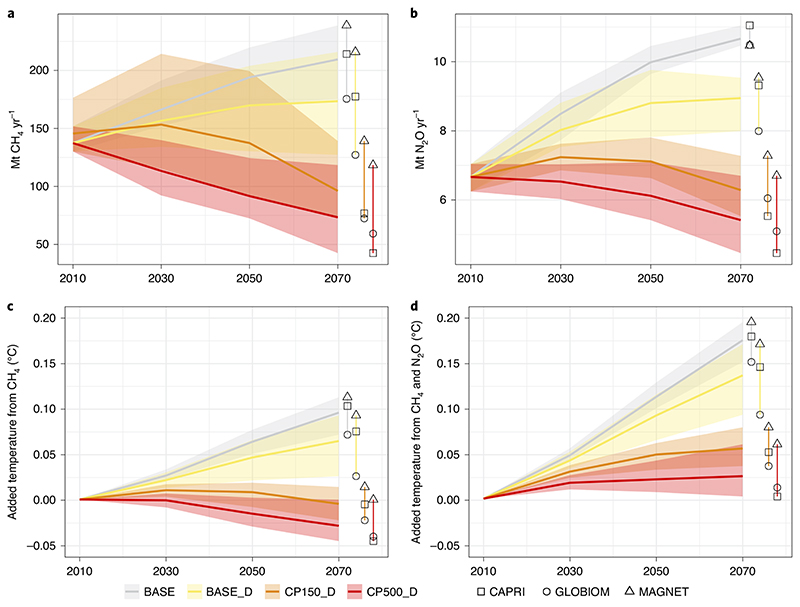
Methane's short atmospheric life has important implications for the design of global climate change mitigation policies in agriculture. Three different agricultural economic models are used to explore how short- and long-term warming effects of methane can affect the cost-effectiveness of mitigation policies and dietary transitions. Results show that the choice of a particular metric for methane's warming potential is key to determine optimal mitigation options, with metrics based on shorter-term impacts leading to greater overall emission reduction. Also, the promotion of low-meat diets is more effective at reducing greenhouse gas emissions compared to carbon pricing when mitigation policies are based on metrics that reflect methane's long-term behaviour. A combination of stringent mitigation measures and dietary changes could achieve substantial emission reduction levels, helping reverse the contribution of agriculture to global warming.
甲烷在大气中的寿命较短,这对农业领域全球气候变化缓解政策的设计具有重要意义。研究使用了三种不同的农业经济模型,以探讨甲烷的短期和长期变暖效应如何影响缓解政策和饮食转变的成本效益。结果表明,选择特定的甲烷变暖潜能指标是确定最佳缓解方案的关键,基于短期影响的指标会带来更大幅度的总体减排。此外,当缓解政策基于反映甲烷长期行为的指标时,推广低肉饮食在减少温室气体排放方面比碳定价更有效。严格的缓解措施与饮食变化相结合,可以实现大幅减排,有助于扭转农业对全球变暖的影响。