Department of Ophthalmology, Taichung Veterans General Hospital, Taichung, Taiwan.
Department of Computer science, Tunghai University, Taichung, Taiwan.
Transl Vis Sci Technol. 2022 Feb 1;11(2):38. doi: 10.1167/tvst.11.2.38.
To investigate the correlation between choroidal thickness and myopia progression using a deep learning method.
Two data sets, data set A and data set B, comprising of 123 optical coherence tomography (OCT) volumes, were collected to establish the model and verify its clinical utility. The proposed mask region-based convolutional neural network (R-CNN) model, trained with the pretrained weights from the Common Objects in Context database as well as the manually labeled OCT images from data set A, was used to automatically segment the choroid. To verify its clinical utility, the mask R-CNN model was tested with data set B, and the choroidal thickness estimated by the model was also used to explore its relationship with myopia.
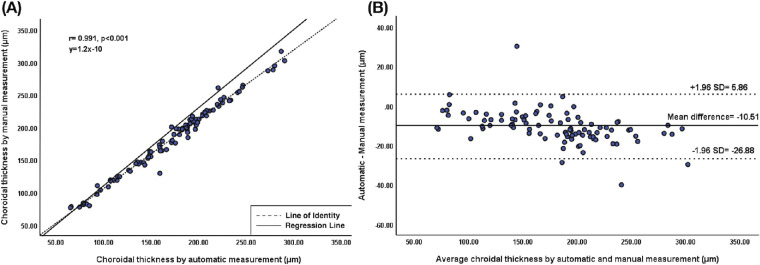
Compared with the result of manual segmentation in data set B, the error of the automatic choroidal inner and outer boundary segmentation was 6.72 ± 2.12 and 13.75 ± 7.57 µm, respectively. The mean dice coefficient between the region segmented by automatic and manual methods was 93.87% ± 2.89%. The mean difference in choroidal thickness over the Early Treatment Diabetic Retinopathy Study zone between the two methods was 10.52 µm. Additionally, the choroidal thickness estimated using the proposed model was thinner in high-myopic eyes, and axial length was the most significant predictor.
The mask R-CNN model has excellent performance in choroidal segmentation and quantification. In addition, the choroid of high myopia is significantly thinner than that of nonhigh myopia.
This work lays the foundations for mask R-CNN models that could aid in the evaluation of more intricate changes occurring in chorioretinal diseases.
利用深度学习方法研究脉络膜厚度与近视进展的相关性。
收集了两个数据集(数据集 A 和数据集 B),共 123 个光学相干断层扫描(OCT)容积,用于建立模型并验证其临床实用性。所提出的基于掩模的卷积神经网络(R-CNN)模型,使用来自上下文数据库的预训练权重以及来自数据集 A 的手动标记的 OCT 图像进行训练,用于自动分割脉络膜。为了验证其临床实用性,使用数据集 B 对掩模 R-CNN 模型进行了测试,并使用模型估计的脉络膜厚度来探索其与近视的关系。
与数据集 B 中手动分割的结果相比,自动分割的脉络膜内、外边界的误差分别为 6.72 ± 2.12 µm 和 13.75 ± 7.57 µm。自动和手动方法分割区域之间的平均骰子系数为 93.87% ± 2.89%。两种方法在早期糖尿病视网膜病变研究区域之间的脉络膜厚度差异平均值为 10.52 µm。此外,使用所提出的模型估计的脉络膜厚度在高度近视眼中较薄,眼轴是最显著的预测因子。
掩模 R-CNN 模型在脉络膜分割和量化方面具有出色的性能。此外,高度近视的脉络膜明显比非高度近视的脉络膜薄。
医学之窗