Basque Center for Applied Mathematics, Alameda de Mazarredo 14, Bilbao, E-48009, Basque Country, Spain; Dipartimento di Matematica, Università degli Studi di Trento, Via Sommarive 14, Povo, Trento, 38123, Italy; Ikerbasque, Basque Foundation for Science, Bilbao, Spain.
Basque Center for Applied Mathematics, Alameda de Mazarredo 14, Bilbao, E-48009, Basque Country, Spain.
Phys Life Rev. 2022 Mar;40:65-92. doi: 10.1016/j.plrev.2022.02.001. Epub 2022 Feb 15.
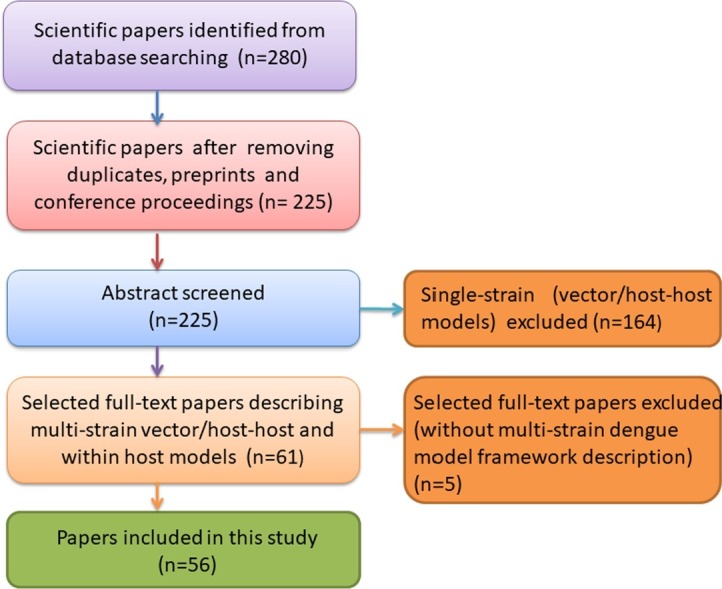
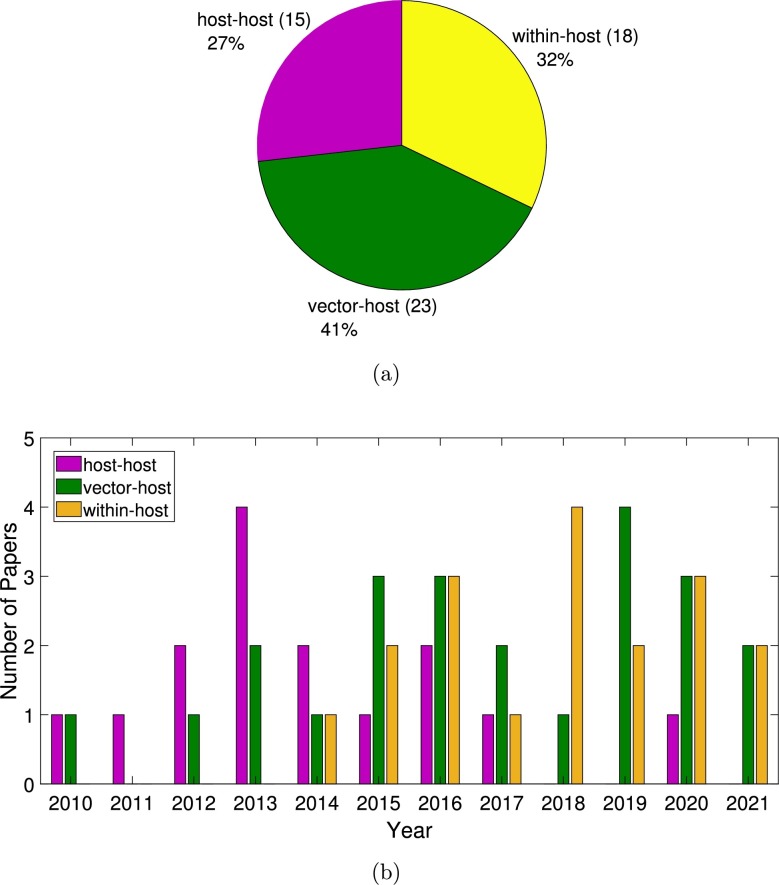
Mathematical models have a long history in epidemiological research, and as the COVID-19 pandemic progressed, research on mathematical modeling became imperative and very influential to understand the epidemiological dynamics of disease spreading. Mathematical models describing dengue fever epidemiological dynamics are found back from 1970. Dengue fever is a viral mosquito-borne infection caused by four antigenically related but distinct serotypes (DENV-1 to DENV-4). With 2.5 billion people at risk of acquiring the infection, it is a major international public health concern. Although most of the cases are asymptomatic or mild, the disease immunological response is complex, with severe disease linked to the antibody-dependent enhancement (ADE) - a disease augmentation phenomenon where pre-existing antibodies to previous dengue infection do not neutralize but rather enhance the new infection. Here, we present a 10-year systematic review on mathematical models for dengue fever epidemiology. Specifically, we review multi-strain frameworks describing host-to-host and vector-host transmission models and within-host models describing viral replication and the respective immune response. Following a detailed literature search in standard scientific databases, different mathematical models in terms of their scope, analytical approach and structural form, including model validation and parameter estimation using empirical data, are described and analyzed. Aiming to identify a consensus on infectious diseases modeling aspects that can contribute to public health authorities for disease control, we revise the current understanding of epidemiological and immunological factors influencing the transmission dynamics of dengue. This review provide insights on general features to be considered to model aspects of real-world public health problems, such as the current epidemiological scenario we are living in.
数学模型在流行病学研究中有着悠久的历史,随着 COVID-19 大流行的发展,对数学模型的研究变得至关重要,对理解疾病传播的流行病学动态具有重要影响。可以追溯到 1970 年就有描述登革热流行病学动态的数学模型。登革热是一种由四种抗原相关但不同血清型(DENV-1 至 DENV-4)引起的病毒性蚊媒感染。由于有 25 亿人面临感染风险,因此这是一个主要的国际公共卫生关注点。尽管大多数病例无症状或症状较轻,但疾病的免疫反应很复杂,与抗体依赖性增强(ADE)有关,即先前登革热感染的抗体不能中和但增强新感染的疾病加重现象。在这里,我们对登革热流行病学的数学模型进行了为期 10 年的系统回顾。具体来说,我们回顾了描述宿主间和媒介宿主传播模型以及描述病毒复制和相应免疫反应的多株框架内的模型。在标准科学数据库中进行了详细的文献检索后,根据其范围、分析方法和结构形式描述和分析了不同的数学模型,包括使用经验数据进行模型验证和参数估计。为了确定在传染病建模方面可以为疾病控制的公共卫生当局提供共识,我们修订了影响登革热传播动态的流行病学和免疫学因素的当前理解。该综述提供了关于建模方面的一般特征的见解,这些特征可以应用于现实世界的公共卫生问题,例如我们目前所处的流行病学情况。