Lajevardi Sepehr S, Rastogi Pratik, Isacson Daniel, Deva Anand K
Department of Plastic, Reconstructive & Maxillofacial Surgery - Macquarie University, NSW, Australia.
JPRAS Open. 2022 Jan 16;32:34-42. doi: 10.1016/j.jpra.2021.11.006. eCollection 2022 Jun.
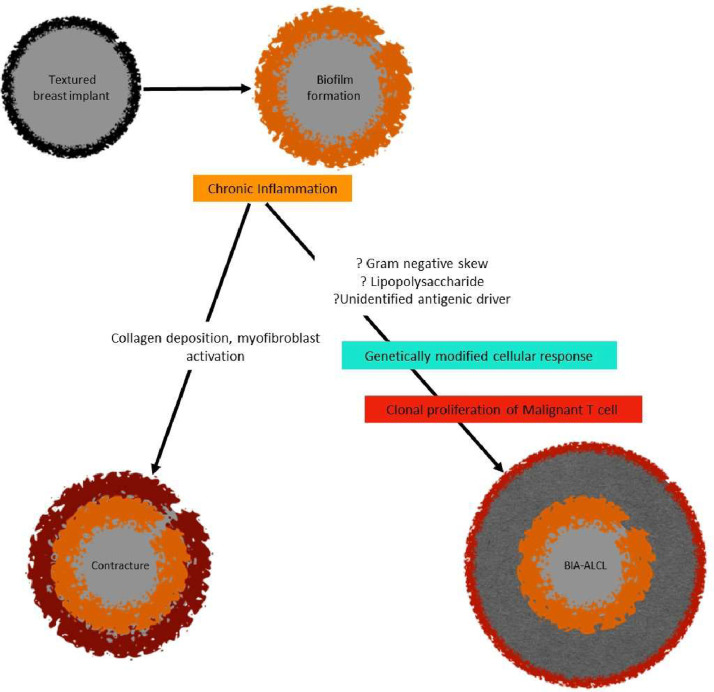
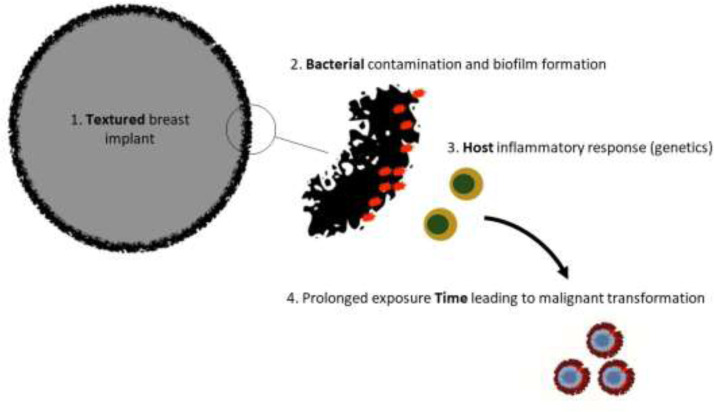
Breast implant-associated anaplastic large cell lymphoma (BIA-ALCL) is a CD30-positive, anaplastic lymphoma kinase-negative T-cell lymphoma. Where implant history is known, all confirmed cases to date have occurred in patients with exposure to textured implants. The etiopathogenesis of BIA-ALCL is likely to be multifactorial, with current evidence-based theories recognising the combination of chronic infection in setting of textured implants, gram-negative biofilm formation, chronic inflammation, host genetics (e.g. JAK/STAT, p53) and time in tumorigenesis. Proposed triggers for the development of malignancy are mechanical friction, silicone implant shell particulates, silicone leachables and bacteria. Of these, the bacterial hypothesis has received significant attention, supported by a plausible biological model. In this model, bacteria form an adherent biofilm in the favourable environment of the textured implant surface, producing a bacterial load that elicits a chronic inflammatory response. Bacterial antigens, primarily of gram-negative origin, may trigger innate immunity and induce T-cell proliferation with subsequent malignant transformation in genetically susceptible individuals. Future research, investigating BIA-ALCL genetic mutations and immunological modulation with Gram-negative biofilm in BIA-ALCL models is warranted to establish a unifying theory for the aetiology of BIA-ALCL.
乳房植入物相关间变性大细胞淋巴瘤(BIA-ALCL)是一种CD30阳性、间变性淋巴瘤激酶阴性的T细胞淋巴瘤。在已知植入物病史的情况下,迄今为止所有确诊病例均发生在接触过带纹理植入物的患者中。BIA-ALCL的发病机制可能是多因素的,目前基于证据的理论认识到带纹理植入物环境中的慢性感染、革兰氏阴性生物膜形成、慢性炎症、宿主遗传学(如JAK/STAT、p53)以及肿瘤发生中的时间等因素的综合作用。推测的恶性肿瘤发生触发因素包括机械摩擦、硅胶植入物外壳颗粒、硅胶可渗出物和细菌。其中,细菌假说受到了极大关注,有一个看似合理的生物学模型作为支撑。在这个模型中,细菌在带纹理植入物表面的有利环境中形成附着的生物膜,产生引发慢性炎症反应的细菌负荷。主要源自革兰氏阴性菌的细菌抗原可能触发先天免疫并诱导T细胞增殖,随后在基因易感个体中发生恶性转化。有必要开展未来研究,在BIA-ALCL模型中研究BIA-ALCL基因突变以及革兰氏阴性生物膜的免疫调节,以建立BIA-ALCL病因的统一理论。