Gray Kathleen, Slavotinek John, Dimaguila Gerardo Luis, Choo Dawn
Centre for Digital Transformation of Health, The University of Melbourne, Parkville, Australia.
South Australia Medical Imaging, Flinders Medical Centre, Bedford Park, Australia.
JMIR Med Educ. 2022 Apr 4;8(2):e35223. doi: 10.2196/35223.
The preparation of the current and future health workforce for the possibility of using artificial intelligence (AI) in health care is a growing concern as AI applications emerge in various care settings and specializations. At present, there is no obvious consensus among educators about what needs to be learned or how this learning may be supported or assessed.
Our study aims to explore health care education experts' ideas and plans for preparing the health workforce to work with AI and identify critical gaps in curriculum and educational resources across a national health care system.
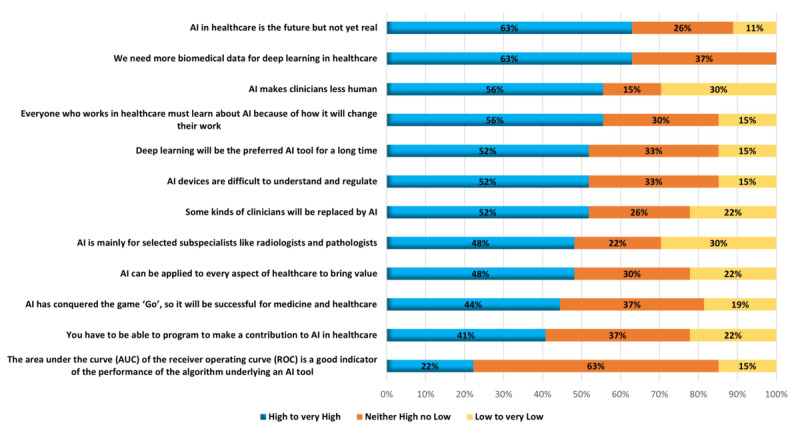
A survey canvassed expert views on AI education for the health workforce in terms of educational strategies, subject matter priorities, meaningful learning activities, desired attitudes, and skills. A total of 39 senior people from different health workforce subgroups across Australia provided ratings and free-text responses in late 2020.
The responses highlighted the importance of education on ethical implications, suitability of large data sets for use in AI clinical applications, principles of machine learning, and specific diagnosis and treatment applications of AI as well as alterations to cognitive load during clinical work and the interaction between humans and machines in clinical settings. Respondents also outlined barriers to implementation, such as lack of governance structures and processes, resource constraints, and cultural adjustment.
Further work around the world of the kind reported in this survey can assist educators and education authorities who are responsible for preparing the health workforce to minimize the risks and realize the benefits of implementing AI in health care.
随着人工智能(AI)在各种护理环境和专业领域的应用不断涌现,为当前及未来的卫生人力做好在医疗保健中使用人工智能的准备成为日益受到关注的问题。目前,教育工作者对于需要学习什么以及如何支持或评估这种学习尚无明显共识。
我们的研究旨在探讨医疗保健教育专家关于使卫生人力具备与人工智能协作能力的想法和计划,并确定全国医疗保健系统在课程和教育资源方面的关键差距。
一项调查征集了专家对卫生人力人工智能教育在教育策略、主题重点、有意义的学习活动、期望的态度和技能等方面的看法。2020年末,来自澳大利亚不同卫生人力亚组的39位资深人士提供了评分和自由文本回复。
回复强调了关于伦理影响的教育、用于人工智能临床应用的大数据集的适用性、机器学习原理、人工智能的具体诊断和治疗应用以及临床工作中认知负荷的变化和临床环境中人与机器的交互的重要性。受访者还概述了实施障碍,如缺乏治理结构和流程、资源限制以及文化调整。
全球范围内开展此类调查所报道的进一步工作,可协助负责培养卫生人力的教育工作者和教育当局将医疗保健中实施人工智能的风险降至最低并实现其益处。